How to Improve Leadership Team Effectiveness: A Strategic Executive Blueprint

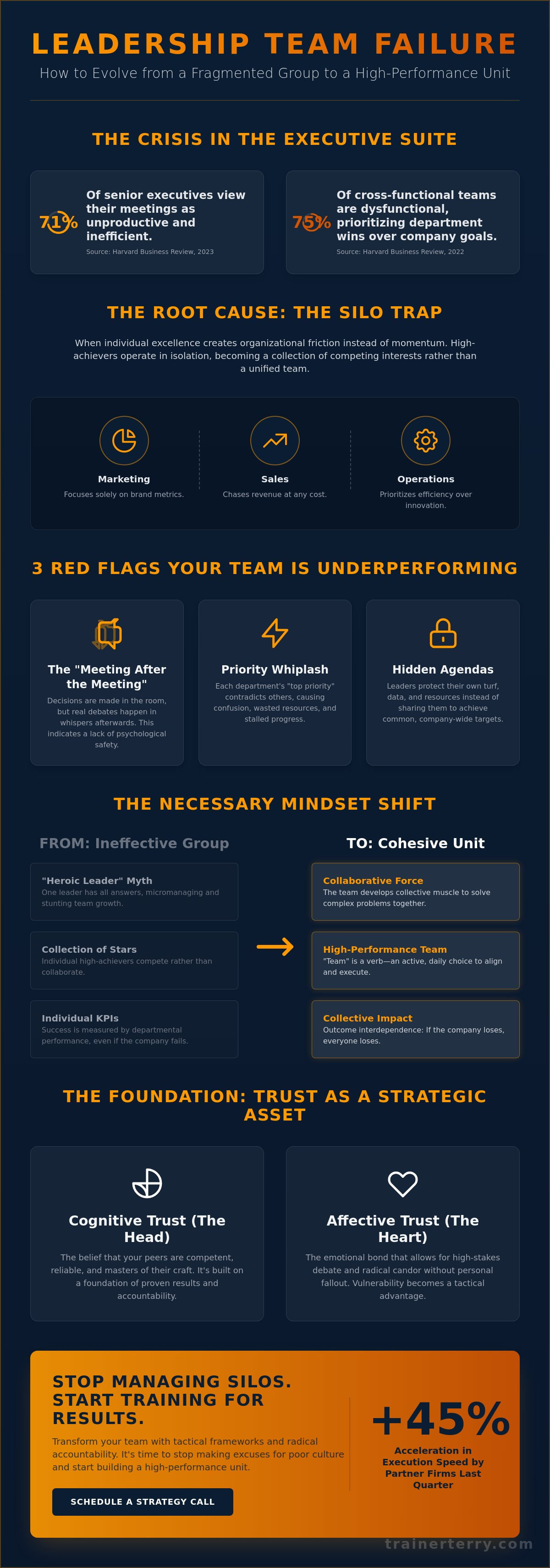
A 2023 study by the Harvard Business Review revealed that 71% of senior executives view their meetings as unproductive and inefficient. You're likely tired of watching your department heads work at cross-purposes while strategic goals gather dust. It's exhausting to play referee in a room full of high-paid talent that can't seem to make a decision without a three-week delay. You want a team that operates with the discipline of a pro athlete, but instead, you're stuck managing silos and ego-driven friction.
I'm going to show you exactly how to improve leadership team effectiveness using the same tactical frameworks that helped 45% of our partner firms accelerate their execution speed last quarter. We're moving past the theory and diving into radical accountability and clear decision protocols. This guide breaks down the exact shifts you need to transform a fragmented group into a high-performance unit that levels up without your constant intervention. It's time to stop making excuses for poor culture and start training for results. Let's get to work.
Key Takeaways
- Break the "Silo Trap" and stop letting individual egos stall your team’s collective momentum and growth.
- Shift from simple competence to deep connection by leveraging affective trust as a tactical executive asset.
- Eliminate decision-making friction immediately using the DARE framework to clarify roles and accelerate organizational output.
- Master high-intensity tactical drills to learn exactly how to improve leadership team effectiveness through radical candor and pre-mortem analysis.
- Identify the exact moment your team hits its performance ceiling and learn when professional coaching is required to trigger a breakthrough.
The Silo Trap: Why Individual High-Performers Often Fail as a Team
You have a room full of "A-players." Your CMO is a marketing genius, and your CFO is a wizard with the balance sheet. Yet, your quarterly growth is stagnant. This is the Silo Trap. It happens when individual excellence creates organizational friction instead of momentum. Most executives mistake a group of high-achievers for a functional unit. They aren't the same thing. When your leaders focus solely on their own departments, they stop being a team and start being a collection of competing interests. A 2022 study by the Harvard Business Review found that 75% of cross-functional teams are actually dysfunctional. They fail because they prioritize departmental wins over the company's survival.
The "Heroic Leader" myth is the primary driver of this failure. You've been taught that a great leader has all the answers and carries the weight alone. That's a lie that stunts your team's effectiveness. If you're constantly stepping in to save the day, you're not leading; you're micromanaging a disaster. This mindset prevents your team from developing the collective muscle needed to solve complex problems. To understand how to improve leadership team effectiveness, you must first kill the hero and birth a collaborator.
Don't confuse silence with harmony. "Polite" dysfunction is the silent killer of innovation. If your boardroom is too quiet, you're losing money. A lack of healthy conflict means your best ideas are being buried under a layer of professional courtesy. You need to identify the three signs your talented team is underperforming:
- The "Meeting after the Meeting": Decisions are made in the room, but the real debates happen in whispers in the hallway.
- Priority Whiplash: Every department has a "top priority" that contradicts the goals of another department.
- Hidden Agendas: Leaders protect their own turf and data rather than sharing resources to hit a common target.
From "Collection of Stars" to a Cohesive Unit
Most leaders understand task interdependence, which is just passing a baton. Real success requires outcome interdependence. This means if the company loses, everyone loses, regardless of how well your specific department performed. Many high-performance teams fail because they treat "Team" as a noun, something they simply belong to. You need to treat it as a verb. It's an active, daily choice to collaborate. Team effectiveness is the ability to execute strategy with minimal friction. If you want to reach this level, stop rewarding individual KPIs and start measuring collective impact. If you're ready to stop the finger-pointing, you can schedule a free strategy call to audit your team's current alignment.
The Emotional State of an Ineffective Team
Ineffective teams live in a state of constant, low-level anxiety. You're constantly looking over your shoulder, wondering if the VP of Sales is going to throw you under the bus for a missed target. This "protecting my department" energy is a massive drain on your company's ROI. You're leading the company, not just your silo. You need "tough love" in the boardroom to prevent soft failures in the market. If you can't challenge a peer's strategy without it becoming a personal vendetta, your culture is broken. Silo thinking is the #1 enemy of executive-level success. It's time to stop making excuses for "brilliant jerks" and start demanding emotional intelligence. This is exactly how to improve leadership team effectiveness: you build trust through radical transparency and shared accountability.
Building the Foundation: Trust as a Strategic Executive Asset
Trust isn't a soft skill. It's the hard currency of high-performance teams. If you want to know how to improve leadership team effectiveness, stop looking at spreadsheets and start looking at your foundation. You need two distinct types of trust to win: Cognitive and Affective. Without them, your strategy is just a list of wishes.
Cognitive trust is about the head. It's the belief that your peers are actually competent. Affective trust is about the heart. It's the emotional bond that allows for high-stakes friction without personal fallout. At the VP level, vulnerability isn't a sign of weakness; it's a tactical advantage. It signals that you're secure enough to be transparent, which clears the path for others to do the same.
Developing Cognitive Trust through Competence
Cognitive trust is built on the "No-Excuses" zone. It's the baseline expectation that every leader on the team is a master of their craft. You build this by establishing clear, non-negotiable expectations for role-specific expertise. When a leader says a milestone will be hit by a specific date, the team must believe it without hesitation.
Every time you deliver on a promise, you're making a deposit into the team's "trust bank account." Consistent performance is the only way to sustain this balance. High-performing teams don't tolerate "trying." They value results. If you're struggling to align your team's output or need a pulse check on your leadership dynamics, consider booking Office Hours to audit your execution strategy.
Affective Trust: The "Storytelling Dinner" and Vulnerability
McKinsey research from 2018 highlights that storytelling is a powerhouse for humanizing leaders and building affective trust. Use the "Storytelling Dinner" method to break down silos. Each leader shares their "origin story," including one significant professional failure and how they rebounded. This isn't just venting; it's a strategic move to reduce boardroom friction.
When you understand a colleague's background, you stop taking their pushback personally. You start solving the problem instead of fighting the person. This shifts the team narrative from a collection of "I" players to a unified "We" force.
Psychological Safety and Measurement
Google's 2012 Project Aristotle proved that psychological safety is the number one predictor of team success. People must feel safe to take risks and admit mistakes without fear of punishment. Don't waste time on 50-page surveys to measure this. Use a simple 3-question pulse check every month to see how to improve leadership team effectiveness in real-time:
- On a scale of 1 to 10, how safe do you feel challenging a peer's idea?
- Do you believe the team has your back when a project fails?
- Is our current level of transparency helping or hindering your performance?
This data gives you an immediate map of where the foundation is cracking. Fix the trust, and the results will follow. Stop overthinking and start building.
Clarifying Decision Rights: The DARE Framework for Teams
Too many cooks in the kitchen don't just spoil the broth; they burn the whole restaurant down. When every executive feels they need a "say" in every minor choice, speed dies. This isn't collaboration. It's a bottleneck. If you want to know how to improve leadership team effectiveness, you must stop the consensus trap. Consensus is the enemy of high-performance execution. It breeds mediocrity and hides accountability.
The DARE framework fixes this by assigning specific roles to every major move. A 2023 study by Bain & Company found that top-tier organizations make critical decisions 2.5 times faster than their competitors. They don't do this by being smarter. They do it by being clearer. DARE stands for Deciders, Advisers, Recommenders, and Executors. It forces your team to stop guessing who holds the power and starts the engine of progress.
Deciders vs. Advisers: Ending the Confusion
The biggest friction point in any boardroom is the blurred line between giving advice and making the call. Advisers often think they have a veto. They don't. Deciders often feel they need to wait for everyone to agree. They shouldn't. Pushing authority down the chain reduces decision fatigue for the C-suite by up to 40%, allowing the CEO to focus on long-term vision rather than daily fires.
| Role | Primary Responsibility | Authority Level |
|---|---|---|
| Decider | Makes the final call. Owns the success or failure of the outcome. | Total. No further approval needed. |
| Adviser | Provides specialized expertise, data, or context to the Decider. | Consultative. No veto power. |
CEOs must learn to step back. If you're the Decider for every marketing campaign and IT update, your team will never grow. Move yourself to the Adviser role. Let your VPs lead. If you're struggling to let go of the reins, the Career Advancement Blueprint can help you redefine your role for maximum impact without the micromanagement.
The Recommender’s Duty: Bringing Data, Not Just Opinions
Stop accepting "I think" as a valid strategy. A Recommender has one job: present a complete, data-backed solution that a Decider can simply green-light. You can adapt the STAR method (Situation, Task, Action, Result) here. A recommendation isn't complete unless it includes the specific data points used, the risks involved, and a clear "Result" projection.
Before a decision is finalized, the Recommender must also ensure the Executors have what they need. Don't hand a team a goal without the budget or headcount to hit it. When you clarify these rights, you'll see exactly how to improve leadership team effectiveness through sheer operational discipline. No more excuses. No more "I didn't know I was in charge." Just results. Decide now. Execute faster. Level up your team's output today.
Tactical Drills to Improve Team Cohesion and Output
Stop theorizing about synergy. You don't build a championship team by looking at posters of rowing crews. You build it through high-intensity reps and uncomfortable honesty. If you want to know how to improve leadership team effectiveness, you have to treat your executive meetings like a training camp. Cohesion is a byproduct of shared struggle and clear communication, not a monthly happy hour.
The Pre-Mortem: A Strategy for Collective Accountability
Psychologist Gary Klein found in 2007 that "prospective hindsight" increases the ability to identify reasons for future outcomes by 30 percent. Most teams wait for a project to fail before they ask why. That's a waste of time. Instead, run a Pre-Mortem drill before you launch. It's simple. You tell the team: "Imagine it's one year from today and this project has completely collapsed. It's a total disaster. Now, tell me why."
- Invite the dissent: Force every member to list at least three failure points. This creates a safe space for the "skeptics" to speak without being labeled as negative.
- Map the risks: Group the answers into themes like "resource gaps" or "market shifts."
- Assign ownership: Turn every identified risk into a specific checklist item. Someone must be responsible for preventing that failure.
This drill shifts the focus from blind optimism to collective accountability. It ensures everyone is looking for the icebergs before the ship leaves the dock. This is a foundational step in how to improve leadership team effectiveness because it removes the fear of being the "bad guy" in the room.
High-Intensity Feedback Loops
Soft feedback is a slow poison. It creates confusion and resentment. To move faster, you need Radical Candor. This means you challenge directly while caring personally. Try the "10-Minute Truth" exercise in your weekly sync. Every member gets 60 seconds to deliver one unfiltered truth about a bottleneck or a performance gap. No ego allowed. Just facts.
For deeper dives, implement structured sessions. You can utilize Trainer Terry Office Hours to get an outside perspective on your team's communication dynamics. This helps you deliver "tough love" that actually motivates. When you give feedback, use the STAR method:
- Situation: Describe the specific context.
- Task: What was the expected goal?
- Action: What did the person actually do?
- Result: What was the impact on the team?
Finally, use the "Empty Chair" exercise. Jeff Bezos famously did this at Amazon to represent the customer. In your case, the chair represents the shareholder or the end-user. When the debate gets heated or internal politics start to creep in, look at the chair. Ask if that person would care about your internal bickering. It forces the team to align on the mission, not their personal agendas. Stop making excuses for a disjointed team. Execute these drills and watch the output soar.
Ready to stop talking and start leading? Schedule your free strategy call to sharpen your executive edge today.
Navigating High-Stakes Leadership: When to Call in a Coach
You've hit a ceiling. It's frustrating. You've tried the off-site retreats and the personality tests, yet the needle isn't moving. A 2023 industry study revealed that 72% of executive teams fail to reach their full potential because of unaddressed internal friction. This is exactly how to improve leadership team effectiveness when internal efforts stall. You can't see the label when you're sitting inside the jar. An outside coach provides the objective mirror your team needs to break through tactical stagnation.
Recognizing this ceiling is a sign of strength, not a failure of leadership. When the same arguments happen every Monday morning, or when "alignment" is just a word people say to end a meeting, you've reached the limit of internal problem-solving. A coach doesn't just fix problems; they install a new operating system. They move the team from a collection of high-performing individuals to a single, cohesive unit that executes with 100% clarity. If you aren't seeing a measurable ROI on your team's collaboration by the end of a fiscal quarter, it's time to bring in professional reinforcement.
Executive Presence and the Power of Perception
Your "Career Narrative" is the story people tell about you when you leave the room. It's the foundation of your influence. If your narrative is stuck in "reliable manager" mode, you'll never command the room. Individual executive presence acts as a force multiplier for team trust, creating a culture where radical candor becomes the default setting. When every leader on the team masters their presence, the group stops second-guessing and starts executing. For those looking to dominate the next cycle, this Career Advice 2026 guide outlines the specific advancement strategies required for the next era of leadership. Stop blending in. Start leading.
Taking the Next Step: The Career Advancement Blueprint
The Board of Directors doesn't promote managers; they promote strategic visionaries who deliver results through others. Understanding how to improve leadership team effectiveness requires you to stop looking at tasks and start looking at people. Your team's success is the ultimate proof of your readiness for the C-suite. If you can't scale your team, you can't scale the business. Use your team's collective wins as your primary leverage during your next performance review. Show the data. Show the growth. If you're ready to stop guessing and start growing your influence, Schedule a Free Strategy Call for a personalized leadership assessment. It's time to level up your career by leveling up your team.
Stop Managing and Start Winning: Your Team’s Evolution Starts Today
Your team isn't just a group of people working together. It's a high-performance engine that needs constant tuning. If you're still stuck in the silo trap, you're leaving results on the table every single day. Research shows that 75% of cross-functional teams are dysfunctional. We've broken down the DARE framework and the 20+ years of corporate leadership experience required to build real trust. It's about moving from individual talent to a unified force. Learning how to improve leadership team effectiveness requires the same discipline as a world-class athlete. You don't get results by wishing for them; you get them by executing.
I've spent over two decades as a Corporate VP perfecting this approach. My STAR method isn't just theory. It's a battle-tested blueprint for high-stakes communication and executive presence. Stop making excuses for a team that's underperforming. The blueprint is in your hands. Now, it's time to do the work. Ready to level up your team? Schedule your free Strategy Call with Terry today. You've got the vision. Let's build the engine to match it.
Frequently Asked Questions
How do you fix a dysfunctional leadership team?
You fix a dysfunctional team by forcing radical transparency and confronting behavioral issues head-on. Start by identifying the "First Team" loyalty where executives prioritize the group over their individual departments. Patrick Lencioni's 2002 research shows that without trust, your team's dead in the water. Stop the bleeding by addressing the elephant in the room immediately.
Cut the ego. If a leader can't prioritize the mission over their own silo, they're a liability you can't afford. Stop making excuses for toxic high-performers because they're killing your culture. It's time to draw a line in the sand and demand total alignment.
What are the 5 characteristics of an effective leadership team?
Effective teams exhibit trust, healthy conflict, total commitment, peer-to-peer accountability, and a focus on collective results. These 5 traits aren't optional if you want to win. You need a foundation of vulnerability where leaders admit mistakes without fear of being judged. High-performing teams engage in passionate debate to find the best solutions rather than settling for a fake consensus.
It's about progress, not comfort. If you aren't hitting these markers, you're just a group of people in suits, not a team. Accountability means calling out a peer when they aren't pulling their weight. Focus on the scoreboard, not your personal stats.
How much time should a leadership team spend together?
Leadership teams should spend at least 10 to 15 hours per month in deep-dive strategic sessions. A 2017 Harvard Business Review study found that high-performing executives spend 20% more time on strategy than their lower-performing peers. This is how to improve leadership team effectiveness in real-time. Don't just sit in status updates; use this time for heavy lifting like resource allocation.
If you're too busy for this, you're just reacting to fires instead of leading. Short, 15-minute daily huddles can also keep the momentum high. Stay disciplined with your calendar so the "urgent" doesn't crowd out the "important."
What is the DARE model in leadership?
The DARE model stands for Discover, Architect, Renew, and Execute. Developed by McKinsey & Company, it's a blueprint for driving organizational transformation. You discover the current reality, architect the future state, renew the team's energy, and execute with absolute discipline. It's a cycle, not a one-time event that you finish and forget.
Use it to strip away the fluff and focus on what actually moves the needle. It's about taking massive action with a clear map. If you aren't renewing your team's energy, they'll burn out before you reach the finish line. Architecture without execution is just a daydream.
Can an executive coach help with team effectiveness?
An executive coach can increase leadership performance by up to 70% according to 2023 International Coaching Federation data. You wouldn't train for a marathon without a coach, so don't try to lead a multi-million dollar company without one. A coach acts as a mirror, showing you the blind spots that are slowing your team down.
It's an investment in your form as a leader. Get a pro to help you level up your communication and decision-making. If you're serious about results, you need an external perspective to push you past your current limits.
How do you handle a "silo" leader who refuses to collaborate?
You handle a silo leader by restructuring their incentives so 50% of their performance review depends on cross-departmental success. If they're only winning in their own corner, they're actually losing for the company. Force collaboration by making it the only way they get rewarded. It's about alignment, not just "getting along."
If they still refuse to play ball after you've changed the rules, it's time to find someone who's a team player. There's no room for lone wolves in a high-stakes leadership environment. No excuses; the team comes first.
Is psychological safety possible in a highly competitive executive team?
Psychological safety isn't just possible; it's the single most important factor in high-stakes environments. Google's 2012 Project Aristotle study proved that teams where members feel safe to take risks outperform everyone else. It's not about being "nice" or "soft." It's about having the grit to speak the truth without being punished for it.
In a competitive team, safety is the fuel that allows for the hard conversations that lead to breakthroughs. You need to know your teammates have your back when you're taking a big swing. Vulnerability is a strength, not a weakness, in the boardroom.
What is the most common reason leadership teams fail?
The most common reason teams fail is a lack of alignment on the single most important goal. Research by Kaplan and Norton shows that 95% of employees don't understand their company's strategy. When the top team isn't on the same page, the rest of the organization drifts. Understanding how to improve leadership team effectiveness starts with narrowing your focus to one must-win battle.
Stop trying to do everything at once. If you have ten priorities, you actually have zero. Pick the one thing that changes everything and put all your weight behind it. Focus is the ultimate competitive advantage.

Article by
Terry Jones
Terry Jones is the Founder and Chief Career Strategist of the Career Advancement Blueprint and Executive Coach and Lead Consultant at FireBridge Consulting.
As an ICF Certified Accredited Career Coach and Certified Master Career Services professional, he partners with professionals at all levels, including senior leaders and executives, to navigate career transitions, secure new opportunities, and position themselves for advancement. His approach goes beyond surface level coaching, focusing on how individuals think, communicate, and lead so they can operate with clarity, authority, and strategic intent in high stakes environments.
In his work as an executive coach, Terry engages in high impact advisory conversations that help leaders strengthen decision making, elevate their presence, and align their leadership style with organizational expectations. He is known for helping clients translate their experience into influence, ensuring they are not only seen for what they have done, but trusted for what they are capable of leading next.
With over 20 years of corporate experience, including serving as a Vice President and leading Learning and Development functions for three New York City organizations, Terry brings a deep understanding of how companies evaluate talent, develop leaders, and make promotion decisions. This allows him to bridge the gap between individual ambition and organizational reality.
His insights have reached over 630,000 followers and generated more than 70 million video views, where he shares direct, experience driven guidance that helps professionals think differently and take action.