How to Overcome Imposter Syndrome in a New Leadership Role: A 2026 Executive Guide

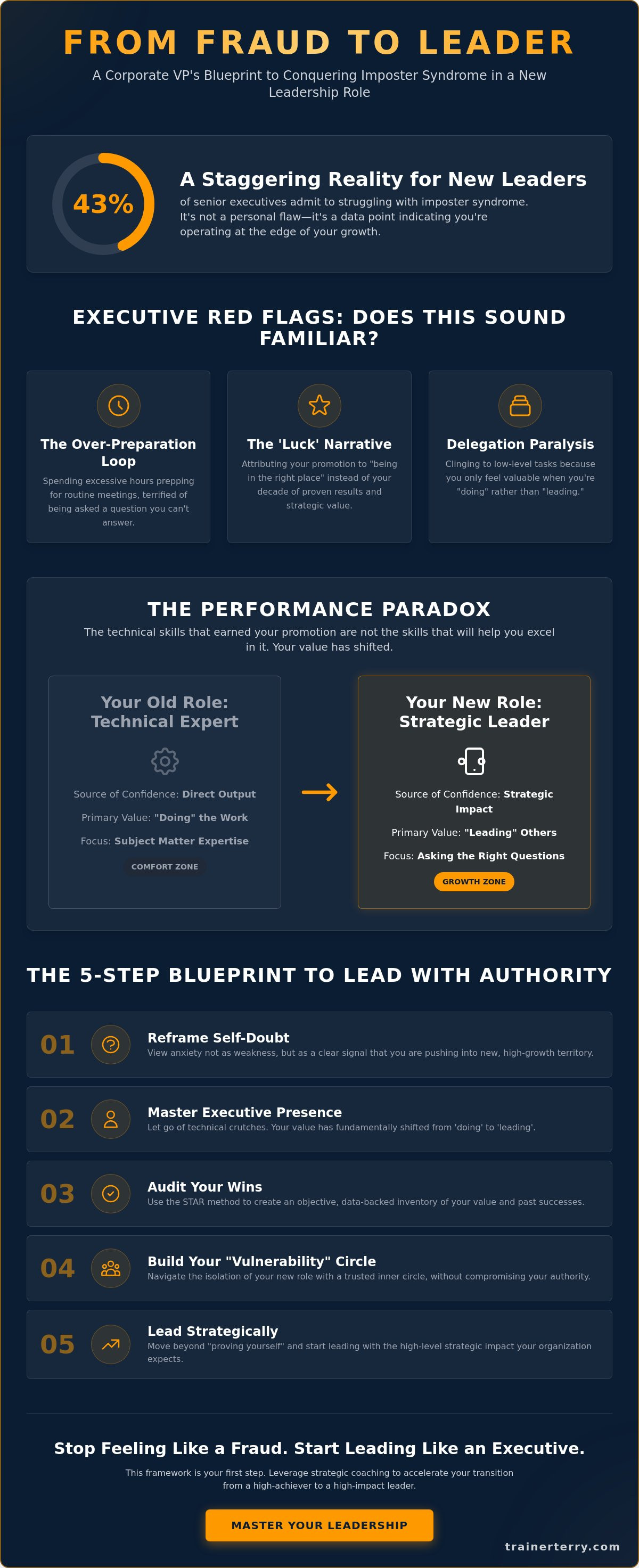
Did you know that 43% of senior executives admit to struggling with imposter syndrome? You finally landed the big promotion, but instead of celebrating, you’re waiting for someone to tap you on the shoulder and tell you it was a mistake. You’re overworking to prove you belong and hesitating on big calls because you feel like a fraud. It’s exhausting. Learning how to overcome imposter syndrome in a new leadership role isn’t about fixing a psychological flaw. It’s a strategic data point indicating you’re operating at the edge of your growth.
I know the isolation you’re feeling. You want to lead with authority without the constant anxiety of being found out. This guide will show you how to shift from feeling like a fraud to leading with executive power using a corporate VP’s strategic framework. We’ll cover how to project executive presence, reduce your daily stress, and finally validate your promotion through decisive action. It’s time to stop over-preparing and start leading with the confidence your new title demands.
Key Takeaways
- Stop viewing self-doubt as a weakness; it's actually a clear signal that you're pushing into new, high-growth territory.
- Learn exactly how to overcome imposter syndrome in a new leadership role by letting go of technical crutches and mastering executive presence.
- Use the STAR method to audit your past wins so you can replace emotional anxiety with objective data about your value.
- Build a circle of "Vulnerability Advocates" to navigate the isolation of your new position without compromising your authority.
- Follow the Career Advancement Blueprint to move beyond "proving yourself" and start leading with the strategic impact your organization expects.
Understanding Imposter Syndrome in Leadership Transitions
You’ve finally stepped into the office you worked years to earn. But instead of pride, you feel a cold weight in your chest. That’s the gap between your perceived self and your new title. Understanding Imposter Syndrome starts with recognizing it as a psychological pattern where you doubt your accomplishments. It peaks during a "step up" because you’ve left your comfort zone. You aren't a fraud. You're just a high-achiever in a new environment who hasn't caught up to their own success yet.
Distinguish between healthy humility and debilitating self-doubt. Humility keeps you coachable. It makes you a better leader. Debilitating doubt, however, shuts down your decision-making and forces you into a defensive crouch. If you feel this way, it actually proves your career positioning is successful. You’ve successfully pushed into a territory that scares you. That’s exactly where growth happens. You are where you belong, even if your brain hasn't received the memo yet.
The Corporate VP Perspective on Feeling Like a Fraud
After two decades in the C-suite, I can tell you that your inner critic is just a high-performance engine running too hot. It’s the same drive that got you promoted, but now it’s panicked because the stakes are higher. You’re likely stuck in the "Scrutiny Trap," believing every subordinate and peer is waiting for you to fail. They aren't. They’re actually waiting for you to lead. Mastering how to overcome imposter syndrome in a new leadership role requires turning that critic back into a tool for excellence rather than a source of fear. It’s a mental shift that changes your entire executive presence.
Signs You Are Experiencing Leadership Imposter Syndrome
Check your current behaviors against these common executive red flags. Do you spend five hours prepping for a routine meeting because you’re terrified of being asked a question you can't answer? That's the over-preparation loop. Maybe you credit your promotion to "being in the right place" rather than your decade of results. That's the luck narrative. The most dangerous sign is delegation paralysis. You keep doing low-level tasks because you feel you only provide value when you’re "doing" rather than "leading." If these habits sound familiar, you need a strategy like the Career Advancement Blueprint to realign your self-image with your new reality.
Why High-Achievers Face the Fraud Narrative During Promotion
You got promoted because you were the best at your technical job. Now, you’re in a role where you aren’t actually doing that job anymore. This is the Performance Paradox. The technical skills that earned you this title won't help you excel in it. Many high-achievers feel like frauds because they’ve lost their primary source of confidence: their direct output. Learning how to overcome imposter syndrome in a new leadership role requires you to confront this reality. When you stop doing and start leading, you enter a vacuum of certainty. It’s uncomfortable, but it’s part of the process.
Subject matter expertise often becomes a dangerous crutch. You dive into spreadsheets or code because you know you’re competent there. But every minute you spend in the weeds is a minute you aren’t providing strategic value. This creates a cycle of guilt. You feel like you’re failing at leadership, so you work harder at your old tasks to feel "productive." Our Career Advancement Blueprint helps you break this cycle by focusing on high-impact growth strategy instead of busy work.
Corporate culture doesn't help. It often rewards being "always on," which just masks your underlying anxiety. To overcome imposter syndrome, you have to acknowledge that your value has shifted. You are no longer the one with all the answers. You are the one who asks the right questions.
The Transition Gap: Skills vs. Strategy
Identify which legacy skills you’re clinging to. Are you still proofreading every email from your team? That’s a legacy skill triggering your doubt. Reframe "not knowing" an answer as strategic listening. It isn't a sign of weakness; it’s an information-gathering phase. You are collecting data to make better executive calls. For more on this, check out The Executive Career Coach for navigating these high-stakes transitions.
Cognitive Reframing for the New Executive
Cognitive reframing is the practice of consciously changing how you interpret your situation to drive better leadership outcomes. You must separate your feelings from the facts. Feeling like a fraud is an emotion. Your promotion, your KPIs, and your track record are facts. Use evidence-based self-talk to neutralize the narrative. Instead of saying "I don't know what I'm doing," say "I am learning the strategic requirements of this new level." This is how to overcome imposter syndrome in a new leadership role. It starts with your internal narrative.
Shifting from Proving Competence to Projecting Executive Presence
Stop trying to prove you belong. It's a trap. When you work 80 hours a week just to show you're "worthy," you aren't showing competence. You’re showing anxiety. Your team senses that desperation, and it erodes your authority faster than any technical mistake ever could. Learning how to overcome imposter syndrome in a new leadership role means realizing that your promotion was the validation. You don't need to earn it every single morning. Your job now is to lead, not to audition.
Executive Presence is the ultimate antidote to the fraud narrative. It shifts the focus from your internal fears to your external impact. Think of it as a tripod. It stands on three legs: Gravitas, Communication, and Appearance. If one is weak, the whole structure wobbles. When you project presence, you stop asking for permission to lead. You simply lead. You own the room not because you have all the answers, but because you have the composure to find them.
Owning the room doesn't require being the loudest person. It requires being the most grounded. Even if you're the newest executive at the table, your perspective is fresh. That’s an asset, not a liability. Use it to your advantage. Your team doesn't want a perfect technical expert; they want a leader who can navigate the unknown with steady hands.
Building Gravitas When You Feel Uncertain
Gravitas is about being the "calm in the storm." You don't need to fill every silence with words to prove you’re smart. Use "Strategic Silence." Listen more than you talk. When you do speak, use decisive body language. Keep your chin level. Project your voice from your chest, not your throat. This is a core part of Executive Presence Coaching. It’s about training your physical presence to lead while your mind catches up. Confidence often follows action, not the other way around.
The Role of Personal Brand in Leadership Success
Your external brand acts as a mirror. When your LinkedIn profile reflects a high-level strategic leader, it reinforces that identity back to you. It aligns your internal narrative with your external professional brand. If you look like an authority to the world, it becomes much harder to feel like a fraud. Check out our guide on How to Use LinkedIn in 2026 to ensure your digital footprint matches your new executive reality. This alignment is a practical step in how to overcome imposter syndrome in a new leadership role because it closes the gap between how you’re seen and how you see yourself.
A Tactical 5-Step Framework to Silence Your Inner Critic
Stop waiting for the "fraud" feeling to disappear on its own. It won't. If you want to master how to overcome imposter syndrome in a new leadership role, you need a system that overrides your emotional response with objective data. High-performance leadership is about execution, not just mindset. Use this tactical framework to ground yourself in your new reality and start leading with the authority your title demands.
- Step 1: Audit your "Wins." Use the STAR method to document your past successes. This creates a hard evidence base that your brain cannot argue with.
- Step 2: Identify "Vulnerability Advocates." Find 2 or 3 trusted mentors outside your direct reporting line. You need a safe space to discuss challenges without fearing it will impact your performance review.
- Step 3: Build a "First 90 Days" Learning Agenda. Replace your anxiety with curiosity. Focus on information gathering rather than proving you already have every answer.
- Step 4: Practice "Strategic Vulnerability." Ask high-level, strategic questions like "What are the primary drivers for this KPI?" instead of staying silent to hide your uncertainty.
- Step 5: Schedule "Office Hours" for Self-Correction. Block 30 minutes every Friday to review your decisions and gather feedback from your team. This turns "fear of failure" into a structured improvement process.
Using the STAR Method for Internal Validation
Most leaders use the STAR Method to get the job, but they forget to use it once they’re in the role. Apply this framework to your own journey. Write down three major achievements from your first month. Define the Situation, the Task you faced, the specific Action you took, and the Result you achieved. When you see your impact written in black and white, the fraud narrative loses its power. This technique builds an unshakeable evidence base for your competence that no inner critic can tear down.
The Power of Strategic Mentorship
You cannot do this alone. Isolation is the fuel that imposter syndrome burns to keep you awake at night. You need a Career Strategist who understands high-stakes leadership transitions. Seek feedback from people who have been where you are. Ask them, "How did you handle the shift in decision-making at this level?" This allows you to gather intelligence without sounding like you are seeking validation. If you’re ready to build a support network that actually moves the needle, schedule a free strategy call today. We’ll help you align your leadership tactics with your long-term career goals.
Beyond Self-Help: Leveraging Strategic Coaching for Leadership Mastery
Positive thinking won't save you when you're managing a multi-million dollar budget or leading a team through a high-stakes merger. At this level, generic self-help books and "fake it till you make it" mantras are insufficient. They don't provide the tactical depth required for executive performance. If you want to know how to overcome imposter syndrome in a new leadership role at the highest levels, you have to treat your mental performance like an elite athlete treats their physical training. You need a strategy, not just a pep talk.
High-stakes leadership requires a safe space to deconstruct the "fraud" narrative without risking your reputation. This is where 1:1 executive coaching becomes your most valuable asset. It provides an objective environment where you can strip away the anxiety and look at the raw data of your performance. You can't be vulnerable with your board or your direct reports. You can, however, be completely transparent with a strategist who is emotionally invested in your success but remains outside your corporate hierarchy.
The ROI of investing in leadership development early in your tenure is massive. Leaders who struggle with imposter syndrome often hesitate on critical decisions, which costs the organization time and capital. By mastering your executive mindset in the first few months, you prevent the burnout that comes from overworking to prove your worth. You move from a state of constant defense to a state of strategic offense. This isn't just about feeling better; it's about delivering the results you were hired to produce.
The Career Advancement Blueprint for New Leaders
The Career Advancement Blueprint isn't just another training course. It's a structured roadmap designed specifically for professionals navigating the complexities of internal advancement. We focus on two critical pillars: promotion strategy and executive presence. By aligning these elements, we ensure that your internal self-image matches the high-level authority you project to your peers and stakeholders. It’s a comprehensive system for how to overcome imposter syndrome in a new leadership role by replacing doubt with a repeatable framework for success.
Taking the Next Step in Your Leadership Journey
Your first 12 months in a new role will define your long-term trajectory at the company. Don't spend that time merely surviving your promotion. You have the opportunity to thrive and set a new standard for leadership in your organization. Having an objective partner helps you navigate the political and psychological landmines that derail even the most talented executives. It’s time to stop second-guessing your seat at the table and start owning it. Book a session today to master your new role and lead with the authority you've earned.
Take Command of Your New Executive Identity
Your promotion wasn't a fluke. It was the result of years of high-performance execution. Now, the stakes have changed. You’ve learned that shifting from technical doing to strategic leading is a mental game as much as a tactical one. By applying the STAR method to your own wins and building a circle of vulnerability advocates, you can silence the inner critic that slows your decision-making. Learning how to overcome imposter syndrome in a new leadership role isn't just about feeling better; it’s about protecting the ROI of your organization’s talent investment.
Don't navigate this high-pressure transition in isolation. I’ve spent over 20 years as a Corporate VP, and I’ve seen how personalized executive presence coaching can transform a hesitant manager into a decisive leader. My proven Strategic Blueprints provide the exact roadmap you need to thrive in the C-suite. Are you ready to stop surviving and start leading with authority? Master your leadership transition with a Free Strategy Call. You’ve earned your seat at the table. Now, it’s time to own it.
Frequently Asked Questions
Is imposter syndrome common in new leadership roles?
Yes, it's incredibly common among high-achievers. A Korn Ferry survey found that 43% of senior executives admit to struggling with these feelings during their careers. When you step into a higher bracket of responsibility, your brain naturally scans for threats. This often manifests as the fear of being "found out." It isn't a sign of failure; it's a signal that you've reached a new level of professional growth.
How can I tell the difference between imposter syndrome and actual lack of skill?
Look at the objective evidence of your track record versus your internal feelings. If you have the results and the promotion but still feel like a fraud, that's imposter syndrome. If you genuinely lack a specific technical competency, that's a "skills gap." You can close a gap with targeted training, but you resolve imposter syndrome by aligning your self-perception with your documented achievements and executive title.
Can imposter syndrome actually make me a better leader?
It can, provided you don't let it paralyze your decision-making. Many successful leaders use these feelings to fuel a drive for excellence and a commitment to staying coachable. It keeps you humble and prevents the arrogance that often derails new executives. The key is to channel that nervous energy into strategic listening and information gathering rather than defensive overworking or hesitation.
What are the best books or resources for overcoming imposter syndrome in 2026?
Focus on resources that bridge the gap between psychology and executive strategy. While classic texts offer a foundation, modern leaders in 2026 benefit most from structured programs like the Career Advancement Blueprint. These provide actionable steps for navigating corporate politics and mastering executive presence. Look for frameworks that prioritize high-impact results over theoretical advice to see the fastest improvement in your confidence.
How do I stop overworking to compensate for feeling like a fraud?
You must shift your focus from "doing" to "leading." Start by auditing your calendar and delegating low-impact technical tasks that you use as a comfort zone. Setting strict boundaries for your work hours forces you to trust your strategic decisions rather than relying on sheer volume to prove your worth. This is a vital step in how to overcome imposter syndrome in a new leadership role.
Should I tell my boss that I am feeling imposter syndrome?
Be cautious about using that specific label with your superior. It can sometimes be misinterpreted as a fundamental lack of confidence. Instead, frame the conversation around seeking high-level feedback and strategic alignment. Ask about the specific outcomes they want to see in your first 90 days. This gives you the clarity you need to feel secure without signaling internal doubt to your leadership.
How long does imposter syndrome typically last in a new role?
It typically peaks during the first 6 to 12 months of a transition. This is the period where you're most vulnerable to the "Scrutiny Trap" as you learn the new landscape. However, without a deliberate strategy to reframe your mindset, these feelings can persist for years. Proactive intervention, such as executive coaching, can significantly shorten this adjustment period and accelerate your path to authority.
How can a career coach help with imposter syndrome?
A coach acts as an objective partner who helps you deconstruct the fraud narrative using hard data. They provide the specific frameworks needed for how to overcome imposter syndrome in a new leadership role, such as mastering executive presence. By offering a safe space to discuss high-stakes challenges, a coach ensures you lead with authority while your internal confidence catches up to your new title.

Article by
Terry Jones
Terry Jones is the Founder and Chief Career Strategist of the Career Advancement Blueprint and Executive Coach and Lead Consultant at FireBridge Consulting.
As an ICF Certified Accredited Career Coach and Certified Master Career Services professional, he partners with professionals at all levels, including senior leaders and executives, to navigate career transitions, secure new opportunities, and position themselves for advancement. His approach goes beyond surface level coaching, focusing on how individuals think, communicate, and lead so they can operate with clarity, authority, and strategic intent in high stakes environments.
In his work as an executive coach, Terry engages in high impact advisory conversations that help leaders strengthen decision making, elevate their presence, and align their leadership style with organizational expectations. He is known for helping clients translate their experience into influence, ensuring they are not only seen for what they have done, but trusted for what they are capable of leading next.
With over 20 years of corporate experience, including serving as a Vice President and leading Learning and Development functions for three New York City organizations, Terry brings a deep understanding of how companies evaluate talent, develop leaders, and make promotion decisions. This allows him to bridge the gap between individual ambition and organizational reality.
His insights have reached over 630,000 followers and generated more than 70 million video views, where he shares direct, experience driven guidance that helps professionals think differently and take action.