Developing an Executive Presence for Women: The 2026 Strategic Blueprint

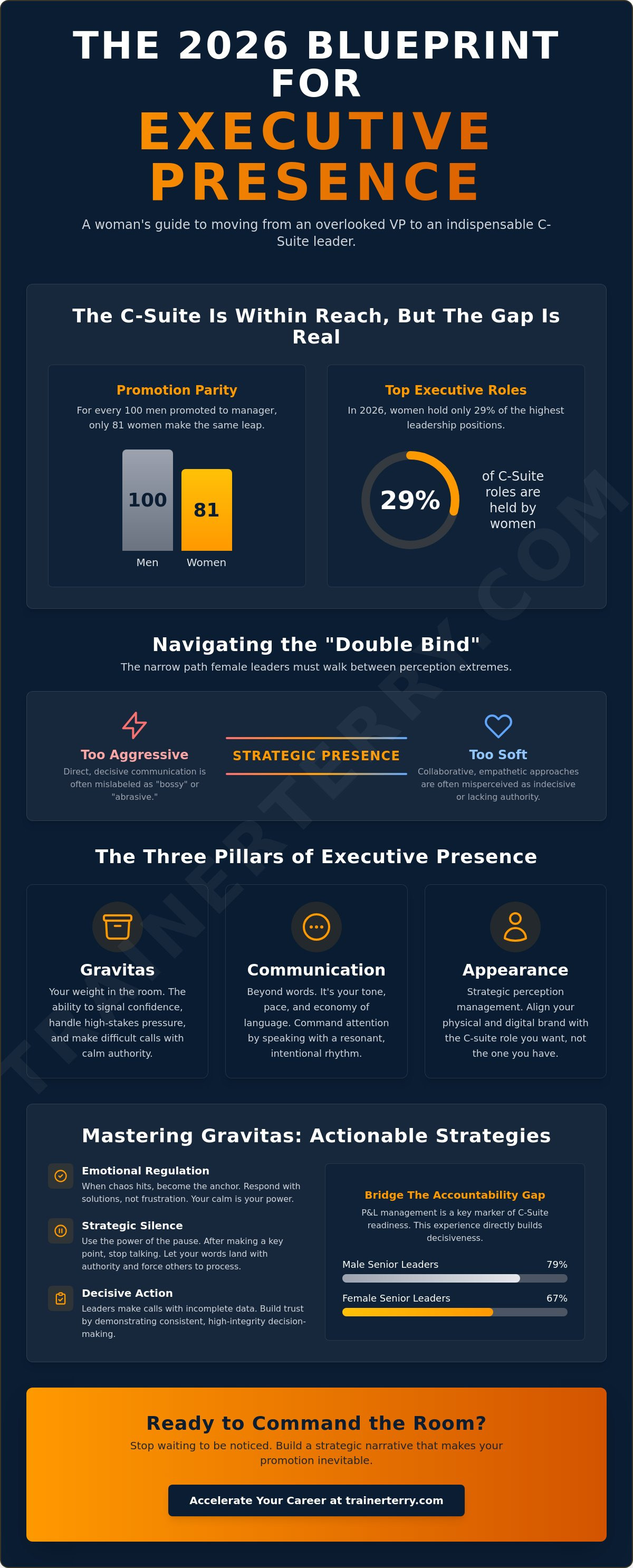
Why are you still stuck at the VP level while others bypass you for the C-suite? In 2026, women hold only 29% of top executive roles, and for every 100 men promoted to manager, only 81 women make the cut. You've hit your targets and outworked the room, yet you're still fighting labels like "too soft" or "too aggressive." It's frustrating to be overlooked when you've done the work. Developing an executive presence for women isn't about changing who you are. It's about changing how you're perceived by those who hold the keys to the boardroom.
I understand the anxiety of high-stakes meetings where your voice feels drowned out. This article promises to help you master the art of leadership communication and strategic positioning to accelerate your executive promotion. You'll learn how to build a strategic narrative that makes your value undeniable and your authority feel natural. We're breaking down the 2026 blueprint for commanding any room with effortless confidence.
Key Takeaways
- Define your gravitas by mastering emotional regulation and using silence as a strategic tool to command authority during high-conflict corporate scenarios.
- Adapt the STAR method for executive-level communication to ensure your contributions in board meetings and town halls resonate with high-stakes impact.
- Stop being overlooked by developing an executive presence for women that aligns your technical performance with the strategic perception required for the C-suite.
- Proactively manage the "Double Bind" using a Career Positioning Strategy to define your leadership narrative before others do it for you.
- Integrate your newfound authority into a structured Career Advancement Blueprint to justify your next promotion and secure the salary you deserve.
What is Executive Presence for Women in 2026?
Executive presence isn't a "vibe" or a mystery. It's a calculated intersection of gravitas, communication, and strategic perception. In 2026, the old "command and control" style of leadership is dead. Influence is the new currency. If you've been grinding away with high performance but no promotion, presence is your missing link. Developing an executive presence for women requires moving beyond just doing the work. You must become the person the board trusts with the company's future.
The core emotional state of a leader with presence is simple. You are calm. You are certain. You are prepared. When the room gets chaotic, you become the anchor. This isn't about being the loudest voice. It's about being the most resonant one. You don't just speak; you command the space through steady, intentional action.
The Three Pillars: Gravitas, Communication, and Appearance
Gravitas is your weight in the room. It signals that you can handle high-stakes pressure and make the difficult calls others avoid. It’s the foundation of authority. Communication goes beyond your vocabulary. It’s about your tone, your pace, and your "economy of language." Stop over-explaining. Speak with a rhythm that commands attention. Appearance is about strategic perception. You must align your physical and digital brand with the C-suite role you want next. Many leaders refine these pillars through Executive education programs to ensure their skills match modern corporate demands.
Why Traditional "Presence" Advice Often Fails Women
For years, you've been told to "lean in." But leaning in without a strategic narrative is just noise. Traditional advice often ignores the reality of gender bias in the boardroom. If you're too direct, you're "aggressive." If you're too collaborative, you're "soft." Developing an executive presence for women means navigating this narrow path by setting the tone yourself. Don't try to fit into the existing culture. You need to define it.
Most advice fails because it's too theoretical. It doesn't give you the tools to bridge the gap between performance and perception. This is why a structured Career Advancement Blueprint is essential. It moves you from being a "high-potential" employee to a "must-promote" leader by building a narrative that justifies your seat at the table. Stop waiting for someone to notice your hard work. Start making it impossible for them to ignore your authority.
Building Gravitas: Commanding Respect in the Boardroom
Gravitas is the weight you carry in a room. It's what makes people stop and listen when you speak. Most competitors tell you to avoid being "bossy" or "emotional." That's weak, reactive advice. Real gravitas comes from emotional regulation during high-conflict corporate scenarios. When a project fails or a deadline is missed, don't react with frustration. Respond with a solution. Developing an executive presence for women means becoming the person who stays calm while everyone else panics.
Silence is another tool of authority. Use the power of the pause. After making a point, stop talking. Let your words land. This forces others to process your message and signals that you don't need to fill the air with nervous chatter. You must also demonstrate decisiveness. Leaders rarely have 100% of the data. In fact, while 79% of male senior leaders have managed a P&L function, only 67% of women have had that same bottom-line accountability according to 2025 data. Bridging this gap requires making firm calls even when the path is ambiguous. Consistent, high-integrity communication builds the stakeholder trust you need to lead.
Mastering the Art of Strategic Influence
Influence happens before the meeting starts. Use a "Pre-Meeting" strategy to build consensus with key stakeholders. By the time you sit in the executive session, the decision should already feel inevitable. This allows you to advocate for your ideas without appearing defensive or territorial. You aren't fighting for your territory; you're presenting a shared vision. Leveraging your unique expertise makes you the go-to advisor for senior leadership. To truly build your executive presence, you must transition from a technical expert to a strategic partner.
Projecting Confidence Under High-Stakes Pressure
Your body speaks before you do. Use physical cues to signal authority. Maintain steady eye contact and use vocal resonance to fill the room. If you feel imposter syndrome creeping in, shift your focus. Don't worry about how you look. Focus on the value you are delivering to the firm. Gravitas is the ability to project certainty in uncertain times. If you want to refine these skills in a high-stakes environment, consider Executive Coaching and Advisory to sharpen your edge and perfect the art of developing an executive presence for women.
Mastering High-Stakes Communication with the STAR Method
Communication is where most high-performers fail to make the leap to leadership. You might have the best ideas in the room, but if you can't articulate them with precision, they won't gain traction. The STAR method (Situation, Task, Action, Result) is often dismissed as a basic interview technique. That's a mistake. In the boardroom, it's a high-level executive communication tool. It forces you to organize your thoughts and deliver value without wasting an executive's most precious resource: time.
Developing an executive presence for women means mastering the "economy of language." Executives don't want a chronological story of how you spent your week. They want to know what happened, why it matters, and what the bottom line is. Whether you're presenting a board report or leading a town hall, the STAR framework ensures you remain the most coherent person in the meeting. If you want to refine this delivery in real-time, you can master high-stakes communication with 1:1 interview prep, which focuses on sharpening your narrative under pressure.
The Executive Update: STAR in 60 Seconds
When you're called on for an update, you have about one minute before attention starts to drift. Use the Situation and Task to set the context in two sentences max. Avoid technical minutiae that cloud the message. The Action phase is where you highlight your strategic decision-making and how you led the team to a solution. Finally, the Result must focus on the bottom-line impact. Did you increase ROI? Did you drive organizational growth? If you can't link your action to a business result, you aren't communicating like an executive.
Eliminating "Minimizing Language" from Your Vocabulary
Your words can either build authority or erode it. Many women fall into the trap of using qualifiers that make them seem uncertain. These speech patterns are often a response to the "double bind" where directness is misinterpreted. To combat this, you must audit your speech for common "minimizers":
- Remove: "I just think" or "I'm no expert, but." These phrases signal a lack of conviction.
- Remove: "Does that make sense?" This suggests you're seeking validation rather than leading.
- Replace: "I feel" with "The data indicates" or "My recommendation is."
These shifts move you from a place of emotion to a place of strategic authority. Executive communication is not about talking more; it is about making every word carry strategic weight. By refining these habits, you bridge the gap between being a contributor and being a leader. You stop asking for permission to speak and start providing the direction the company needs. This tactical shift is a core component of developing an executive presence for women that lasts.
Overcoming the "Double Bind": Strategic Positioning and Perception
The Double Bind is a structural trap. If you're collaborative, you're seen as lacking authority. If you're decisive, you're labeled aggressive. Developing an executive presence for women requires you to reject these labels. You cannot win a game where the rules change based on your gender. Instead, you must use a Career Positioning Strategy to set the terms of your own evaluation. This moves the focus from your personality to your strategic impact. Remember the "broken rung" bottleneck; 2025 data shows that for every 100 men promoted to manager, only 81 women receive the same opportunity. You need to position yourself as the obvious choice before the decision is even made. For a deeper dive into these leadership dynamics, read The Executive Career Coach: Navigating High-Stakes Leadership in 2026.
Strategic perception is about controlling the narrative. Don't leave your reputation to chance. If you're performing at a high level but still being overlooked, the gap isn't in your work. It's in how that work is perceived by the C-suite. You must bridge this gap by aligning your daily actions with the high-stakes expectations of executive leadership.
Designing Your Personal Strategic Brand
Stop hiding your wins. Identify your Leadership Superpower and make it visible to decision-makers. Is it turnaround strategy? Is it high-growth scaling? Whatever it is, your LinkedIn presence must reflect it. If your profile still reads like a mid-level manager, you aren't signaling readiness for the boardroom. Your digital brand is often the first thing a search committee or internal board reviews. Book a strategy call to refine your executive brand and align your digital narrative with your 2026 career goals.
Managing Up: Influencing the C-Suite
Managing up is a strategic alignment, not a chore. You must understand the specific pressures on your boss and your boss’s boss. What are their KPIs? What keeps them awake at night? Align your projects with those high-level goals so your success becomes their success. When problems arise, deliver bad news with an executive-level solution already in hand. This signals that you own the outcome and can handle the weight of leadership. Build social capital by networking strategically across departments. This creates a chorus of advocates who will justify your promotion when you aren't in the room. If you want to master this perception, start a Career Positioning Strategy today to take control of your professional narrative.
Accelerating Your Growth with the Career Advancement Blueprint
Performance alone is a trap. You've been told that if you work hard and hit your numbers, the promotion will follow. It won't. Developing an executive presence for women is a critical skill, but without a promotion strategy, it's just a polished performance. You're essentially putting on a high-quality show for a room that hasn't bought a ticket to your next level. You need a structured path that turns your authority into a signed executive offer.
This is where a dedicated blueprint changes the game. It moves you from being a "reliable contributor" to a "visionary leader" in the eyes of the board. High-level 1:1 executive coaching acts as the mirror you can't provide for yourself. It identifies the subtle presence blind spots that are stalling your growth. Maybe your vocal tone loses resonance during conflict, or perhaps your career narrative isn't aligned with the company's 2026 growth targets. Identifying these gaps is the first step toward closing them for good.
Structured Mentorship vs. Generic Advice
Generic advice tells you to "be more confident." That's useless. You need a coach who has lived the "Former VP" experience and knows how the boardroom actually operates. This is the Trainer Terry difference. We don't just talk about leadership; we execute it. Moving beyond "office hours" into a dedicated advancement plan is the only way to ensure your growth is sustainable. You can secure your promotion with the Career Advancement Blueprint and stop leaving your professional future to chance.
Your 90-Day Executive Presence Roadmap
Success requires a timeline, not a wish list. A structured 90-day sprint ensures you don't just learn these skills, but you embed them into your daily leadership style.
- Month 1: Perform a deep audit of your current perception. This includes a full LinkedIn and resume strategy refresh to ensure your digital brand matches your C-suite ambitions.
- Month 2: Implementation. Start using the STAR communication method and the strategic influence tactics we've discussed. Watch how the room shifts when you speak with an economy of language.
- Month 3: Execution. This is when you trigger your promotion strategy and negotiate your executive offer with confidence.
Transitioning from a high-performer to a recognized leader isn't an overnight event. It's a calculated move. For more insights on the long-term landscape, check out Career Advice 2026: The Strategic Blueprint for Executive Growth. Stop waiting for permission to lead. Start executing your plan today.
Own Your Authority in the Boardroom
Your high performance has brought you this far, but it won't take you to the C-suite on its own. Developing an executive presence for women is the strategic bridge between being a great manager and being a visionary leader. By mastering high-stakes communication through the STAR method and navigating the "double bind" with a proactive career narrative, you stop waiting for recognition. You start commanding it. You've already done the work; now it's time to ensure the board sees your value as clearly as you do.
Don't let another promotion cycle pass you by while you remain in the shadows. My approach is built on 20 years of experience as a Corporate VP, focusing on tactical execution rather than generic advice. We offer customized Career Advancement Blueprints that provide the specific structure you need to justify your next move and secure your executive offer. It's time to turn your ambition into a concrete result. Schedule your free Executive Strategy Call with Terry today and start your 90-day roadmap to the top. You have the talent. Now, let's build the presence to match it.
Frequently Asked Questions
How can I develop executive presence if I am naturally introverted?
Introversion is a strategic advantage in leadership because it often correlates with high emotional intelligence and deep listening. Developing an executive presence for women who are introverted involves focusing on the "power of the pause" rather than trying to be the loudest person in the room. You don't need to dominate the conversation; you need to dominate the insight. Prepare your strategic narrative in advance so you can speak with absolute certainty when the moment arises.
What are the most common executive presence killers for women leaders?
The most damaging killers are "upspeak" and the frequent use of minimizing qualifiers. Upspeak makes your statements sound like questions, which immediately erodes your authority in the boardroom. Phrases like "I just think" or "I'm sorry, but" signal a lack of conviction to your peers. Other killers include avoiding eye contact or failing to maintain a confident, open posture during high-stakes discussions.
Is executive presence different for women than it is for men?
The core elements of gravitas and communication are universal, but the perception of those traits is often filtered through gender bias. Women must navigate a narrower path where being decisive can be misinterpreted as being aggressive. Developing an executive presence for women requires a more intentional Career Positioning Strategy to ensure your actions are interpreted as leadership rather than personality traits.
How do I balance being "authentic" with the need for professional presence?
Authenticity means aligning your external delivery with your internal values, not sharing every unfiltered thought. You aren't "faking" authority; you're removing the communication habits that hide your true expertise. Professional presence is a tool that allows your authentic ideas to be heard and respected by senior decision-makers without the distraction of minimizing behaviors.
Can executive presence be learned, or is it an innate quality?
Executive presence is a skill set that is built through consistent practice and targeted feedback. It's not a "natural gift" that you either have or don't. Just as you train for physical performance, you train your mental and vocal discipline. Most leaders refine these skills through executive coaching and structured advancement plans that identify and correct specific blind spots in their delivery.
How does my digital presence (LinkedIn) impact my executive presence?
Your digital brand is your "pre-meeting" presence. it sets the expectation for your authority before you even walk into the room. If your LinkedIn profile looks like a list of tasks rather than a record of strategic impact, you've already lost ground. Aligning your digital narrative with your C-suite goals is essential for modern career positioning and internal promotion planning.
How do I handle being interrupted in meetings while maintaining presence?
Stay calm and use your voice to reclaim the floor without becoming defensive. A simple "I'd like to finish my point" delivered with steady eye contact is usually enough to stop an interrupter. If the interruption continues, don't try to talk over them. Wait for a beat of silence, then resume exactly where you left off. This signals that you own the content and the clock.
How long does it take to noticeably improve executive presence?
You can see a shift in how others perceive you within 30 days of consistent implementation. However, a full transformation usually follows a 90-day roadmap. This allows enough time to audit your current brand, master high-stakes communication tools like the STAR method, and execute a promotion strategy that reflects your new level of authority and leadership capability.

Article by
Terry Jones
Terry Jones is the Founder and Chief Career Strategist of the Career Advancement Blueprint and Executive Coach and Lead Consultant at FireBridge Consulting.
As an ICF Certified Accredited Career Coach and Certified Master Career Services professional, he partners with professionals at all levels, including senior leaders and executives, to navigate career transitions, secure new opportunities, and position themselves for advancement. His approach goes beyond surface level coaching, focusing on how individuals think, communicate, and lead so they can operate with clarity, authority, and strategic intent in high stakes environments.
In his work as an executive coach, Terry engages in high impact advisory conversations that help leaders strengthen decision making, elevate their presence, and align their leadership style with organizational expectations. He is known for helping clients translate their experience into influence, ensuring they are not only seen for what they have done, but trusted for what they are capable of leading next.
With over 20 years of corporate experience, including serving as a Vice President and leading Learning and Development functions for three New York City organizations, Terry brings a deep understanding of how companies evaluate talent, develop leaders, and make promotion decisions. This allows him to bridge the gap between individual ambition and organizational reality.
His insights have reached over 630,000 followers and generated more than 70 million video views, where he shares direct, experience driven guidance that helps professionals think differently and take action.