The Career Path from Director to VP: A Strategic Blueprint for Executive Promotion

Being the highest-performing Director in your company is exactly why you aren't a Vice President yet. You've spent years perfecting the art of execution, but the executive suite doesn't hire "super-managers." They hire visionaries who can influence across boundaries. If you're stuck waiting for your results to be noticed, you're losing time. Navigating the career path from director to vp requires a total tactical pivot that most leaders never make.
You likely feel the frustration of being invisible to the C-suite despite your team's wins. It's exhausting to deliver excellence while seeing others get promoted because they "look the part." With 71% of leaders reporting increased stress in 2026, you can't afford to waste energy on the wrong activities. This article will change your trajectory. You'll learn how to translate functional expertise into enterprise-wide value and build the executive presence that earns you a seat at the table.
We're laying out a strategic blueprint to help you identify internal sponsors and master high-level communication. You'll even see why effective negotiation can increase your executive compensation by up to 30% according to recent industry data. It's time to stop executing and start leading.
Key Takeaways
- Break the "Director Trap" by shifting your focus from operational execution to strategic vision and organizational "why."
- Navigate the career path from director to vp by mastering business acumen that extends far beyond your specific functional silo.
- Build a network of high-level internal sponsors who will advocate for your promotion in rooms where you aren't yet present.
- Rebuild your professional narrative on LinkedIn and your resume to highlight enterprise-wide impact rather than just task completion.
- Leverage the Career Advancement Blueprint to gain a structured, results-oriented roadmap designed to secure your seat in the executive suite.
Defining the Gap: Why the Career Path from Director to VP Stalls
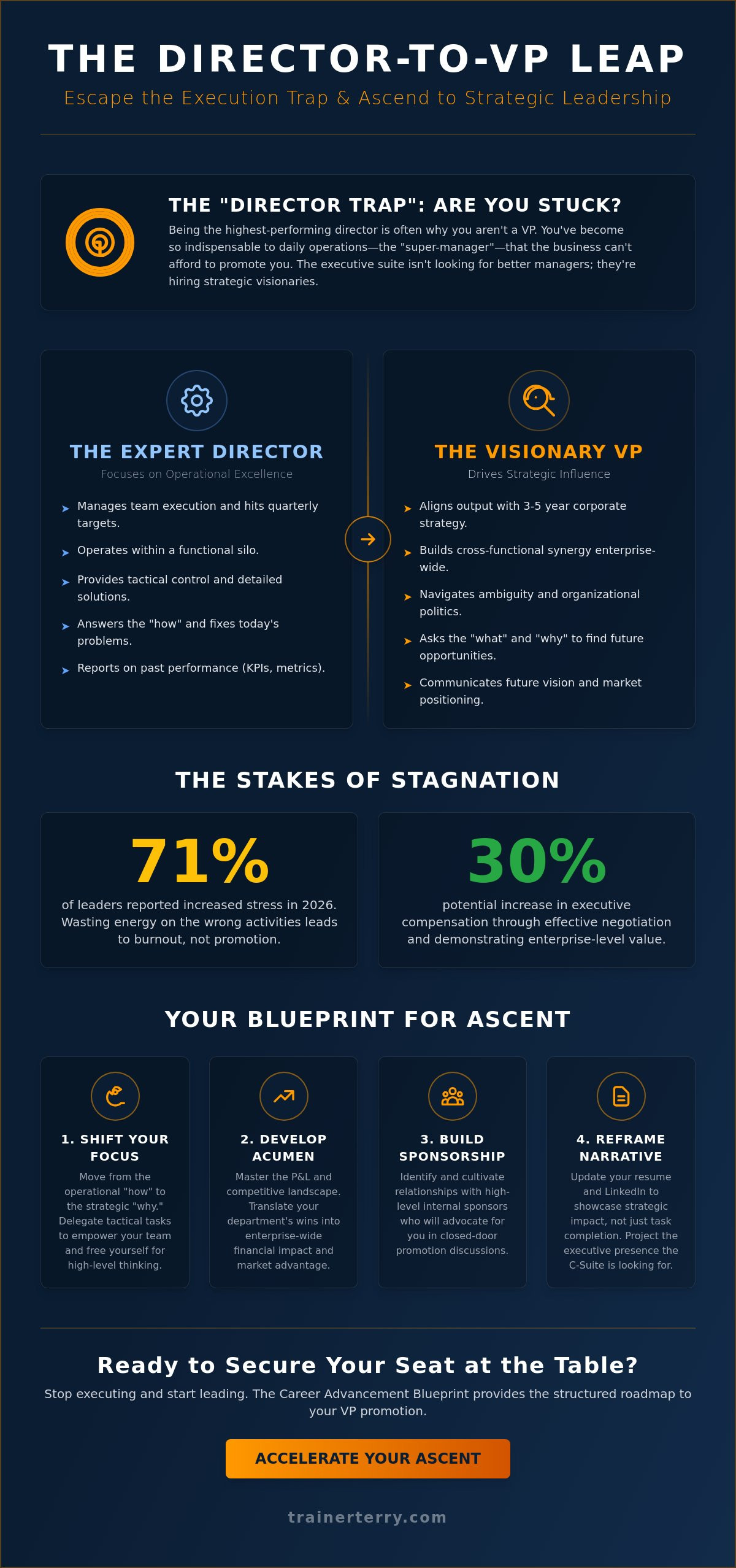
You've hit a wall, and it's likely because you're too good at your current job. Your department runs like a well-oiled machine. You're the person everyone calls when a crisis hits. While that feels like success, you've actually fallen into the "Director Trap." You've made yourself so indispensable to daily operations that the business can't afford to move you. If you're constantly fixing the "how," you'll never have time for the "what" and "why."
The career path from director to vp isn't a reward for being a super-manager; it's a total transition into enterprise leadership. While a Director manages the execution of today, a VP aligns departmental output with the company's 3-5 year corporate strategy. You must let go of tactical control to grab strategic influence. This requires a massive psychological shift. You have to stop finding comfort in the details and start getting comfortable with the big, messy picture of the whole organization. If you don't step back, you'll never step up.
Operational Excellence vs. Strategic Influence
Directors live in the world of efficiency. You focus on optimizing workflows and hitting quarterly targets. That's your baseline, but it's not a promotion trigger. VPs focus on market positioning and cross-functional synergy. They don't just ask if the team is working; they ask if the team is working on the right things to beat the competition. Understanding the Corporate title structure helps you see that a VP is an officer of the company, not just a senior manager. Strategic Influence is the ability to shape the organization’s future by leveraging resources and people you don't directly control. You have to move from solving internal problems to identifying external opportunities that drive revenue or market share.
The Invisible Ceiling: Perception vs. Performance
The board doesn't care about your past KPIs as much as you think. Performance is assumed at this level. Instead, they evaluate potential and vision. They look for someone who can navigate ambiguity and build trust across every department. This is where your Executive Presence becomes the deciding factor. If you look like a tactical firefighter, you'll stay in the trenches. You need to shift how you're perceived by the C-suite. Your career path from director to vp depends on your ability to project authority and strategic foresight before you even have the title. Stop reporting on what happened last month. Start talking about where the industry is going in the next three years. That is the language of an executive.
Master the Shift: From Managing People to Leading Strategy
Stop thinking like a manager and start acting like an owner. The career path from director to vp requires you to stop being the smartest person in the room regarding technical details. You need to become the person who understands how those details affect the company's bottom line. If you're still the primary problem solver for your team, you've failed at the first hurdle of executive leadership. You must build a team that operates at peak performance without your constant intervention. Only then will the C-suite see you as someone ready to take on larger, cross-functional responsibilities. If you are indispensable to the daily grind, you are unpromotable.
You have to master the P&L at a corporate level. It's not enough to manage your department’s budget. You must understand how your decisions ripple through the entire organization’s financial health. Executives don't just look at what happened; they identify opportunities to change what happens next. Before you make your move, consider these questions to ask before seeking a VP promotion to ensure you're aligned with the company’s broader vision. Shift your mindset from "managing people" to "leveraging resources" for maximum impact.
Developing Strategic Business Acumen
True acumen means knowing the competitive landscape as well as you know your own team. You must look outside the building. What are the industry trends for 2026? How is AI disrupting your competitors? To transition, you need to contribute to initiatives that cross departmental lines. Don't just report your data; translate it into executive-level insights. If your department's efficiency increased by 20%, tell the board how that saves the company $2 million in annual operating costs. Speak the language of value, not the language of tasks.
Cultivating Executive Presence and Communication
Reports are for managers. Recommendations are for executives. When you enter a meeting with the C-suite, stop providing status updates. They assume the work is being done. Instead, provide high-level summaries that lead to a decisive "yes" or "no." Your communication must be crisp, punchy, and results-oriented. This shift in how you present yourself is the core of what an Executive Career Coach focuses on to bridge the gap. If you want to accelerate this transformation, the Career Advancement Blueprint provides the exact framework to refine your positioning and command the room.
The Invisible Promotion: Building Influence and Internal Advocacy
You don't promote yourself to the executive suite. Other people do. While you're busy hitting targets, the real decisions about your career path from director to vp are happening in rooms where you aren't present. To bridge this gap, you must stop relying solely on your performance reviews. High-level leadership is a team sport, and you need a roster of advocates who will put their own reputation on the line for your advancement. If no one is fighting for you when the doors are closed, you're just a highly efficient manager who is easy to keep exactly where you are.
The most dangerous mistake is confusing a mentor with a sponsor. A mentor is someone who talks to you; they give advice, review your resume, and offer a shoulder to lean on. A sponsor is someone who talks about you. They are the power players who use their political capital to pull you up. In a healthy organization, the talent review process should have a completion rate of 95% or higher, meaning leadership is actively looking for the next wave of VPs. If your name isn't being mentioned in those 30-day calibration cycles, you haven't built the right advocacy yet.
Stakeholder Management Beyond Your Department
Executive influence is horizontal, not just vertical. You need to become a "problem solver of choice" for peers in Finance, HR, and Operations. If the CFO knows that you understand the P&L impact of your department's decisions, they become a natural ally. Build social capital by identifying pain points in other departments and offering strategic support. This isn't about being "political" in a negative sense. It's about mapping the C-suite and ensuring the CEO and COO see you as an enterprise leader who cares about the whole business, not just your specific silo.
Finding and Engaging Executive Sponsors
Sponsorship isn't something you wait for; it's something you earn through high-stakes delivery. Identify the senior leader whose goals align with your expertise and offer to take a lead role on a cross-functional project that keeps them up at night. When you make the "ask," be direct. Tell them you're aiming for a VP role and ask what specific gaps they see in your executive presence. This transparency builds trust and signals that you're ready for the next level. If you need a structured way to identify these stakeholders, our Career Advancement Blueprint provides a proven framework for internal advocacy. Don't leave your promotion to chance; schedule a strategy call to start mapping your ascent today.
Positioning for the Seat: Executive Branding and Interviewing
You can't walk into a VP role wearing a Director’s brand. Even if your internal influence is growing, your professional persona must signal executive authority to the Board. The career path from director to vp often stalls because a candidate’s resume reads like a list of chores rather than a record of organizational transformation. You have to stop listing what you did and start proving what you made possible for the business. If your brand doesn't scream "Executive," you'll never be invited to the table where the real decisions are made.
Executive branding is about projecting the vision you've already developed. It's the external proof of your internal shift from execution to strategy. When the C-suite looks at your profile, they shouldn't see a high-performing manager. They should see a peer who understands the complexities of the 2026 market. This requires a complete overhaul of how you present your history and your future potential.
Optimizing Your Executive Digital Brand
Your LinkedIn profile is your digital handshake. If your headline just says "Director of [Department]," you're missing a massive opportunity to claim your space. Use keywords that reflect strategic leadership, such as "Enterprise Growth," "Cross-functional Transformation," or "Operational Strategy." Your featured content should showcase thought leadership, not just team outings. For a deep dive into refining your presence, read our strategic guide for career advancement on LinkedIn. When you rewrite your resume, ditch the generic bullet points. Focus on ROI and scale. Did you scale a division by 40%? Did you save the company $500,000 through strategic consolidation? That is the language of a VP.
The VP Interview: Using the STAR Method Strategically
Board-level interviews are not about your technical skills. They are about your judgment. When you're asked how you handle conflict or failure, the board is looking for enterprise-level emotional intelligence. You must adapt the STAR method to focus on high-stakes leadership. Don't just talk about how your team hit a goal. Explain how that goal moved the needle for the entire organization’s strategic objectives. The "Result" in your STAR stories must always link back to the company’s bottom line or market position. This shows you're thinking about the whole ship, not just your oar.
This is high-stakes territory. One wrong answer can end your candidacy before it begins. If you want to ensure your narrative is bulletproof, you need to master the art of the executive interview. Don't leave your future to chance. Invest in 1:1 Job Interview Prep to refine your delivery and command the room with the confidence of a seasoned executive. The career path from director to vp is won or lost in these final conversations. Make sure you're ready to win.
Accelerate Your Ascent with the Career Advancement Blueprint
You've seen the map. You understand the shift from execution to strategy. Now, you have to execute the most important project of your life: your own promotion. The career path from director to vp is too steep to climb with trial and error. You need a proven system. Trainer Terry brings over 20 years of VP-level experience to your corner. This isn't just theory from a textbook. It's practical, battle-tested intelligence from someone who has sat in the rooms where your future is decided. If you want to stop guessing and start leading, you need a partner who has already won the game you're playing.
Waiting for your hard work to be noticed is a losing strategy. The executive suite requires a proactive, disciplined approach to personal growth. You've spent years building your team. Now, it's time to build your own executive brand. The transition from a functional leader to an enterprise visionary is the hardest jump you'll ever make. Don't do it alone. You deserve a mentor who is emotionally invested in your success and has the scars to prove they've been in the trenches.
Personalized Strategy for Aspiring Executives
Generic career advice is for entry-level roles. At the executive level, your challenges are specific and often political. You might have a visibility gap with the CEO or a perceived lack of financial acumen. A one-size-fits-all approach won't fix those blockers. You need a coach who can look at your specific situation and provide a surgical strike of a strategy. Stop listening to people who haven't reached the level you're aiming for. It's time to get expert eyes on your trajectory. Schedule a Free Strategy Call today to map your specific path to the executive suite.
Structured Success with the Career Advancement Blueprint
The Career Advancement Blueprint is the bridge you've been looking for. It takes the guesswork out of the career path from director to vp by providing a structured curriculum. We focus on executive presence, high-stakes communication, and internal advocacy. Our graduates don't just "hope" for a promotion. They command it. We've seen Directors transform into VPs by following this exact roadmap, moving from the tactical trenches to strategic influence. Don't let another year pass as a "super-manager." The executive suite is waiting. Take the first step and secure your legacy now.
Claim Your Seat at the Executive Table
The jump to the executive suite isn't about working harder. It's about working differently. You've learned that the career path from director to vp requires you to trade your tactical expertise for strategic influence. You must stop managing the "how" and start leading the "why." By building a network of internal sponsors and refining your executive brand, you're no longer just a high-performing manager. You're a visionary leader who understands the enterprise-wide bottom line.
Don't let the "Director Trap" define your legacy. You have the skills; now you need the blueprint to make them visible to the C-suite. Trainer Terry, a former Corporate VP with over 20 years of experience, has helped countless leaders secure internal promotions through specialized STAR method preparation and high-stakes positioning. Your success is a matter of strategy, not luck.
Ready to stop waiting and start leading? Secure your path to the executive suite with the Career Advancement Blueprint. Your transformation into an executive isn't a distant dream. It's an active process that begins the moment you decide to step up. Take the lead and own your future.
Frequently Asked Questions
What is the biggest difference between a Director and a VP?
Directors focus on the "how" of execution, while VPs lead the "why" of strategy. A Director ensures their specific department hits quarterly targets and maintains efficiency. In contrast, a Vice President acts as an officer of the company, aligning departmental goals with the long-term corporate vision and influencing across organizational boundaries. You have to stop managing tasks and start leading the entire enterprise.
How long does it typically take to move from Director to VP?
Most leaders spend between 2 and 5 years at the Director level before they are ready for promotion. Navigating the career path from director to vp isn't just about time in the seat; it's about your ability to demonstrate strategic impact. If you can prove you've built a team that runs without you, you'll accelerate this timeline significantly. Don't wait for tenure to earn you the role.
Do I need an MBA to become a Vice President in 2026?
No, an MBA is no longer a strict requirement for executive leadership in 2026. While advanced degrees have value, boards now prioritize "durable" human skills like empathy, adaptability, and ethical reasoning. Your track record of navigating AI integration and market volatility is far more important than a traditional degree. Focus on your results and your ability to lead through constant change.
How can I improve my executive presence as a Director?
Stop providing status updates and start giving recommendations. Executive presence is the ability to command a room by speaking the language of value and ROI. When you enter a meeting with the C-suite, keep your communication crisp and punchy. Show that you understand the company’s financial health and competitive landscape, not just your team's weekly output. Command the room with your vision.
What are the common mistakes Directors make when trying to get promoted?
The most common error is falling into the "Director Trap" by being too indispensable to daily operations. If the business can't function without you in the weeds, they won't move you to the executive suite. Another mistake is focusing on functional wins instead of enterprise-wide value. You must stop being a "super-manager" and start acting like a strategic partner to the C-suite.
How do I ask for a promotion to VP if the seat isn't currently open?
Pitch the business case for your elevation by identifying a strategic gap in the current leadership structure. Show how your promotion on the career path from director to vp allows you to solve a high-level problem or capture a new market opportunity. You aren't asking for a favor; you're proposing a structural change that drives revenue and improves organizational health. Make it an easy "yes."
Can the STAR method be used for executive-level interviews?
Yes, but you must pivot the "Result" to reflect organizational impact rather than departmental wins. When using the STAR method at the VP level, focus on how your actions influenced the company's 3-5 year strategy or bottom line. The board wants to see your judgment and emotional intelligence in high-stakes scenarios. Every story you tell should prove you can handle the complexity of the executive suite.
What should I include in a VP-level resume that is different from a Director resume?
Your VP resume must focus on scale, ROI, and organizational transformation. While a Director resume lists responsibilities and task completion, an executive resume highlights how you led the business through change. Use concrete data to show how you scaled divisions, saved significant costs, or drove revenue growth. Ditch the tactical jargon and speak the language of the board: value, impact, and future vision.

Article by
Terry Jones
Terry Jones is the Founder and Chief Career Strategist of the Career Advancement Blueprint and Executive Coach and Lead Consultant at FireBridge Consulting.
As an ICF Certified Accredited Career Coach and Certified Master Career Services professional, he partners with professionals at all levels, including senior leaders and executives, to navigate career transitions, secure new opportunities, and position themselves for advancement. His approach goes beyond surface level coaching, focusing on how individuals think, communicate, and lead so they can operate with clarity, authority, and strategic intent in high stakes environments.
In his work as an executive coach, Terry engages in high impact advisory conversations that help leaders strengthen decision making, elevate their presence, and align their leadership style with organizational expectations. He is known for helping clients translate their experience into influence, ensuring they are not only seen for what they have done, but trusted for what they are capable of leading next.
With over 20 years of corporate experience, including serving as a Vice President and leading Learning and Development functions for three New York City organizations, Terry brings a deep understanding of how companies evaluate talent, develop leaders, and make promotion decisions. This allows him to bridge the gap between individual ambition and organizational reality.
His insights have reached over 630,000 followers and generated more than 70 million video views, where he shares direct, experience driven guidance that helps professionals think differently and take action.