How to Ask for a Promotion with a New Job Offer: The 2026 Leverage Strategy

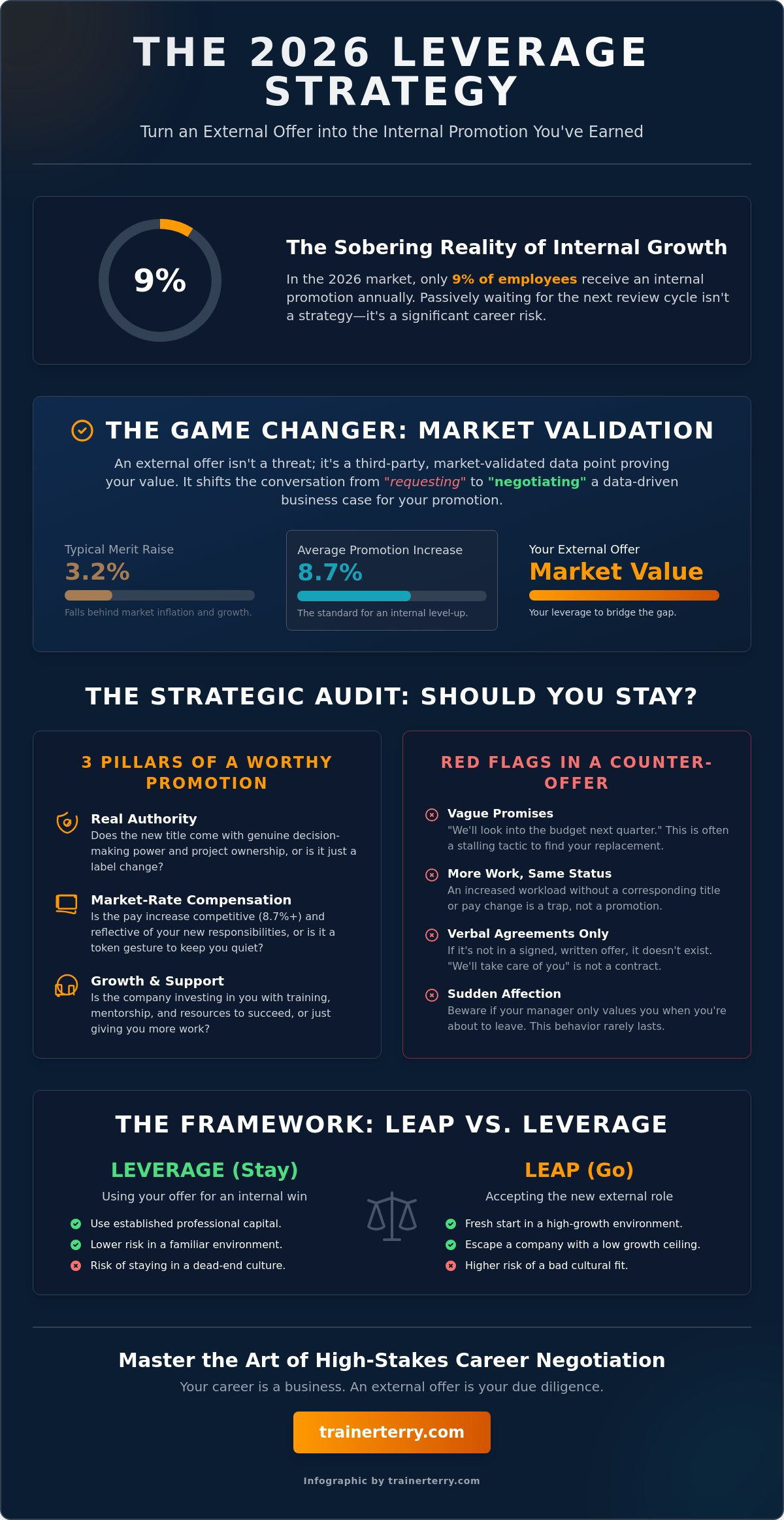
An external offer isn't a threat to your current company; it's a market-validated data point that proves you're under-leveled. You might feel like bringing it up is a betrayal, but in a 2026 market where only 9% of employees get promoted, sitting back and waiting isn't a strategy. It's a risk. You've worked hard, you've delivered results, and now you finally have the leverage to prove your true market value.
It's natural to feel anxious about the "disloyalty" label or worry that your boss will simply let you walk. You want the title and the salary match, but you want to keep your professional relationships strong too. This article shows you exactly how to ask for a promotion with a new job offer without burning bridges or looking like you have one foot out the door. You'll learn to master the high-stakes art of the 2026 Leverage Strategy to secure the internal growth you've earned. We'll cover the specific scripts, the psychological timing, and the data-driven tactics you need to turn an outside offer into an inside win.
Key Takeaways
- Reframe your external offer as market validation that bypasses slow annual cycles and proves your immediate Retention ROI.
- Audit your current role for "Growth Ceilings" to ensure a promotion leads to long-term advancement rather than just a temporary salary bump.
- Apply the "Leap vs. Leverage" framework to weigh the risks of starting fresh against the benefits of your established professional capital.
- Discover exactly how to ask for a promotion with a new job offer using a high-performance script that focuses on strategy and future value.
- Shift from reactive negotiating to building a 365-day promotion narrative that keeps your market value high without needing outside leverage.
The Psychology of Leverage: Why an External Offer Is Your Best Promotion Tool
Stop waiting for the annual review cycle to recognize your worth. Companies often rely on slow, bureaucratic schedules that ignore your daily contributions. An external offer changes the dynamic instantly. It provides "Market Validation." This is the objective proof that a third party has evaluated your skills and assigned them a specific market price. You're no longer just an employee hoping for a raise. You're a professional presenting a verified business case.
Learning how to ask for a promotion with a new job offer requires a shift in mindset. You're moving from "requesting" to "negotiating." Managers often prioritize budgets over talent until they're faced with the "Retention ROI" reality. It's significantly cheaper to promote a proven internal leader than to recruit, onboard, and train a replacement. Mastering the art of negotiation helps you highlight this financial fact. It forces your leadership to acknowledge your executive presence and your commitment to the company's 2026 goals.
Breaking the 'Disloyalty' Myth
Seeking a new role isn't a betrayal of your team. It's a strategic career move. High performers stay sharp by knowing their current market value. Frame your external search as a way to stay competitive and informed. You aren't a flight risk; you're a top-tier asset ensuring your current environment aligns with your professional trajectory. True loyalty is about delivering results, not accepting a salary that's below your worth.
Identifying Your True Market Value
In 2026, the average pay increase for a one-level promotion is 8.7%. If your current employer is only offering a standard 3.2% merit raise, they are ignoring the market. Use your external offer to benchmark your title and responsibilities. Don't let "internal equity" or rigid HR bands cap your growth. If you need a specific roadmap for this transition, the Career Advancement Blueprint offers a structured path to internal growth. Leverage is the intersection of market demand and internal impact.
The Strategic Audit: Should You Stay or Should You Go?
Before you step into your manager's office, you need a cold, hard look at the scoreboard. An external offer is a powerful tool, but it isn't a magic wand for a broken culture. Start by evaluating your "Growth Ceiling." If you secure this promotion today, where does it lead in 2027? Some companies use internal moves as "hush-money" to keep high performers quiet while the ship sinks. You aren't looking for a temporary fix. You're looking for a launchpad. You must spend time weighing the dangers and benefits before committing to stay.
Analyze the long-term viability of your current firm against the new offer’s potential. Does the external role provide skills your current company lacks? In a 2026 job market where only 9% of employees get promoted, you can't afford to waste leverage on a dead-end path. Knowing how to ask for a promotion with a new job offer also means knowing when to say no to your current boss. If the new offer puts you in a high-growth sector while your current firm is cooling down, the choice is clear. Don't let comfort kill your momentum.
The Three Pillars of a Worthy Promotion
Decision-making power matters. Does the new title come with real authority, or is it just a "senior" tag on your old email signature? Your compensation must reflect the 2026 market. With the average pay increase for a one-level promotion hitting 8.7%, a token 3% bump is an insult. Finally, demand support. A real promotion includes an investment in your leadership development. If they won't train you to lead at the next level, they're setting you up to fail.
Red Flags in Internal Counter-Offers
Watch out for vague promises. If your manager says they'll "look into the budget" next quarter, they're buying time to find your replacement. An increased workload without a corresponding title or pay change is a trap, not a promotion. You need a signed agreement, not a verbal "we'll take care of you." Use the Career Advancement Blueprint to evaluate your long-term growth and ensure your next move is a win. If you feel like you're negotiating for scraps, it's time to take the external offer and run.
The 'Leap vs. Leverage' Framework: Comparing Your Options
Choosing between an internal promotion and an external jump isn't just about the paycheck. It's about your career capital. When you stay, you leverage years of built-up trust and institutional knowledge. When you leap, you pay an "Onboarding Tax." You have to learn new systems, navigate fresh office politics, and prove your worth from scratch. Understanding how to ask for a promotion with a new job offer requires you to weigh these two paths with surgical precision. Don't let the excitement of a new offer blind you to the "Legacy Burden" of staying or the high risk of starting over.
Use the STAR method to audit your recent wins before the big meeting. This framework isn't just for acing interviews; it's the foundation of your internal business case. Document your Situation, Task, Action, and Result to show exactly how you've impacted the bottom line. If your achievements are undeniable but your title is stagnant, your leverage is at its peak. However, if your "Legacy Burden" means you're stuck doing junior tasks despite a new title, the external move might be the only way to reset your professional narrative.
Internal Promotion: The Pros and Cons
Staying put offers the safety of existing relationships and deep institutional knowledge. You know how to get things done without asking for directions. But you face the "Yesterday's Perception" trap. Even with a new title, colleagues may still see you as the person you were three years ago. You must consciously reset your Executive Presence during this transition. Demand a clear shift in responsibilities, not just a raise. If the company won't let you evolve, your "established capital" is actually a cage.
External Move: The Pros and Cons
An external move offers a clean slate and an immediate jump in market status. Research shows that job hoppers in 2026 report a 64% success rate in boosting their careers and salaries. The downside? You're entering a "low-hire-low-fire" environment where only 28% of professionals feel it's a good time to move. The risk is high. Even with an offer in hand, 1:1 job interview prep is essential to ensure you've fully vetted the new firm's culture. You don't want to trade a stable role for a company that lacks a long-term growth strategy.
Your LinkedIn personal brand strategy must reflect this decision. If you stay, your profile should highlight your new leadership scope and internal impact. If you leave, it needs to signal your arrival as a high-value external hire. In either case, the goal is clarity. You're a high-performance professional who knows their worth and isn't afraid to act on it.
Executing the Conversation: A High-Performance Script
Stop being a spectator in your own career. When you have an external offer, you aren't just an employee anymore; you're a high-value asset with options. But don't just walk in and drop a resignation letter on the desk. That's a low-level move that ends the relationship. Mastering the mechanics of how to ask for a promotion with a new job offer requires you to own the room and lead the narrative from the first sentence.
The execution follows a strict five-step protocol designed for maximum leverage. First, request a private "Strategy and Growth" meeting. Avoid calling it a "notice" or "urgent" meeting, as this triggers immediate defensiveness. Once inside, lead with your wins. Remind them of your commitment to the company's 2026 goals and the specific ROI you've delivered over the last six months. Only then do you introduce the external offer, framing it as a "difficult dilemma" caused by high market demand for your specific skill set.
- Define the Gap: Present the specific promotion and title change that would make staying the only logical choice.
- Set the Clock: Give them a firm but professional deadline. A decision by the end of the week shows you're serious and prevents them from "buying time" to replace you.
The Power-Negotiation Script
Preparation is the difference between a raise and a rejection. If your boss asks why you didn't come to them first, don't apologize. Explain that you weren't actively looking, but the market's reach is aggressive in 2026. Use this specific phrasing: "I've built significant capital here, and I want to keep scaling with this team. However, I've been approached with a role that matches the level of impact I'm already delivering. I want to stay, but I cannot ignore my market value." This keeps the focus on your worth, not your "loyalty."
Managing the Boss's Reaction
Expect resistance. If your manager gets defensive or mentions "budget constraints," stay calm. Don't mirror their emotional energy. Redirect the conversation back to the business impact you've documented. Use Career Advice 2026 principles to stay focused on future results rather than past grievances. If the conversation stalls, it's a clear signal that they value the budget more than your talent. If you want to refine your approach before the meeting, schedule a free strategy call to lock in your negotiation plan. Own your value, or someone else will dictate it for you.
Beyond the Offer: Building a Promotion-Proof Career
Relying on an external offer for every career jump is a high-risk gamble. While it works as a tactical strike, doing it repeatedly labels you as a mercenary rather than a leader. You want to be the person the company fights to keep, not the one they feel forced to pay. Learning how to ask for a promotion with a new job offer is a vital skill, but your ultimate goal should be to make your value so obvious that the company moves first. You need a "Promotion Narrative" that works 365 days a year, ensuring your market value is always visible to the decision-makers who matter.
This is where your LinkedIn positioning and personal brand become your strongest assets. High-performance professionals don't wait for a crisis to update their profiles. They treat their career like a product, constantly refining their message and showing their impact. My Career Advancement Blueprint is designed to automate this process. It helps you shift from a reactive employee to a proactive executive who dictates their own growth trajectory. Don't leave your future to chance or annual HR cycles.
Creating a Strategic Advancement Plan
Start by setting quarterly "Impact Milestones." These aren't just a list of completed tasks; they're documented wins that show a direct line to company revenue or efficiency. When you have these on paper, your executive presence becomes undeniable. You also need to look beyond your immediate manager. Network internally to find sponsors, high-level leaders who will advocate for you when you aren't in the room. A boss manages your work, but a sponsor manages your career. If you only talk to your boss about your future, you're missing half the game.
Your Next Steps for Executive Growth
The most successful professionals I work with never truly stop interviewing. They stay in the market to keep their skills sharp and their market data current. This isn't about being disloyal; it's about being informed. Knowing that job hoppers in 2026 see a 64% success rate in boosting their salaries gives you the confidence to stand your ground. Working with an executive career coach provides the outside perspective you need to spot your own blind spots and refine your long-term strategy.
Are you ready to stop reacting and start leading? You've earned your seat at the table, now it's time to secure the title and compensation that reflects it. Don't let another quarter pass in a role you've already outgrown. Schedule a Free Strategy Call today and let's build the blueprint for your next level. Your career won't wait for you to be ready. Take the lead now.
Claim Your Seat at the Next Level
Your career capital is a currency. In 2026, it's time to spend it wisely. You've seen that an external offer isn't a bridge-burning tool; it's a data point that forces your organization to acknowledge your true executive presence. By applying the "Leap vs. Leverage" framework, you can objectively decide if your current firm offers a launchpad or a ceiling. Mastering how to ask for a promotion with a new job offer isn't just about a single meeting. It's about shifting from a passive employee to a high-performance professional who owns their narrative.
Don't leave your advancement to the mercy of slow annual reviews. I've spent over 20 years as a Corporate VP, and I've seen exactly how leaders evaluate talent. I specialize in STAR method negotiation and executive positioning to ensure you aren't just getting a raise, but a career-defining title. Ready to stop guessing and start leading? Secure your next promotion with the Career Advancement Blueprint. It's time to execute the strategy that reflects your real market value. You've done the work, now claim the reward.
Frequently Asked Questions
Is it risky to use a job offer to get a promotion?
Using an external offer is a calculated risk, but in a 2026 market with only a 9% promotion rate, it's often the only way to break through. Knowing how to ask for a promotion with a new job offer means understanding that the real danger isn't the conversation; it's being unprepared to leave. If you aren't willing to take the new role, don't start the negotiation. Leverage without action is just a bluff that kills your credibility.
What if my current boss says no to the promotion?
You must be prepared to walk. Staying after a rejection tells the company you'll accept being underpaid and under-leveled indefinitely. This is exactly how to ask for a promotion with a new job offer effectively: you lead with value but carry a packed suitcase. A "no" is simply a sign that your current environment has reached its growth ceiling. Don't beg for what the market has already granted you elsewhere.
How long should I give my company to decide on the counter-offer?
Give them 48 to 72 hours. A firm deadline prevents them from buying time to find your replacement or stalling until the external offer expires. In a fast-moving 2026 market, they either value you enough to make a decision or they don't. You need a signed agreement on the new title and salary, not just a verbal promise. If they can't decide in three days, they've already given you their answer.
Should I tell my boss the name of the company that gave me the offer?
Keep the offering company's name confidential to maintain your professional edge. Your manager doesn't need to know who wrote the check; they only need to know the market value it represents. Focus on the scope of the new role and the 8.7% average raise for one-level promotions in 2026. Revealing the name invites unnecessary comparison and could lead to back-channeling that undermines your position. Focus on the data, not the logo.
What if the new job offer is for more money but a lower title?
Use the higher salary as proof that your current title is a "Legacy Burden" that doesn't reflect your market worth. If a company offers you more money for a lower title, it proves your current firm is getting a massive discount on your talent. Negotiate for the title you've earned internally by using that salary as the baseline. Don't let a "senior" tag mask a junior paycheck. Title and pay must align with your actual impact.
Can I ask for a promotion if I've only been in my current role for a year?
Tenure is a legacy metric; impact is the 2026 metric. If you've delivered significant ROI within twelve months, you're ready. Nearly 70% of employers now use skills-based hiring, meaning they care more about what you can do than how long you've sat in a chair. If you have the offer, you have the proof. Don't wait for an arbitrary anniversary to claim the growth you've already achieved. Your results are your permission slip.
What happens to my reputation if I stay after using an offer as leverage?
Your reputation stays intact if you continue to deliver at an elite level. Some fear being seen as "disloyal," but high-performers are respected for knowing their value. Once the deal is signed, move immediately into your new responsibilities with intensity. Resetting your executive presence is key. If you act like a leader who chose to stay, your team will treat you like one. Professionalism isn't about silence; it's about transparency.
How do I handle it if the new company finds out I'm using their offer to negotiate?
Professionalism is your best defense. If the new company asks, be honest that you're evaluating your long-term growth options. Most hiring managers expect you to have multiple conversations in this market. Frame it as being thorough, not manipulative. You're a high-value asset making a strategic life decision. If they're a top-tier employer, they'll respect the fact that you're in high demand. Never apologize for managing your career capital.

Article by
Terry Jones
Terry Jones is the Founder and Chief Career Strategist of the Career Advancement Blueprint and Executive Coach and Lead Consultant at FireBridge Consulting.
As an ICF Certified Accredited Career Coach and Certified Master Career Services professional, he partners with professionals at all levels, including senior leaders and executives, to navigate career transitions, secure new opportunities, and position themselves for advancement. His approach goes beyond surface level coaching, focusing on how individuals think, communicate, and lead so they can operate with clarity, authority, and strategic intent in high stakes environments.
In his work as an executive coach, Terry engages in high impact advisory conversations that help leaders strengthen decision making, elevate their presence, and align their leadership style with organizational expectations. He is known for helping clients translate their experience into influence, ensuring they are not only seen for what they have done, but trusted for what they are capable of leading next.
With over 20 years of corporate experience, including serving as a Vice President and leading Learning and Development functions for three New York City organizations, Terry brings a deep understanding of how companies evaluate talent, develop leaders, and make promotion decisions. This allows him to bridge the gap between individual ambition and organizational reality.
His insights have reached over 630,000 followers and generated more than 70 million video views, where he shares direct, experience driven guidance that helps professionals think differently and take action.