How to Demonstrate Leadership Potential When Not a Manager: The 2026 Strategic Blueprint

Why are you still stuck in the "doer" lane while others cruise into the boardroom? You're hitting 100% of your KPIs, yet you feel invisible when promotion season hits. It's a trap. Being a "great doer" doesn't make you a leader; it makes you indispensable in your current role. You must learn how to demonstrate leadership potential when not a manager before that title ever appears on your business card.
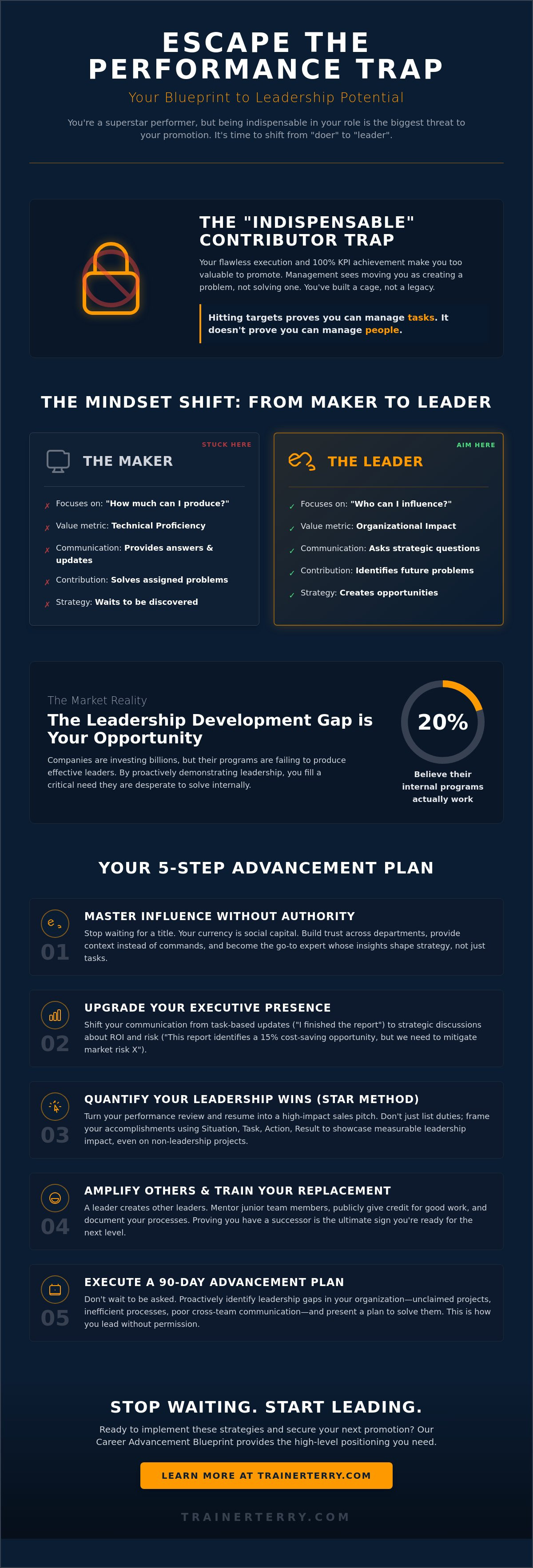
I get it. It's frustrating to be the most reliable person in the room while being told you lack "executive presence." You aren't alone. While the leadership development market is projected to hit $113.96 billion in 2026, only 20% of organizations believe their internal programs actually work. This gap is your opportunity. This article promises to shift your mindset from "maker" to "leader" and give you a clear strategy to secure your next promotion by mastering influence and executive presence.
We'll break down how to influence stakeholders without formal authority and quantify your leadership impact on your resume using the same high-level positioning strategies we use in our Career Advancement Blueprint. It's time to stop waiting for permission and start acting like the executive you're meant to be. Let's get to work.
Key Takeaways
- Stop falling into the "Performance Trap" where being a superstar doer makes you too valuable to move out of your current role.
- Master the art of influence without authority to learn how to demonstrate leadership potential when not a manager by building social capital and cross-departmental trust.
- Upgrade your executive presence by shifting your communication style from task-based updates to high-level discussions about ROI and risk mitigation.
- Turn your performance review into a high-impact sales pitch using the STAR method to quantify your leadership wins on your resume.
- Execute a structured 90-day Advancement Plan to proactively identify and fill leadership gaps in your organization before you are even asked.
The Performance Trap: Why Being a "Superstar" Isn’t Enough for a Promotion
You're crushing it. Your KPIs are green, your inbox is empty, and your boss calls you the "backbone" of the team. But when a management opening appeared last month, they hired an outsider or promoted someone else. You're caught in the Performance Trap. This happens when your execution is so flawless that moving you creates a hole the company can't fill. You've become too expensive to promote because you're too good at your current job.
Hitting 100% of your targets proves you can manage tasks. It doesn't prove you can manage people. This is the "Invisible Contributor" syndrome. You're doing the heavy lifting, but you aren't owning the narrative. To break out, you need Strategic Positioning. You must learn how to demonstrate leadership potential when not a manager by showing you can scale your impact beyond your own keyboard. If you don't show them you can lead, they'll keep you right where you are.
The Maker vs. Leader Mindset
Stop obsessing over "how much" you produced today. Leaders focus on "who" they influenced. Technical proficiency is just the entry fee. True organizational impact comes from shifting others' behavior and solving problems before they reach the C-suite. Modern theories of leadership and influence suggest that leadership isn't a title; it's a social process. If your boss is afraid to promote you because the department would collapse, you haven't built a legacy; you've built a cage. You need to train your replacement to prove you're ready for the next level.
The Fallacy of the "Open to Work" Mentality
Waiting to be "discovered" is a losing strategy. In a 2026 market where 92% of companies recognize leadership development as a critical investment, being passive is career suicide. You might think a LinkedIn badge will save you, but why your "Open to Work" badge might be hurting your executive job search is a real conversation you need to have. Stop being a candidate and start being an active leader within your current walls. This is how to demonstrate leadership potential when not a manager: you solve problems that aren't on your job description. You don't wait for permission to lead; you just start leading.
Manager vs. Leader: Mastering the Art of Influence Without Authority
Management is a title. Leadership is a behavior. If you're waiting for a promotion to start leading, you've already lost the race. You're currently facing the "Authority Gap." This is the challenge of getting results when you can't fire, hire, or discipline anyone. In 2026, where 92% of companies recognize leadership development as a critical investment for strategic agility, your only currency is social capital. You don't get things done through commands; you get them done through trust and alignment.
Stop trying to control people and start providing context. Most "makers" stay stuck because they only see their own silo. A leader helps the whole team see the big picture. This is how to demonstrate leadership potential when not a manager: you become a "Domain Leader." You aren't just the person who does the work; you're the person who shapes the strategy because your expertise is undeniable. You're the one who identifies risks before they become disasters. If you want to master this level of influence, our Career Advancement Blueprint shows you exactly how to map out your internal influence network.
Shifting from Answers to Questions
Stop being the person with all the answers. It's a "maker" habit that limits your growth. Real leaders use Socratic questioning to guide their peers toward the right solution. Instead of saying, "I know how to fix this," try asking, "How does this specific fix align with our Q4 revenue goals?" This shift forces you to think three levels above your current pay grade. It shows the C-suite that you aren't just thinking about the "how," but the "why." That's how you level up your executive presence and prove you're ready for the boardroom.
The "Amplify Others" Framework
Real leaders give away credit and take the blame. It's a discipline most people lack. Use your status as a high-performing contributor to mentor newer team members. Don't hoard your secrets; share them. When you help a colleague hit their targets, you're acting as a "talent scout" for your own manager. This isn't just being "nice." It's a strategic move. By building a team of people who owe their success to your guidance, you prove you're already doing the job of a leader without the title. This is the ultimate way how to demonstrate leadership potential when not a manager in 2026.
Building Executive Presence and Domain Leadership in 2026
Executive presence isn't some mystical aura reserved for the C-suite. It's a skill set you build through discipline and repetition. In 2026, where the leadership coaching segment is projected to exceed $10 billion, companies aren't just looking for technical skills; they're looking for gravitas. Gravitas is the ability to project confidence under pressure and make people listen when you speak. If you want to know how to demonstrate leadership potential when not a manager, start by looking and acting like you've already been there. This includes your communication, your appearance, and most importantly, how you handle high-stakes feedback.
Executives speak the language of ROI and risk mitigation. They don't want a 20-minute play-by-play of your daily tasks. They want to know how your work protects the bottom line or accelerates growth. Developing a "thick skin" is non-negotiable. When you get shredded in a review, don't pout or get defensive. Analyze the data, thank them for the perspective, and execute the pivot with professional alacrity. You can Elevate Your Executive Presence with Trainer Terry to master these high-stakes interactions and stop being seen as "just a doer."
Communicating with Impact
Stop the fluff. Use the BLUF (Bottom Line Up Front) method for every email and meeting. Lead with the result. "We saved 15% on server costs" beats "I spent the week looking at AWS logs" every single time. Stop apologizing for your space in the room. Phrases like "I just think" or "Maybe we could" bleed your authority dry. They make you sound unsure. Replace them with "I recommend" or "The data shows." Master the Strategic Pause. Silence is power. It shows you aren't rushing to fill the air with nervous energy. It forces others to process your last point.
Domain Leadership: The Maker’s Path to Power
You don't need a team to lead a niche. Become the absolute authority on one critical business function that others find confusing or difficult. This is how to demonstrate leadership potential when not a manager: you translate your technical "domain" wins into business "leadership" wins. If you fixed a bug, that's technical. If you prevented a $50,000 service outage through proactive monitoring, that's leadership. Your personal brand should reflect this expertise across all platforms. Learn how to use LinkedIn in 2026: a strategic guide for career advancement to broadcast your domain authority to the stakeholders who actually make the promotion decisions.
Tactical Execution: Using the STAR Method to Prove Leadership
Your performance review isn't a report card. It's a high-stakes sales pitch. If you treat it like a list of completed chores, you're telling the company you're a great "doer" who should stay exactly where you are. To move up, you must package your actions into a leadership narrative. This is how to demonstrate leadership potential when not a manager: you stop talking about what you did and start talking about what you enabled. You shift the focus from your own output to the collective success of the team.
The STAR Method (Situation, Task, Action, Result) is your secret weapon for this transition. Most contributors fail because they spend 80% of their time explaining the Situation and the Task. Leaders do the opposite. They spend 80% of their narrative on the Action and the Result. You need to quantify your influence with cold, hard data. Did you mentor a peer who subsequently increased their output by 20%? That's a leadership win. Did you streamline a cross-departmental workflow that saved the company $15,000 in monthly overhead? That's executive thinking. If you want to refine this technique, start mastering the STAR method for internal promotions today.
Drafting Your Leadership Narrative
Don't just wing it when the stakes are high. Follow these steps to build a case that the C-suite can't ignore:
- Step 1: Identify a specific moment you influenced a stakeholder or peer without having formal authority over them.
- Step 2: Isolate the "Action." What specific leadership trait did you use? Was it conflict resolution, strategic foresight, or resource allocation?
- Step 3: Highlight the "Result." Use percentages or dollar amounts. If you can't find a direct revenue link, use time saved or error rates reduced.
Your goal is to define your "Leadership Brand" in one punchy sentence. For example: "I am a strategic facilitator who optimizes cross-functional team performance to drive measurable revenue growth." This tells them exactly who you are and why they need you in a higher bracket.
Managing Up: Socializing Your Success
Sharing your wins isn't bragging; it's providing your manager with the ammunition they need to fight for your promotion. You need to align your growth with their departmental pain points. Use your 1-on-1 sessions to ask about their biggest obstacles and then present your STAR stories as evidence that you're already solving them. If you're struggling to frame your value, book Terry for a strategic Office Hours session to get your narrative tight and professional. Leadership is a discipline. If you don't document it, it didn't happen.
Your Internal Advancement Plan: From Maker to Leader
You have the theory and the narrative. Now you need a deadline. Without a timeline, your ambition is just a wish. To change how the C-suite perceives you, you must execute a structured plan that moves you out of the weeds and into the strategy room. Identifying "Leadership Gaps" is your first mission. Don't wait for a job posting. Look for the friction points your manager is too busy to fix. In 2026, 68% of companies are struggling with management gaps in remote and hybrid environments. If you bridge those gaps today, you're already doing the job of a leader before the title exists.
When you finally sit down to ask for the promotion, avoid the "Hopeful Plea." Never say, "I've been here two years and I think I'm ready." That's a weak position. Use the "Strategic Ask" instead. Present the data. Show them the STAR stories you've documented. Tell them, "I've already been operating at a leadership level by delivering X and Y results. Let's formalize this role so I can scale these efficiencies across the entire department." This is how to demonstrate leadership potential when not a manager: you make the promotion the only logical decision for the business's bottom line.
The 90-Day Visibility Audit
You can't lead if you're buried in tickets. Follow this 90-day sprint to reset your professional image:
- Month 1: Audit your current "Maker" tasks. Identify the repetitive work that doesn't require your specific expertise. Delegate, automate, or eliminate 20% of it to find your "leadership margin."
- Month 2: Initiate one cross-functional project. This must require leading peers over whom you have no authority. Focus on a goal that benefits multiple departments.
- Month 3: Compile your results. Present your "Leader" narrative to your boss, focusing on the organizational impact rather than your personal effort.
Level Up Your Strategy
Sometimes you're too close to the work to see your own potential. You need an outside perspective to sharpen your executive presence and cut through the internal noise. Organizations with formal mentoring and coaching see a 20% higher rate of internal promotions for participants. Don't leave your career to chance. If you're ready to stop being the "best doer" and start being the "obvious leader," you need a proven system. Schedule your Free Strategy Call today to map out your next move. If you want the full roadmap, apply for the Career Advancement Blueprint and let's get you that seat at the table. No excuses. Just results.
Take Command of Your Professional Future
You've been playing the "maker" game for too long. It's time to stop waiting for someone to hand you a title and start acting like the leader you already are. We've covered how to break the performance trap by shifting your focus from task execution to strategic influence. You now have the blueprint for how to demonstrate leadership potential when not a manager by mastering executive presence and using the STAR method to quantify your impact on the bottom line.
Don't let your talent go to waste in a role that's too small for your vision. My approach is led by a former Corporate VP with over 20 years of high-level experience. We use a proven STAR method framework for internal promotions that focuses on high-stakes executive positioning. You have the skills; now you need the strategy to make them visible to the people who sign the checks.
Ready to stop being the best-kept secret in your company? Join the Career Advancement Blueprint today.
The boardroom isn't going to open itself. You have to kick the door down with results and presence. Level up and take your seat. I'm ready when you are.
Frequently Asked Questions
Can I demonstrate leadership if I work in a fully remote environment?
Yes, you can lead from any zip code. Remote leadership in 2026 is about digital visibility and asynchronous influence. Be the person who clarifies messy project threads and sets the pace in Slack or Teams. 68% of organizations are currently hunting for contributors who can bridge management gaps in hybrid environments without needing a physical office to command respect.
How do I show leadership on my resume without a manager title?
Focus on your impact, not your job description. Use active verbs like "orchestrated," "mentored," or "architected" to define your contributions. This is how to demonstrate leadership potential when not a manager on paper. Quantify your wins by showing how a specific project you led resulted in a 15% efficiency gain or protected a key revenue stream.
What is the difference between domain leadership and people leadership?
Domain leadership is about being the "go-to" expert in a specific technical or functional niche. People leadership is about scaling that expertise by influencing and developing others. You need both to reach the executive level. Domain authority gives you the credibility to speak; people leadership gives you the power to move the entire organization toward a goal.
What if my manager is blocking my path to leadership?
Build social capital outside your immediate silo. If your direct boss won't advocate for you, you need other VPs to do it. Organizations with formal or informal mentoring programs see a 20% higher rate of internal promotions. Start solving problems for other departments to ensure your reputation as a leader is known across the entire C-suite.
How do I lead peers who have more experience than I do?
Lead with Socratic questioning rather than direct commands. Years of experience don't always translate to strategic alignment with current company goals. Ask questions that guide senior peers toward solutions that hit Q4 revenue targets. When you help them look like superstars to the executive team, they'll naturally look to you for direction on the next project.
What are the most important leadership traits for non-managers in 2026?
Emotional intelligence and ROI-focused communication are the non-negotiable traits for 2026. The global leadership development market is projected to reach $113.96 billion because companies are desperate for people who can handle high-stakes pressure without burning out. You must show you can handle feedback with professional alacrity and keep the team focused on the bottom line.
How often should I be "managing up" to my boss?
You should manage up during every single 1-on-1 session. Don't wait for a formal performance review to share your wins. Use your weekly check-ins to align your current projects with your manager's biggest pain points. When you consistently solve their problems, you stop being a "doer" and start being a strategic partner they can't afford to lose.
Is the STAR method effective for internal promotion interviews?
The STAR method is the gold standard for internal advancement. It forces you to stop listing tasks and start selling results. Internal interviews are high-stakes sales pitches where you are the product. Use the STAR framework to prove that your past actions have already delivered the leadership results the company needs for its future growth.

Article by
Terry Jones
Terry Jones is the Founder and Chief Career Strategist of the Career Advancement Blueprint and Executive Coach and Lead Consultant at FireBridge Consulting.
As an ICF Certified Accredited Career Coach and Certified Master Career Services professional, he partners with professionals at all levels, including senior leaders and executives, to navigate career transitions, secure new opportunities, and position themselves for advancement. His approach goes beyond surface level coaching, focusing on how individuals think, communicate, and lead so they can operate with clarity, authority, and strategic intent in high stakes environments.
In his work as an executive coach, Terry engages in high impact advisory conversations that help leaders strengthen decision making, elevate their presence, and align their leadership style with organizational expectations. He is known for helping clients translate their experience into influence, ensuring they are not only seen for what they have done, but trusted for what they are capable of leading next.
With over 20 years of corporate experience, including serving as a Vice President and leading Learning and Development functions for three New York City organizations, Terry brings a deep understanding of how companies evaluate talent, develop leaders, and make promotion decisions. This allows him to bridge the gap between individual ambition and organizational reality.
His insights have reached over 630,000 followers and generated more than 70 million video views, where he shares direct, experience driven guidance that helps professionals think differently and take action.