Building a Business Case for My Promotion: The Strategic Blueprint for 2026

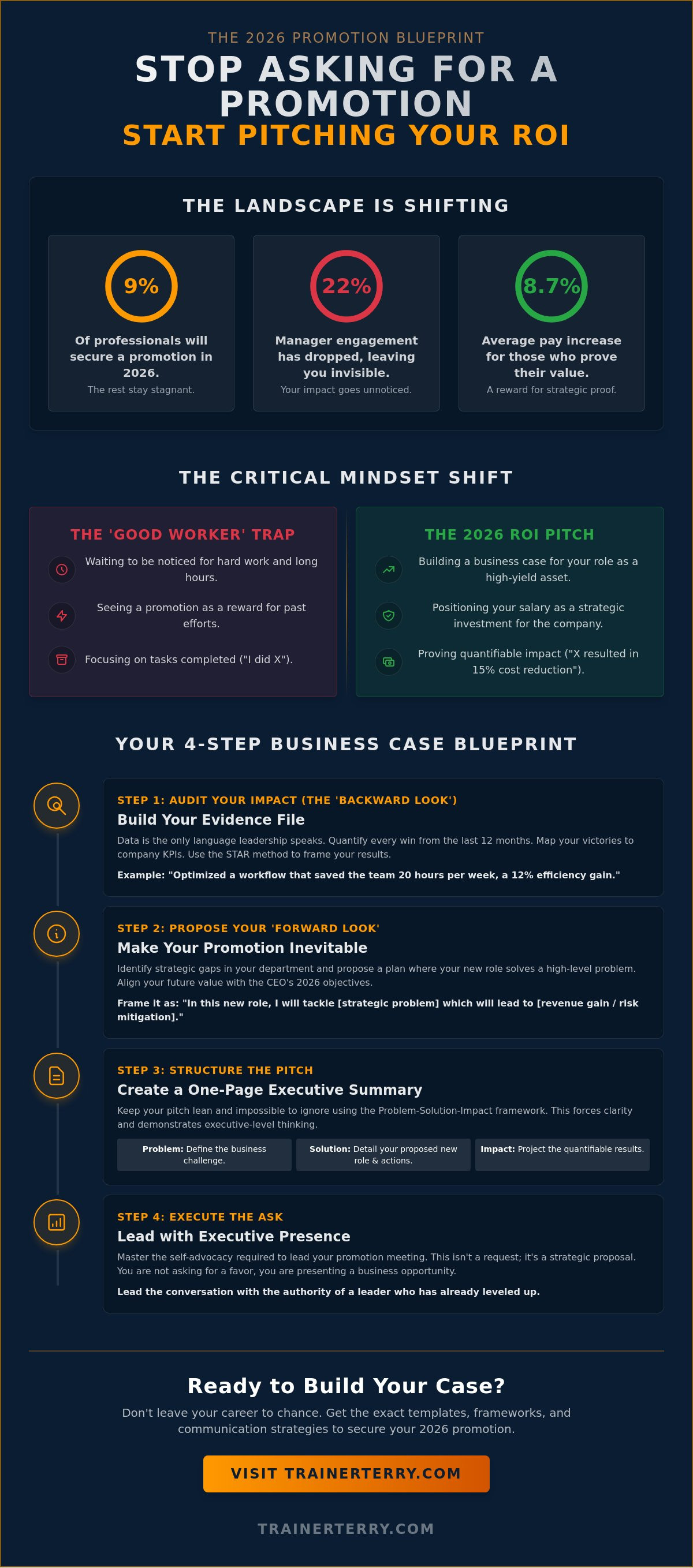
Why is it that only 9% of the workforce will secure a promotion in 2026 while everyone else stays stuck? You've been grinding. You're hitting every KPI, yet you feel completely invisible when leadership talks about the budget. Stop waiting for a pat on the back and start building a business case for my promotion that positions your role as a high-yield asset. If you want that 8.7% average pay increase projected for 2026, you can't just ask for a favor. You have to prove your ROI.
I get it. It's frustrating to see your impact ignored while manager engagement has dropped to just 22% this year. You're tired of the "Great Stay" keeping you stagnant and afraid of budget freezes. This article promises to transform your career narrative into a strategic blueprint that senior leadership cannot ignore. We'll break down how to quantify your leadership skills, justify your salary increase with 2026 market data, and lead high-stakes meetings with the confidence of an executive who knows their worth.
Key Takeaways
- Shift your mindset from seeking a reward to offering a high-yield investment that aligns with leadership’s 2026 goals.
- Stop guessing your worth and start building a business case for my promotion by using hard data to prove your revenue impact and efficiency gains.
- Identify strategic gaps in your department and propose a Forward Look plan that solves high-level problems before your boss even notices them.
- Create a professional one-page executive summary using the Problem-Solution-Impact framework to keep your pitch lean and impossible to ignore.
- Master the executive presence and self-advocacy required to lead your promotion meeting with the authority of a leader who has already leveled up.
The Mindset Shift: Why a Promotion is a Business Investment, Not a Reward
If you think working hard is your ticket to the top, you're already behind. In 2026, putting in long hours is just the baseline; it's the cost of entry. Companies aren't handing out promotions as trophies for participation anymore. They're looking for ROI. You need to stop viewing a title change as a reward for past behavior and start building a business case for my promotion that treats your salary as a strategic investment. When you ask for a raise, you aren't asking for a favor. You're pitching a deal where the company wins as much as you do.
Most professionals confuse recognition with advancement. Recognition is emotional; it's the "thank you" note or the shout-out in the Slack channel. Advancement is structural. It requires a fundamental shift in how you're perceived within the performance appraisal process. If you're still waiting for someone to notice your "hustle," you're leaving your career to chance. Take control. Think like the person signing the checks. They don't care about your effort; they care about the impact that effort has on the bottom line.
Breaking the 'Good Worker' Trap
Are you the person everyone goes to when they need something done? Be careful. You might be getting "rewarded" with more work instead of more pay. This is the "Good Worker" trap. To escape, you must stop saying "I did X" and start proving "X resulted in a 15% reduction in operational costs." Your narrative has to evolve. If you want to level up, your daily output must clearly signal that you've already outgrown your current pay grade. Don't wait for permission to lead. Show them the data first.
The ROI of Your Role in 2026
The corporate world in 2026 is obsessed with efficiency. With over 80% of enterprises integrating generative AI into their production environments, tactical execution is becoming a commodity. Your value lies in your strategic leadership. Ask yourself: "How does my work directly increase revenue or mitigate risk for this organization?" If you can't answer that in one sentence, you aren't ready for the next level. My Career Advancement Blueprint focuses on this exact transition. It's about moving from being a "doer" to being a "driver" of business results. No excuses. No fluff. Just results.
Auditing Your Impact: Building the 'Backward Look' with Quantitative Proof
Data is the only language senior leadership speaks fluently. If you're building a business case for my promotion based on how hard you've worked, you've already lost the room. You need an evidence audit. This isn't just a list of tasks; it's a 12-month trail of documented victories mapped directly to company KPIs. If you can't measure your impact, you can't justify your raise. In 2026, companies are relying more on analytics to assess leadership potential, so you must bring your own receipts.
Start by using the STAR method to frame every internal win. Don't just say you managed a project. Explain the Situation, the Task, the specific Action you took, and most importantly, the Result. Did you optimize a workflow that gave the team back 20 hours a week? Did you negotiate a contract that saved the company 12% in operational costs? These are the numbers that turn a "maybe" into a "yes." If you need help structuring these narratives, my Career Advancement Blueprint provides the exact templates to turn raw data into a compelling executive story.
Quantifying the Unquantifiable
Many professionals struggle to put a dollar value on "soft skills." It's not impossible; it just requires a different lens. If you improved team morale, look at the retention rates. If you mentored three junior staff members, calculate the time saved in senior oversight. Use "Supporter" quotes from cross-functional partners as qualitative data points. A success log that identifies patterns of high performance is far more persuasive than a vague claim of being a "team player."
Mapping Achievements to 2026 Company Goals
Your 2024 wins are ancient history. In the current corporate climate, your value is tied to your 2026 trajectory. You must align your personal wins with the CEO’s public-facing objectives. Does the company want to lead in AI integration? Show how you've used automation to scale your output. This alignment within a formal career progression framework proves you aren't just looking for more money; you're looking to scale the company's success. For more on this, check out my guide on Career Advice 2026 to see how the top 1% of earners are positioning themselves this year.
Forecasting Future Value: Making Your Promotion Inevitable
Past performance is just the entry fee. If you want the title, you have to prove you can handle the future. Stop looking in the rearview mirror. When you're building a business case for my promotion, the "Forward Look" is what actually closes the deal. You need to identify the high-level work that's currently falling through the cracks. Is there a strategic gap in how your department handles 2026 market volatility? Find it. Solve it. Most professionals wait for a problem to be assigned to them. Leaders find the problem first. Make your advancement the only logical choice for the company's survival by showing you're already looking six months ahead.
Don't wait for a new job description to be handed to you. Write it yourself. If you're already performing 50% of the duties of the next level, you have the leverage. In 2026, businesses are desperate for "Agile Leaders" who don't need a map to find the exit during a crisis. Show them you aren't just a tactical executor; you're a strategic partner who sees the storm before it hits. This isn't about arrogance. It's about demonstrating that you've already outgrown your current pay grade and are ready to tackle the next set of challenges.
The Scalability of Your Leadership
True leadership is about scalability. If your promotion makes your boss's life harder, it's never going to happen. You must prove that by moving up, you're freeing them to focus on 20% higher-level strategic initiatives. Present a clear succession plan for your current tactical duties. Who takes over the daily execution? If you haven't identified a successor, you're stuck in your current seat. Use my Career Advancement Blueprint to map out this transition. Executive presence isn't a suit; it's the ability to create a vacuum in your current role that only a promotion can fill.
Solving for 2026 Challenges
The 2026 corporate environment is a meat grinder of AI integration and remote team silos. You cannot just be a "manager" anymore. You have to be the stabilizer. With manager engagement dropping to 22% globally this year, your ability to maintain team cohesion is a measurable financial asset. Position yourself as the innovator who can bridge the gap between human talent and the 80% of enterprises now running GenAI in production. My promotion reduces operational risk by institutionalizing the AI-driven workflows I developed, ensuring the department remains competitive regardless of market volatility.
Structuring the Pitch: How to Write a Business Case That Wins
Brevity is your best friend when you're dealing with executives who have a five-second attention span. If you can't fit your value on one page, you don't understand your value yet. Don't write a novel. Write a contract for success. When building a business case for my promotion, your document must be lean, data-heavy, and visually undeniable. Use a simple bar chart to show your output growth over the last 12 months. A single image showing a 20% increase in team efficiency beats a thousand words of "trying hard" every single time.
Every bullet point in your document must follow the Problem-Solution-Impact framework. Stop listing your responsibilities. Start listing the fires you've put out and the revenue you've protected. For example: "Identified a 15% leak in department spend (Problem), implemented an AI-driven auditing tool (Solution), and saved $45,000 in Q3 alone (Impact)." This isn't just a list of tasks; it's a record of your ROI. This is the core of building a business case for my promotion that turns your boss into your biggest advocate.
The Document Architecture
Your blueprint needs a solid foundation. Start with a three-sentence Executive Summary that hooks the reader with your biggest win from the last year. Follow this with the "Backward Look" proof we gathered in section two. Next, pivot to the "Forward Look" ROI we forecasted in section three. Finally, make "The Ask." Be specific. Don't ask for "a raise." Ask for the 8.7% average pay increase projected for one-level promotions in 2026. Clear numbers lead to clear decisions.
Handling Objections Pre-emptively
Address the elephant in the room before your boss does. Research shows that 61% of employers anticipate the economy will significantly impact compensation decisions in 2026. Don't get defensive about budget freezes. Focus on "Cost Neutrality" instead. Show how your promotion pays for itself through the efficiencies you've already created. If you've saved the company $50,000, a $10,000 raise is a bargain for them. They aren't spending money; they're reinvesting a fraction of the profit you generated. If you want to master the art of the counter-offer, check out my Salary Negotiation Strategy to ensure you don't leave money on the table. Ready to lock in your next level? Book a free strategy call today and let's build your undeniable case.
Executing the Ask: Communication Strategy and Executive Presence
You've done the heavy lifting. The data is audited. The future value is forecasted. Now comes the moment of truth. Walking into that room without executive presence is like trying to bench press 300 pounds with no warm-up. You'll fail. building a business case for my promotion requires more than just a PDF; it requires a performance. You need to command the room with the "tough love" attitude of someone who knows their worth and isn't afraid to show it. Stop fidgeting. Speak in low, controlled tones. Your body language must scream "leader" before you even open your mouth.
This isn't a casual catch-up. It's a strategic negotiation. Set the stage by booking a specific time for this discussion. Don't let it get buried at the end of a weekly 1:1. You're there to discuss a business investment, so treat the meeting with the same respect you'd give a board presentation. If you're nervous, remember that you're solving their problems, not asking for a favor. You're the one bringing the value to the table.
Mastering the Promotion Meeting
Start the meeting with total clarity. Use this exact line: "I want to discuss the business case for my advancement." It's direct. It's professional. It immediately shifts the vibe from "employee" to "partner." If they hit you with a "no" or "not right now," don't fold. Ask for specific success criteria and a definitive timeline for the next review. With the 2026 promotion rate dropping to 9%, you can't afford to be vague. If you need a dry run, use my Office Hours to schedule a call and practice your pitch until it's bulletproof. We'll find the weak spots before your boss does.
Building Long-Term Leverage
Execution doesn't end when the meeting finishes. Your professional brand needs to reflect your new "Business Case" everywhere, especially online. Your LinkedIn profile shouldn't look like a resume; it should look like a leadership manifesto. If you aren't positioning yourself for that next level publicly, you're invisible to the market. Check out my guide on LinkedIn Makeover strategies to ensure your profile matches your ambition. Leverage the Career Advancement Blueprint to maintain your momentum. Success is a habit, not an event. Commit to your trajectory. No excuses. Own your growth and the results will follow.
Take Command of Your Career Trajectory
The days of being "discovered" are over. With promotion rates dropping to 9% in 2026, you can't leave your advancement to chance. You've learned that a promotion isn't a reward for past hustle; it's a strategic business investment. By mastering the STAR method and forecasting your future ROI, you've already done more than 90% of your peers. Stop settling for being a "good worker" and start acting like the leader the company needs to navigate 2026 market volatility. building a business case for my promotion is the only way to ensure your salary reflects your actual impact and value.
Don't let another budget cycle pass you by while you remain invisible. My strategy is led by a former Corporate VP with over 20 years of experience and is built specifically for high-performance professionals who don't have time for fluff. It's time to leverage an undeniable, no-nonsense system that turns your request into an executive-level pitch. Ready to secure your next level? Level up with the Career Advancement Blueprint today. Your next level isn't a gift from your boss. It's a target you've earned through discipline and data. Now go out there and take it.
Frequently Asked Questions
How long should a business case for a promotion be?
Keep your executive summary to a single page and your total document under three pages. High-level leaders don't have time to read a manifesto; they want the bottom line. If you can't communicate your ROI in under 500 words, you haven't refined your value proposition enough. Use appendices for raw data if they ask for more, but lead with the punchy results.
What if my company doesn't have a formal promotion process?
Create the process yourself by building a business case for my promotion that sets a new standard for the organization. Lack of structure is actually an opportunity for you to demonstrate leadership. Propose the new role, define the KPIs, and show how it solves a current business gap. You aren't just asking for a title; you're designing a strategic solution for the company.
Should I include my desired salary in the business case document?
Yes, include a specific salary range based on 2026 market data in the "Ask" section of your document. Vague requests lead to vague offers. By providing a researched number, you show you've done your homework and understand your market value. This transparency prevents awkward back-and-forth and positions the increase as a fair market adjustment rather than a random guess.
How do I handle a boss who is hesitant to promote me?
Ask for specific "Success Criteria" and a 90-day follow-up date to review your progress. Hesitation usually stems from a lack of evidence or a fear of budget risk. Don't get defensive. Instead, pin them down on exactly what metrics you need to hit to make the promotion undeniable. This turns a subjective "no" into an objective roadmap for your next level.
Can I use a business case for a lateral move or a title change?
Lateral moves require the same level of justification as a vertical promotion because they still involve a shift in resources. Use the blueprint to show how your skills will be better utilized in the new department to drive efficiency. Even if the salary stays the same, you must prove that the move increases your long-term ROI for the organization.
How often should I update my promotion business case?
Update your success log every 30 days and your formal business case every quarter. Waiting for the annual review is a recipe for stagnation. When you keep a running tally of your wins, you're always ready for a high-stakes meeting. This habit ensures you don't forget the small, high-impact victories that happen between major performance cycles.
What are the most common mistakes when building a promotion case?
The biggest mistake is focusing on your effort or tenure instead of your results. Your boss doesn't care that you've been there for three years; they care about what you'll achieve in the next three. Avoid vague qualifiers like "passionate" or "hardworking." If you can't attach a number, a date, or a specific outcome to a claim, leave it out of the document.
How do I quantify my value if I work in a 'non-revenue' department?
Focus on cost avoidance, time savings, and risk mitigation when building a business case for my promotion in a support role. If you optimized a process that saves the team 10 hours a week, calculate the labor cost savings of those 40 hours a month. Every role either makes money, saves money, or manages risk. Find your category and lead with the numbers.

Article by
Terry Jones
Terry Jones is the Founder and Chief Career Strategist of the Career Advancement Blueprint and Executive Coach and Lead Consultant at FireBridge Consulting.
As an ICF Certified Accredited Career Coach and Certified Master Career Services professional, he partners with professionals at all levels, including senior leaders and executives, to navigate career transitions, secure new opportunities, and position themselves for advancement. His approach goes beyond surface level coaching, focusing on how individuals think, communicate, and lead so they can operate with clarity, authority, and strategic intent in high stakes environments.
In his work as an executive coach, Terry engages in high impact advisory conversations that help leaders strengthen decision making, elevate their presence, and align their leadership style with organizational expectations. He is known for helping clients translate their experience into influence, ensuring they are not only seen for what they have done, but trusted for what they are capable of leading next.
With over 20 years of corporate experience, including serving as a Vice President and leading Learning and Development functions for three New York City organizations, Terry brings a deep understanding of how companies evaluate talent, develop leaders, and make promotion decisions. This allows him to bridge the gap between individual ambition and organizational reality.
His insights have reached over 630,000 followers and generated more than 70 million video views, where he shares direct, experience driven guidance that helps professionals think differently and take action.