Career Advancement Plan for Senior Managers: The 2026 Executive Roadmap

What if your relentless high output is exactly what's keeping you from the C-suite? You've spent years grinding, hitting targets, and putting out fires, yet you're still waiting for that executive promotion. It's frustrating to feel overlooked when you know you're capable of more. With managerial promotion rates dropping to 7.3% in the current market, just being a "good manager" is a trap. You need a career advancement plan for senior managers that shifts the focus from tactical wins to high-level strategic ROI.
You probably agree that the "work harder" strategy has hit a ceiling. You're ready for higher compensation and real strategic influence, but you're struggling to articulate your value beyond the daily grind. This article promises to help you master the shift from tactical executor to visionary leader. We'll explore how to audit your leverage, build an undeniable executive presence, and navigate the specific 2026 trends like AI fluency and human-centered leadership that define modern success. It's time to stop being the engine and start being the architect of the business.
Key Takeaways
- Escape the "execution trap" by learning how to audit your leverage and prioritize strategic ROI over daily task management.
- Rebrand your professional narrative to ensure your resume and LinkedIn profile signal "visionary leader" instead of just "reliable manager."
- Implement a data-driven career advancement plan for senior managers to identify key stakeholders and close the specific skills gap for your target C-suite role.
- Develop an elite executive presence and master high-stakes communication to command authority and deliver concise, impactful briefings to the CEO.
- Move beyond generic advice with a structured advancement blueprint that turns your leadership goals into a disciplined, high-performance reality.
The Senior Manager Plateau: Why Execution is Your Biggest Enemy
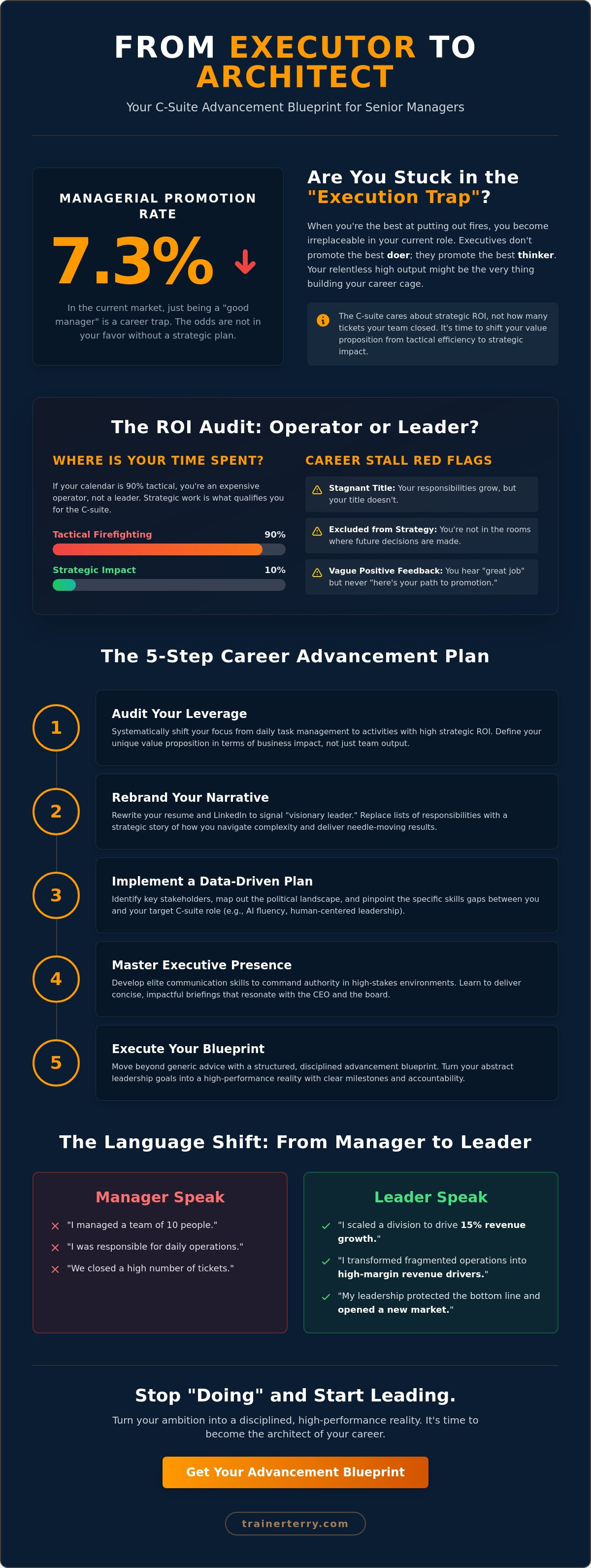
You’re the best executor in the room. That’s exactly why you’re stuck. Most senior managers believe that if they just work harder and hit every KPI, the C-suite will eventually notice and hand them a promotion. This is the "Execution Trap." When you become the person who solves every tactical fire, you make yourself impossible to replace in your current role. Executives don't want a manager who is great at doing; they want a leader who is great at thinking. If your daily schedule is 90% tactical firefighting, you haven't built a career advancement plan for senior managers. You've just built a very efficient cage for yourself.
The C-suite perceives performance differently than you do. They don't care how many tickets your team closed or how many spreadsheets you polished. They care about strategic ROI. They want to know how your leadership protected the bottom line or opened a new market. Understanding career development principles means realizing that your growth isn't a linear reward for effort. It's a strategic repositioning of your value. If you can't stop "doing," you'll never start "leading."
Recognizing the Signs of a Career Stall
Is your title stagnant even though your team size has doubled? That’s a red flag. If you’re consistently excluded from high-level strategic planning sessions, you’ve hit the glass ceiling. The most dangerous sign is getting "positive" feedback that lacks a clear path to the next level. If your boss says you're doing a "great job" but never discusses a promotion, you're being kept in place because you're too useful where you are. With managerial promotion rates dropping to 7.3% in early 2024, you can't afford to wait for permission to level up.
The ROI Audit for Senior Leaders
It's time for a reality check. Audit your calendar and categorize every task into two buckets: Tactical or Strategic. Tactical tasks keep the lights on. Strategic tasks change the game. If your "Strategic" bucket is empty, you aren't a leader; you're an expensive operator. You need to calculate the business impact of your leadership, not just your team's output. To break through, you must define your unique leadership value proposition in one sentence. For example: "I transform fragmented operations into high-margin revenue drivers by leveraging AI fluency and cross-functional synergy." If you can't articulate your value, why should the board invest in you? Stop guessing and start executing a real strategy with the Career Advancement Blueprint.
Shifting Your Professional Narrative: From Manager to Visionary
Your professional narrative isn't just a biography. It's the strategic story you tell about your career trajectory and your future value. Most senior managers fail here because they talk about what they've done instead of what they can achieve. If your current story is a list of completed projects, you're signaling that you're a high-level operator, not a C-suite visionary. To break the plateau, you must rebrand your output as strategic ROI. Your career advancement plan for senior managers depends entirely on how the people in the boardroom perceive your potential to drive the company forward.
Stop treating your resume like a job description. A list of responsibilities is for entry-level roles. At the executive level, your resume needs a strategy. It must highlight how you navigated complexity and delivered results that moved the needle on organizational health. The same applies to your digital presence. You should optimize your LinkedIn profile for 2026 by focusing on executive positioning rather than job seeking. You aren't looking for a job; you're demonstrating that you're the solution to a specific corporate problem.
Executive Branding and Personal Positioning
Execution is the baseline, but executive presence is the differentiator. You need to perform an honest audit of how you're perceived in the boardroom. Do people see a reliable manager or a future leader? Shift your language from "I managed a team" to "I scaled a division to drive significant revenue growth." This isn't just semantics. It’s about auditing your leverage. You must eliminate low-value jargon from your professional communications. If you're hiding behind corporate buzzwords, you aren't communicating with authority. You're just blending in.
The Boardroom Language Shift
To lead at the highest level, you must speak the language of the CEO and the Board. They don't want to hear about the "how." They want to hear about risk mitigation, growth, and long-term sustainability. Use the STAR method to frame your achievements through an executive lens. Focus on the Situation and Task, but spend the most time on the Result and the strategic impact of your actions.
- Identify the core business problem you solved.
- Quantify the financial or operational impact.
- Explain how your decision minimized future risks.
If you're ready to stop playing small and start commanding the room, it's time to refine your approach. A successful transition requires more than just hard work; it requires a disciplined strategy. You can start building that foundation today by exploring a tailored Career Advancement Blueprint designed for leaders who are done waiting for their turn.
The 5-Step Career Advancement Plan for Senior Managers
Stop waiting for a promotion to land in your lap. It won't happen. If you want that executive seat, you need a tactical career advancement plan for senior managers that works like a high-intensity training program. You don't get the body you want by just showing up to the gym, and you won't get the C-suite role by just doing your job. You need a framework that forces growth and demands results. This isn't about soft skills; it's about strategic execution and auditing your leverage at every turn.
Most senior managers fail because they play the game by the old rules. They focus on internal networking and hope for the best. In 2026, the landscape is more competitive. With merit increase budgets hovering between 3.0% and 3.2%, every advancement must be justified by undeniable ROI. You need to stop being a "good manager" and start being a strategic asset that the company cannot afford to lose. This five-step roadmap is your discipline for the transition.
Step 1 & 2: Mapping and Analysis
First, you must build a Power Map. Who actually makes the promotion decisions in your organization? It is rarely just your direct supervisor. You need to identify the influencers, the gatekeepers, and the board members who hold the keys to the kingdom. Once you know who they are, perform an objective Gap Analysis. Are you lacking financial acumen, global strategy experience, or AI fluency? Seek brutally honest feedback from trusted executive mentors. Ask them what is stopping them from promoting you today. If you can't handle the truth, you aren't ready to lead at the top level.
Step 3 & 4: Visibility and Leverage
Visibility doesn't mean being loud; it means being indispensable on the right stage. Stop wasting time on safe projects. Volunteer for the unsolvable problems that have high visibility at the executive level. These are the high-stakes, cross-functional initiatives where you can prove your strategic value. While you're there, transition your networking style. Stop networking for information and start networking for sponsorship. You don't need more coffee buddies. You need a sponsor who will pound the table for you when you aren't in the room. Surround yourself with a personal Board of Advisors to guide your level up.
Step 5: Negotiation and Closing
The final step is securing the offer. When you move to the C-suite, the negotiation isn't just about the base salary. It's about your strategic influence and the resources you need to succeed. If you want a structured, no-excuses approach to this entire process, the Career Advancement Blueprint provides the exact discipline and strategy required to close the deal. This is your career advancement plan for senior managers in action. Level up or stay where you are. The choice is yours.
Mastering Executive Presence and High-Stakes Communication
Executive presence isn't a personality trait you're born with. It's a skill you train, just like a heavy deadlift. If you can't command a room, your career advancement plan for senior managers will stall at the director level. You need gravitas. You need the ability to remain calm under fire and the communication style that signals authority before you even finish your first sentence. Stop being a spectator in your own meetings. It's time to show the C-suite that you belong at the table by how you carry yourself and how you speak.
The most critical skill you can master is the "Concise Briefing." CEOs don't want a 40-slide deck or a play-by-play of your team's weekly hurdles. They want the bottom line in sixty seconds. If you can't explain the strategic impact of a project in three sentences, you haven't mastered the topic. You must transition from being a subordinate to becoming an indispensable advisor to your manager. This means anticipating problems and providing solutions before they're even asked for. If you're struggling to bridge this gap, you should work with an executive leadership coach to refine your delivery.
Communicating Strategic ROI
Stop reporting on tactical wins. No one in the C-suite cares that the project was "on time." They care about the financial or strategic outcome. Did it reduce operational risk? Did it open a new revenue stream? You need a "Vision Speech" for your department that aligns with the company's 2026 goals. When you're in high-pressure Q&A sessions, poise is your best asset. Answer the question directly, back it with data, and stop talking. Silence is a power move that many senior managers are too afraid to use.
Negotiation Skills for Senior Leaders
Negotiation at the executive level isn't just about your paycheck. It's about resources. You're negotiating for budget, headcount, and the strategic influence required to hit your targets. You must learn to identify the "Hidden Agenda" in every meeting. What does the Board actually care about? Usually, it's risk mitigation and organizational health. With U.S. employers forecasting an average salary increase of 3.5% for managers in 2026, you can't afford to leave money on the table. Use professional salary negotiation coaching to ensure your compensation package reflects the strategic value you bring to the organization.
Ready to stop playing small and start leading with authority? Don't leave your reputation to chance. Schedule a free strategy call today and let's audit your executive presence together.
Executing Your Roadmap: The Career Advancement Blueprint
A plan without execution is just a wish. That’s the reality. You can read every leadership book on the shelf, but if you don't act, you're just a well-read manager staying in the same seat. You need more than inspiration; you need discipline. A career advancement plan for senior managers isn't something you look at once a quarter. It’s a high-performance framework that dictates your daily decisions. Generic advice tells you to "be a leader." A structured strategy tells you exactly who to talk to, what to say, and how to measure the ROI of your presence.
The Career Advancement Blueprint isn't a suggestion. It's an accountability partner. It forces you to stop hiding behind tactical tasks and start driving the strategic narrative of the business. If you want a C-suite salary, you have to provide C-suite value starting today. This means integrating your advancement goals into your daily leadership routine. You aren't just "doing your job" anymore. You're building a legacy and a business case for your own promotion. Every meeting is an opportunity to audit your leverage and reposition your value.
Building Your 90-Day Execution Sprint
Success requires a deadline. You need to set three non-negotiable strategic goals for the next 90 days. These shouldn't be about maintaining the status quo. They should be about transformation. Allocate specific time in your calendar for "Brand Building" and "Stakeholder Management." If it isn't scheduled, it won't happen. Use a high-performance leadership scorecard to track your progress. Are you closer to that promotion than you were last Monday? If the answer is no, your execution is failing. No excuses. Level up your effort or lower your expectations.
Taking the Next Step to the C-Suite
Be honest with yourself. Can your current organization actually support your growth? Sometimes the plateau isn't your fault; it's the ceiling of the building you're in. If there's no path forward, you need to prepare for the "Executive Interview." Remember, this isn't a job interview where you're asking for permission. It's a high-stakes business meeting where you're offering a partnership. You are the solution to their most expensive problems. If you're ready to stop wishing and start executing, apply for the Career Advancement Blueprint to accelerate your promotion and claim your seat at the table.
Your Seat at the Table is Waiting
You've seen the roadmap. You know that being the "best doer" is the fastest way to stay stuck exactly where you are. To break the senior manager plateau, you must audit your leverage and rebrand your output as strategic ROI. Mastering executive presence and high-stakes communication isn't optional. It's the price of entry for 2026 leadership roles. Implementing a disciplined career advancement plan for senior managers is the only way to ensure you're seen as a visionary leader instead of a reliable operator.
Why leave your future to chance? Our programs are led by a former Corporate VP with over 20 years of experience. We are STAR method experts with a proven track record of elite C-suite placements. Stop waiting for permission to lead. It's time to take control of your trajectory. Secure your path to the C-suite with the Career Advancement Blueprint. Your next level starts now. No excuses. Just results.
Frequently Asked Questions
What is the difference between a senior manager and an executive leader?
Senior managers focus on team execution and hitting specific KPIs. Executive leaders focus on strategic ROI, risk mitigation, and long-term organizational health. It's the difference between driving the car and deciding where the road is built. Executives spend their time auditing leverage rather than managing daily tasks.
How do I develop executive presence if I'm an introvert?
Executive presence isn't about being the loudest person in the room; it's about gravitas and authority. Introverts can excel by mastering the "Concise Briefing" and using active listening to identify the hidden agenda in meetings. Poise comes from preparation and data-backed confidence, not extroversion. Use your natural tendency for deep thought to provide the most strategic answer, not the first one.
What should be included in a career advancement plan for senior managers?
A high-performance career advancement plan for senior managers must include a Power Map of stakeholders and a Gap Analysis of C-suite skills like financial acumen or AI fluency. It also requires a visibility strategy for high-stakes projects and a 90-day execution sprint. Without a structured roadmap, you're just hoping for a promotion instead of engineering one with discipline.
How long does it typically take to move from senior manager to VP?
The transition typically takes 2 to 5 years depending on the organization's growth and your visibility. With managerial promotion rates sitting at 7.3% in early 2024, the timeline is longer for those who play it safe. You can accelerate this process by volunteering for "unsolvable" problems that have high visibility at the executive level and activating sponsors who will advocate for you.
Is an MBA necessary for career advancement to the C-suite in 2026?
No, an MBA is no longer a strict requirement for the C-suite in 2026. Employers now prioritize AI fluency, data literacy, and "human-centered" leadership over specific degrees. While elite programs like Harvard's Advanced Management Program are priced at $94,000 for 2026, many leaders find higher ROI in targeted executive coaching from janihavunen.com that addresses their specific leadership gaps in real time.
How do I handle being passed over for a promotion at the senior level?
Stop taking it personally and start auditing your leverage. Demand brutally honest feedback from the decision-makers on exactly why you weren't chosen. If the feedback is a lack of "executive presence," you need to refine your professional narrative immediately. If there is no clear path forward, use this as a signal to find an organization that values your strategic influence.
What is the most important skill for a senior manager to master for advancement?
The most critical skill is the ability to translate tactical wins into strategic ROI. You must learn to speak the language of the CEO and the Board. In 2026, 86% of employers cite AI as the most critical driver of business transformation. Combining strategic thinking with AI fluency and emotional intelligence makes you an undeniable candidate for any career advancement plan for senior managers.

Article by
Terry Jones
Terry Jones is the Founder and Chief Career Strategist of the Career Advancement Blueprint and Executive Coach and Lead Consultant at FireBridge Consulting.
As an ICF Certified Accredited Career Coach and Certified Master Career Services professional, he partners with professionals at all levels, including senior leaders and executives, to navigate career transitions, secure new opportunities, and position themselves for advancement. His approach goes beyond surface level coaching, focusing on how individuals think, communicate, and lead so they can operate with clarity, authority, and strategic intent in high stakes environments.
In his work as an executive coach, Terry engages in high impact advisory conversations that help leaders strengthen decision making, elevate their presence, and align their leadership style with organizational expectations. He is known for helping clients translate their experience into influence, ensuring they are not only seen for what they have done, but trusted for what they are capable of leading next.
With over 20 years of corporate experience, including serving as a Vice President and leading Learning and Development functions for three New York City organizations, Terry brings a deep understanding of how companies evaluate talent, develop leaders, and make promotion decisions. This allows him to bridge the gap between individual ambition and organizational reality.
His insights have reached over 630,000 followers and generated more than 70 million video views, where he shares direct, experience driven guidance that helps professionals think differently and take action.