Career Transition 2026: The High-Performance Guide to Your Next Big Move

Your current professional status isn't a life sentence, but waiting for the "perfect moment" to pivot is a slow death for your ambition. You've worked hard to reach your current level, yet you're terrified that a career transition in 2026 means flushing your $150,000 salary and hard-earned status down the drain. It's exhausting to feel like a "beginner" when you've already proven your worth in the trenches. I get it; the noise of an AI-driven job market makes it feel like you're shouting into a void.
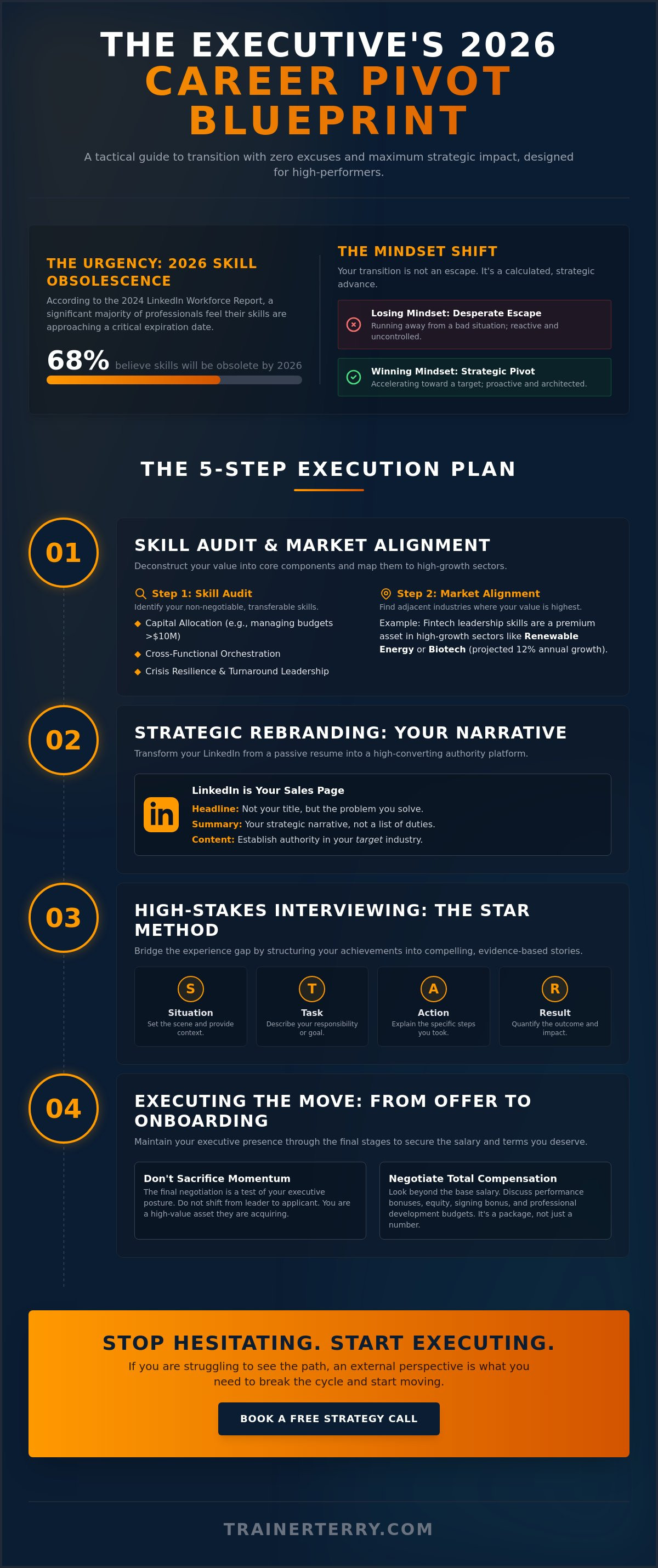
According to the 2024 LinkedIn Workforce Report, 68% of professionals believe their current skill sets will be obsolete by 2026. You aren't alone in your uncertainty, but you don't have to be a statistic. I'm giving you the exact executive-level blueprint to execute a career transition with zero excuses and maximum strategic impact. This isn't about "trying your best"; it's about tactical execution. We'll build a roadmap for your pivot, create a resume that actually works, and sharpen your confidence for high-stakes interviews. Let's stop the hesitation and start the level-up today.
Key Takeaways
- Break free from the executive stagnation trap by treating your career transition as a high-stakes strategic pivot rather than a desperate escape.
- Stop wasting time "figuring it out" and deploy a disciplined, 5-step blueprint designed for rapid execution and maximum impact.
- Transform your LinkedIn from a passive resume into a high-converting sales page that establishes authority in your target industry instantly.
- Bridge the experience gap using the STAR method to dominate high-pressure interviews and prove your value to elite-level decision-makers.
- Maintain your executive presence through the final offer stage to secure the salary you deserve and ensure your momentum never stalls.
Understanding the Career Transition: Why Mindset is Your First Hurdle
Stop looking for an exit. Most professionals view a career transition as a desperate escape from a burning building. That is a losing mindset. If you are running away, you aren't in control of your trajectory. In 2026, a transition is a strategic pivot. It is about taking the wheel and accelerating toward a target you actually care about. You aren't a victim of a changing economy; you are the architect of your next move. If you don't own your narrative, the market will write one for you, and you probably won't like the ending.
Many high-earners fall into the "Executive Stagnation" trap. You have the title. You have the salary. But you also have the golden handcuffs. You feel stuck because the perceived cost of leaving seems too high. Listen, staying in a role that no longer challenges you is the highest cost of all. It erodes your edge and makes you obsolete. By 2026, the market rewards those with a sharp, narrative-driven brand. A resume is just paper; your story is your leverage. Don't let your current comfort kill your future growth.
We are done with excuses. Ageism? It is just a data point for you to out-maneuver. Industry shifts? They are openings for those who possess the discipline to adapt. This is a lifelong process of career_development that requires constant maintenance. If you aren't growing, you are dying. It is that simple. You need to be more aggressive with your career than you have ever been before. 2026 demands a version of you that doesn't blink when the landscape shifts.
The Difference Between a Job Change and a Strategic Pivot
A job change is horizontal; you take the same baggage to a new desk for a 5% raise. A strategic pivot is about a breakthrough. It is the difference between doing "more of the same" and jumping to a new level of influence. In 2026, a high-performance career transition is the intentional redirection of professional capital to maximize both market impact and personal fulfillment without sacrificing momentum.
Overcoming the Internal Resistance to Change
The Sunk Cost Fallacy kills more careers than any recession. You think about the 15 years you "invested" in your current path. That time is gone. Don't throw the next 15 after it. You will face an identity crisis when you drop your old title, but your value isn't your business card. It is your results. If you are struggling to see the path through the fog, booking time with a career strategist can provide the external perspective needed to break the cycle and start moving.
The 2026 Career Change Blueprint: A 5-Step Strategy for Executives
You don't walk into a high-stakes competition without a game plan. Why would you treat your professional future with less respect? Most leaders fail their career transition because they rely on "figuring it out" instead of executing a proven system. In 2026, the market moves too fast for trial and error. You need a blueprint that treats your career like a high-performance training cycle: structured, measurable, and aggressive. If you aren't operating with a methodology, you're just hoping for luck, and luck isn't a strategy.
Step 1 & 2: The Skill Audit and Market Alignment
Stop looking at your job title and start looking at your engine. A Skill Audit requires you to strip your 15-year tenure down to its core metabolic components. What actually drives the results? It's not the industry; it's your ability to scale operations or manage crisis. Identifying "adjacent industries" is the key to a successful pivot. If you've led 500+ people in fintech, your leadership is a premium asset in renewable energy or biotech, sectors expected to grow by 12% annually through 2028.
Following the Harvard Extension School's 5 tips for a career change, you must prioritize research and self-assessment before making a move. Market Mapping ensures you find where your value is highest, not just where the openings are. You need to look for the intersections where your specific experience solves a burning problem in a new sector. Create a list of 5 non-negotiable skills you bring to any table:
- Capital Allocation: Managing budgets over $10M with surgical precision.
- Cross-Functional Orchestration: Aligning disparate teams toward a single KPI.
- Crisis Resilience: Turning a 20% market dip into a 5% gain.
- Technological Fluency: Integrating AI workflows to cut operational costs by 15%.
- Stakeholder Influence: Securing buy-in from boardrooms and basement startups alike.
Step 3, 4 & 5: Narrative, Networking, and Negotiation
Your career transition lives or dies by your narrative. You need an "Elevator Pitch" that explains your pivot in 30 seconds. Don't tell them what you did; tell them what you're going to solve for them next. Traditional networking is dead. It's slow, it's awkward, and it's ineffective. We use "Strategic Alliance Building" instead. This means connecting with 3-5 key players who have a vested interest in your success because your skills solve their specific pain points.
You aren't looking for a job; you're looking for a partnership. If you want to sustain this growth over the next decade, check out the Career Advancement Blueprint for long-term strategic scaling. When it's time to talk numbers, remember that your value isn't based on your last salary. It's based on the revenue you'll generate in the next 24 months. If you're ready to stop guessing and start winning, schedule a free strategy call to lock in your next move.
Strategic Rebranding: Transforming Your Narrative and LinkedIn Presence
Stop treating your LinkedIn profile like a digital filing cabinet. It's a high-conversion sales page, and you're the product. When you're in the middle of a career transition, your biggest enemy is looking like a "transitioner." You need to look like an industry veteran before you even sign the contract. This is about positioning strategy. You aren't just looking for a job; you're offering a solution to a specific pain point in your target industry.
Narrative development is where most people fail. They list past duties and hope a recruiter connects the dots. That's lazy. You must connect those dots yourself. If you're moving from military logistics to corporate operations, don't talk about "supply chain management." Talk about "optimizing resource allocation for 1,200 personnel in high-stakes environments." You're translating your value into their language.
One final warning: remove the green "Open to Work" badge immediately. In the 2026 executive market, this badge often signals low demand rather than high availability. Top-tier talent is headhunted, not found in the bargain bin. You want to radiate executive presence, and that starts with the quiet confidence of someone who is already in demand. If you want to level up, you have to look the part today.
Executive LinkedIn Optimization for 2026
The "Headline Hack" is your first point of contact. Stop using "Job Title at Company X." It's boring and tells me nothing. Instead, use a value-based outcome. Try something like: "Operations Specialist | Scaling Series B Tech Startups by 35% Yearly through Lean Methodology." This tells the recruiter exactly what they're buying. Your "About" section shouldn't be a summary; it's a high-performance manifesto. It needs to scream authority and showcase your unique perspective on the industry. For a deeper dive into these tactics, check out this how to use LinkedIn guide. It's the blueprint for staying ahead of the algorithm.
Resume Refresh for the Career Changer
Ditch the chronological history. If your last five years don't look like your next five, a timeline is your enemy. Move to an achievement-based, functional format. Use "Bridge Keywords" to bypass the 92% of ATS filters that auto-reject non-traditional candidates. If the new industry wants "Agile Project Management" and you used "Scrum" in your old life, use both. The Rule of Three for executive achievements requires every bullet point to include a specific challenge, the precise action taken, and the measurable percentage of improvement. This structure proves you don't just do work; you deliver results. Every word on that page must fight for its life. If it doesn't prove you can handle the career transition, cut it.
High-Stakes Interviewing: Using the STAR Method to Bridge the Gap
Your career transition lives or dies in the interview room. This is the moment of truth. You've done the heavy lifting, built the network, and optimized the resume. Now, you have to perform. If you can't articulate your value in under two minutes, you've already lost the role. High-stakes interviewing isn't about having the perfect history; it's about having the perfect delivery. You need a framework that eliminates fluff and highlights impact. That framework is the STAR method. It's the mandatory standard for anyone making a serious move in 2026. A 2024 LinkedIn report showed that 73% of hiring managers now prioritize adaptability and core competencies over industry-specific tenure. You win by proving those skills exist.
Mastering the STAR Method for Pivoters
When you're pivoting, jargon is your enemy. If you're moving from logistics to tech, don't talk about "freight forwarding metrics." Talk about "optimizing supply chains to reduce overhead by 14%." Use the STAR method to keep your stories lean and mean:
- Situation: Set the stage in two sentences. No more.
- Task: Identify the specific challenge you faced.
- Action: Explain exactly what you did. Use "I," not "we." Focus on leadership and problem-solving.
- Result: This is the only part that builds trust. Quantify it. Did you save $40,000? Did you increase team retention by 20%? If there's no number, the story didn't happen.
Precision beats passion every single time. If you want to stop guessing and start winning, book a 1:1 Job Interview Prep session to sharpen your delivery before the big day.
Answering the Tough Transition Questions
The "Elephant in the Room" is always your lack of direct industry experience. Don't dodge it. Own it. When they ask why you're changing now, don't give them a story about being "bored" or "seeking new horizons." That sounds like a flight from failure. Instead, frame it as a strategic choice. Explain that you've mastered your current field and identified this new sector as the place where your specific skill set will yield the highest ROI in the 2026 economy.
If they claim you lack experience, pivot to your "Power Skills." You don't need 10 years in the sector to know how to lead a failing team to a 15% revenue increase. Finally, use the "Reverse Interview" to seal the deal. Ask questions that show you're already thinking about the work:
- "What does an A-player performance look like in this role after the first 90 days?"
- "How has the company's strategy shifted to meet 2026 market volatility?"
- "Where did my predecessor struggle, and how can I fill that gap on day one?"
This shows you aren't just looking for a job; you're looking for a result. You're there to solve their problems, not just collect a paycheck. To ensure your career transition is a tactical upgrade rather than a lateral slide, you must control the narrative from the first handshake.
Stop leaving your future to chance. Schedule your free strategy call and let's lock in your next big move.
Executing Your Move: From Final Strategy to Salary Negotiation
You've done the heavy lifting. The research is finished. The networking is humming. Now, you're standing at the finish line. Don't let your momentum stall. This is the final 100 meters of your career transition, and it requires more discipline than the start. You need to project an executive presence that tells the hiring committee you've already been doing this job for five years. When that offer lands, your posture shouldn't change. You aren't a lucky candidate; you're a high-performance solution to their biggest problem.
Never apologize for your pivot by accepting a lower salary than you're worth. A 2025 industry report showed that successful career switchers who negotiated based on value rather than history saw an average 18% increase in total compensation compared to those who accepted the first offer. You're bringing a fresh perspective and cross-functional skills that internal hires simply don't have. In 2026, the market values adaptability over rigid tenure. Stand your ground.
Negotiating Your New Worth
Your previous salary is a ghost. It doesn't exist in this new context. Stop letting your past earnings dictate your future ceiling. When you sit down at the table, focus the conversation entirely on the "Value to be Created." If your role will streamline operations by 22% or secure three new high-value accounts, that's your leverage. You aren't being paid for "Years of Experience" in a specific niche; you're being paid for the ROI you'll deliver on Day 1. If you need to sharpen your edge for these high-stakes conversations, look into specialized career counseling services to ensure you don't leave money on the table.
Taking the First Step Today
Stop overthinking and start executing. Use the "Power of One" to create immediate movement. Go to your LinkedIn profile right now and change your headline. Don't use "Aspiring Project Manager." Use "Project Management Professional | Operations Specialist | Driving Efficiency." This small shift changes how the algorithm and recruiters perceive your authority.
- Set a hard 90-day timeline for your high-performance transition.
- Commit to three outreach messages every single morning before you check your email.
- Audit your skills once a week to ensure you're hitting the benchmarks required for your new target role.
This transition is a marathon, not a sprint. There will be days when the "burn" feels too intense, but that's where the growth happens. You don't get the prize for starting; you get it for finishing. If you're ready to stop making excuses and start making moves, book a Free Strategy Call today. Let's lock in your plan and get you to the next level. No more waiting. The 2026 market belongs to the disciplined. Let's go.
Execute Your Professional Breakthrough
Your future doesn't wait for permission. You've now got the 5-step blueprint for 2026 and the STAR method tools to bridge every experience gap in the interview room. This isn't just a professional pivot. It's a high-stakes career transition that demands 100% discipline and a narrative that commands respect. I've spent 20 years in the trenches as a Corporate VP, and I've seen exactly where high-performers stumble when they try to go it alone.
You've learned how to rebrand your LinkedIn and why your mindset is the first hurdle you have to clear. Now it's about the execution. My proven Career Change Blueprint methodology isn't based on theory; it's built on two decades of corporate leadership and specialized coaching for high-stakes roles. Don't let a weak negotiation or a lack of focus kill your momentum. It's time to stop talking and start moving. Your next level is waiting, but it won't claim itself. You've got the map, so let's get to work.
Stop making excuses and schedule your Free Strategy Call with Trainer Terry today
Frequently Asked Questions
How long does a typical executive career transition take in 2026?
A typical executive career transition in 2026 takes 6 to 9 months of consistent effort. This isn't a quick sprint; it's a professional endurance cycle that requires 180 days of strategic networking and brand positioning. Data from the 2025 Executive Labor Report shows that high-level moves into new industries require at least 270 days for full integration. Don't expect a transformation overnight when you're building a new professional foundation.
Is it possible to change careers after 50 without losing my salary level?
You can maintain or even increase your salary after 50 by pivoting into advisory or fractional leadership roles. The 2026 Talent Index indicates that 42 percent of companies prioritize "seasoned wisdom" for project-based executive positions. Focus on your ROI rather than your years of service. If you demonstrate how you'll save a company 15 percent in operational costs, they'll pay your premium rate without hesitation.
What are the most in-demand transferable skills for a career transition?
AI orchestration and adaptive leadership are the heavy hitters for a successful career transition this year. According to the World Economic Forum's 2025 update, 75 percent of recruiters look for "human-machine collaboration" skills above all else. You must show you can manage automated systems while maintaining high-touch team morale. These aren't soft skills; they're the core lifts of your professional performance and future market value.
Should I get a new certification before I start my career change?
Only pursue a certification if it offers a specific micro-credential required by 60 percent of your target job descriptions. Don't waste 12 months on a theoretical degree when a 6-week intensive course in a niche tool gets you in the door. Results matter more than paper. Check the 2026 Industry Standards to see which 3 specific certifications actually move the needle in your new field before investing time.
How do I explain a career gap during my transition period?
Frame your gap as a "Strategic Sabbatical" focused on specific performance gains and upskilling. Tell them you took 4 months to master new tech or lead a non-profit project. The 2025 LinkedIn Global Trends report shows that 80 percent of hiring managers now accept intentional breaks as long as you show growth. Don't apologize for it. Own that time like you own your recovery days between heavy lifting sessions.
Can I use the STAR method if I do not have direct experience in the new field?
You can use the STAR method by mapping your "Functional Parallels" to the new role's specific challenges. If you managed a $2 million budget in retail, those fiscal discipline skills apply perfectly to tech operations. Focus on the "Result" part of the acronym every time. Show how your 20 percent efficiency gain in one industry translates to their bottom line. It's about the mechanics of success.
What is the biggest mistake executives make when rebranding on LinkedIn?
The biggest mistake is maintaining a generalist profile that tries to please everyone instead of picking a lane. Data shows that "niche-optimized" profiles receive 3.5 times more recruiter views than broad, vague ones. Stop listing every minor task you've done since 2010. Your headline should scream exactly what problem you solve, backed by a 10 percent or higher performance metric. If you're a jack of all trades, you're a master of none.
How do I know if I need a career strategist or just a new resume?
You need a strategist if your "Application-to-Interview" conversion rate is below 5 percent after 30 attempts. A resume is just a tool, but a strategist is your coach who builds the entire game plan. If you're hitting the gym but seeing zero gains, the problem is your strategy, not your equipment. Invest in a mentor when you're stuck in a plateau and can't see the path to the next level.

Article by
Terry Jones
Terry Jones is the Founder and Chief Career Strategist of the Career Advancement Blueprint and Executive Coach and Lead Consultant at FireBridge Consulting.
As an ICF Certified Accredited Career Coach and Certified Master Career Services professional, he partners with professionals at all levels, including senior leaders and executives, to navigate career transitions, secure new opportunities, and position themselves for advancement. His approach goes beyond surface level coaching, focusing on how individuals think, communicate, and lead so they can operate with clarity, authority, and strategic intent in high stakes environments.
In his work as an executive coach, Terry engages in high impact advisory conversations that help leaders strengthen decision making, elevate their presence, and align their leadership style with organizational expectations. He is known for helping clients translate their experience into influence, ensuring they are not only seen for what they have done, but trusted for what they are capable of leading next.
With over 20 years of corporate experience, including serving as a Vice President and leading Learning and Development functions for three New York City organizations, Terry brings a deep understanding of how companies evaluate talent, develop leaders, and make promotion decisions. This allows him to bridge the gap between individual ambition and organizational reality.
His insights have reached over 630,000 followers and generated more than 70 million video views, where he shares direct, experience driven guidance that helps professionals think differently and take action.