C-Suite Interview Questions and Answers 2026: The Strategic Executive Playbook

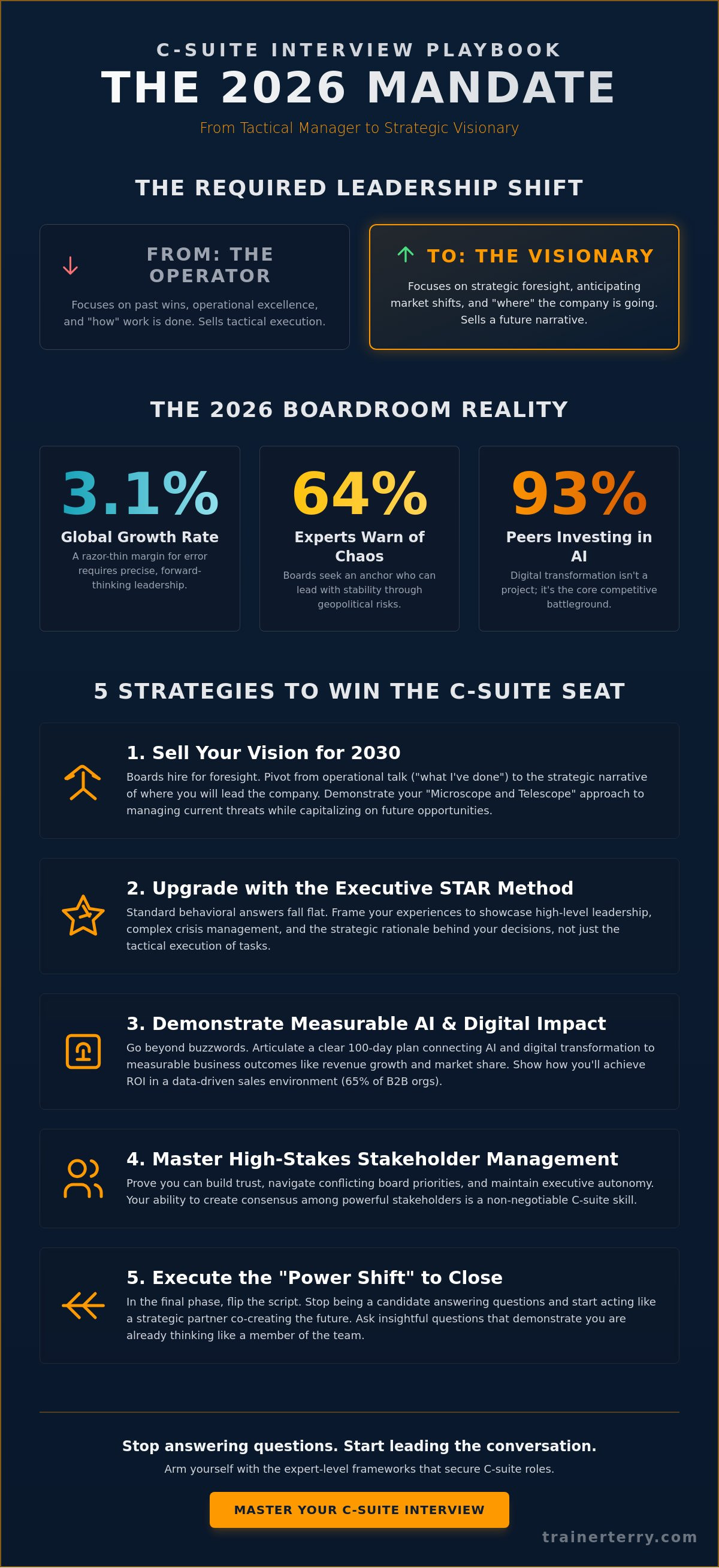
What if the board isn't looking for a high-performing manager, but a visionary who can lead through a 3.1% global growth rate while 64% of experts warn of geopolitical chaos? You've likely felt the pressure to prove your worth through tactical wins. That's exactly what keeps you stuck in the "doer" category. To win the seat, you must master c-suite interview questions and answers 2026 by shifting your focus from what you've done to the strategic narrative you'll build.
It's frustrating to feel like your deep expertise is being overlooked because you haven't yet cracked the code of board-level communication. I understand that anxiety. This playbook promises to arm you with expert-level frameworks and 2026-specific leadership insights that transform your interview performance. We'll explore how to handle AI-driven leadership requirements, build immediate trust with the board, and position yourself for a superior salary package. It's time to stop simply answering questions and start leading the conversation with the confidence of a true executive partner.
Key Takeaways
- Stop selling your past and start selling your vision for 2030. You'll learn to pivot from operational talk to the strategic foresight boards demand.
- Upgrade your behavioral answers with the Executive STAR method. It's designed to showcase high-level leadership and crisis management rather than just tactical execution.
- Prepare for the specific c-suite interview questions and answers 2026 regarding AI and digital transformation. You need to show measurable business impact, not just tech awareness.
- Master the art of board relations by learning how to navigate conflicting stakeholder priorities while maintaining your executive autonomy.
- Flip the script during the closing phase. Use the "Power Shift" strategy to move from being a candidate to a strategic partner who's ready on day one.
The 2026 C-Suite Landscape: Why the Interview has Changed
The rules of the executive suite have been rewritten. If you're walking into a boardroom expecting to talk about "operational excellence" or "process optimization," you're already behind the curve. In 2026, boards aren't hiring for what you can manage; they're hiring for what you can foresee. With global economic growth projected at 3.1%, the margin for error is razor-thin. Leaders are now evaluated on their Strategic Foresight, the ability to anticipate market shifts before they appear on a balance sheet. You need to prove you're more than a safe pair of hands.
Success in this environment requires a deep understanding of the evolving C-Suite Landscape. Board members are looking past your resume. They want to see Executive Presence. This isn't about charisma; it's about the weight you carry in a room and your ability to anchor a team when geopolitical risks become reality. You aren't just a title. You're a human-centric anchor in a world saturated by AI. While 30% of CEOs report revenue gains from AI, the real winners are those who use technology to empower their people, not just automate them. ESG and sustainable growth are no longer optional "side projects"; they're the core metrics by which your leadership will be judged.
From Tactical Operator to Strategic Visionary
Stop talking about "how" you work and start showing how you think. The Board doesn't care about your daily checklist. They care about your mental framework for 2026 challenges like core PCE inflation and regionalized supply chains. You must demonstrate the "Microscope and Telescope" approach: managing immediate threats while scanning the horizon for long-term growth. When preparing your c-suite interview questions and answers 2026, focus on narratives that prove you can scale sustainable growth without sacrificing long-term stability. It's about vision, not just execution. If you can't articulate where the industry is going, you won't be the one leading the company there.
The Rise of the Fractional and Hybrid C-Suite
The corporate structure is no longer a rigid pyramid. We're seeing a massive shift toward fractional roles and decentralized leadership. You might be leading a team that spans four continents and three time zones. Can you maintain culture in a hybrid world? Boards are looking for leaders who are adaptable and can integrate IT strategy across every department. If you want to master this transition, our high-level interview strategy helps you position yourself as the agile leader these modern organizations demand. You must prove you can lead a global, decentralized workforce with the same intensity and discipline as a traditional in-person office. The flexibility of 2026 requires a leader who is both firm in their goals and fluid in their execution.
Strategic Vision and Digital Transformation Questions
"How would you position this company for success in the next 5 years?" This is the ultimate test of your strategic foresight. In 2026, a vague answer about growth or efficiency will end your candidacy. You're operating in an economy where 65% of B2B sales organizations have moved to data-driven strategies. Your answer must reflect that shift. You've got to balance the 3.1% global growth reality with the fact that 93% of your peers are pouring capital into AI and cybersecurity. Boards aren't looking for a cheerleader; they're looking for a pilot who can fly through a storm.
Winning the seat means proving you can integrate AI into the core business strategy without bankrupting the culture. It's about finding the ROI in a volatile market. Don't just talk about innovation. Talk about how you'll measure it. Use our Career Advancement Blueprint to refine your 100-day execution plan before you even step into the room. You need to show that you understand the "Microscope and Telescope" CEO model, managing 2.7% inflation while identifying long-term digital opportunities.
Articulating a 2026-Ready Strategic Roadmap
Your 100-day plan is your proof of concept. Boards want to see how you synthesize market data into a narrative that moves people. You aren't just fighting traditional rivals anymore. You're fighting non-traditional digital disruptors who move faster than legacy systems. Your roadmap needs to address these threats head-on. Show them you've analyzed the regionalization of supply chains and the core PCE inflation trends. A 2026-ready leader doesn't wait for certainty. They build a framework that thrives on ambiguity and focuses on measurable business impact.
Leading through the AI Revolution
When the board asks about tech-stack optimization, they're really asking if you can handle workforce displacement. This is where the 84% of CxOs focusing on employee well-being comes in. You need a Digital-First mindset that remains Human-First. Tell them about a time you led a digital pivot. Perhaps you transitioned a legacy firm to AI-driven predictive maintenance. You didn't just buy software; you upskilled the team. This proves you can capture the 30% revenue increase AI offers while keeping your talent engaged. Mastering c-suite interview questions and answers 2026 means showing you can scale tech while protecting your most valuable asset: your people.
Mastering Behavioral Questions with the Executive STAR Method
Standard behavioral interview techniques are for middle management. They don't cut it when you're vying for a seat at the top table. To excel at c-suite interview questions and answers 2026, you need to abandon the basic "I did this" narrative. Boards aren't looking for a hero. They're looking for a systemic architect. When they ask, "Tell us about a time you led through a major crisis," they're testing your ability to maintain composure while the 64% geopolitical risk factor hits the fan. You must demonstrate how you leveraged resources and people to protect the organization's core value.
The standard framework needs an upgrade. You aren't just solving a problem; you're shifting the entire trajectory of the business. This requires a level of professional humility and strategic distance that most candidates lack. If you want to refine this approach, our high-level interview strategy provides the direct feedback you need to strip away tactical fluff. You've got to speak the language of the board, which is the language of impact and accountability.
The Executive STAR Framework
The Situation must be high-stakes. Don't talk about a missed deadline. Talk about a market collapse or a hostile takeover attempt. Your Task is the strategic imperative. It's the "why" behind the move. For the Action, stop saying "I." Focus on how you delegated, how you empowered your VPs, and how you made the hard pivots that others were afraid to make. Finally, the Result must be massive. Quantify it. Did you protect EBITDA during a 2.7% inflation spike? Did you gain 5% market share while competitors were retreating? This is how you prove you're ready for the seat.
Culture and Team Building in 2026
In 2026, culture is a performance metric. With 84% of CxOs stating their primary obligation is employee well-being, the board will grill you on how you foster innovation in a hybrid world. You need to prove you aren't just a manager, but a cultural steward. Use the STAR method to highlight specific instances where your leadership style directly improved retention or engagement. Show them how you build high-performance teams that thrive without constant oversight. Your ability to drive results through others, rather than through personal effort, is what separates an executive from a director. Don't just tell them you're a leader. Show them the wake of success you've left behind.
Board Relations and High-Stakes Stakeholder Management
Boards in 2026 are under immense pressure. They're navigating a 4.5% unemployment rate and 2.7% PCE inflation while trying to hit aggressive growth targets. When they ask how you handle a Board of Directors with conflicting priorities, they're testing your ability to mediate between a risk-averse CFO and a growth-hungry Chairman. You aren't there to pick a side. You're there to synthesize their goals into a single, executable strategy. Mastering c-suite interview questions and answers 2026 means showing you can manage near-term threats while identifying long-term opportunities without breaking the trust of your directors.
Trust is the currency of the boardroom. During the interview, you must move from a candidate mindset to an advisor mindset. Positioning yourself as a resource means you're already doing the job before you've even signed the contract. You've got to navigate the delicate line between transparency and executive autonomy. If you share too much detail, you look indecisive. If you share too little, you look like a liability. Focus on communicating complex risks, like the 64% geopolitical threat identified by INSEAD faculty, without causing panic. Boards in 2026 need to know you can handle the microscope and the telescope simultaneously. It's about being the calmest person in the room when the market data looks grim.
Managing the Board of Directors
Building trust starts with how you handle friction. Don't avoid the "conflicting priorities" question. Lean into it. Explain your framework for alignment. You need to show that you can listen to divergent views and still drive a firm decision. This isn't about consensus; it's about clarity. Use the interview to demonstrate that you can communicate risks to investors without triggering a sell-off. You're not just an employee of the board. You're their most vital strategic partner.
Stakeholder Diplomacy and ESG
Stakeholder diplomacy is about more than just managing the board; it's about aligning corporate goals with social responsibility. ESG is now a central part of business strategy, not a separate department. Boards will ask how you align climate initiatives with economic growth. Your answer needs to be data-driven and practical. Show them how you've used sustainability to drive efficiency or open new markets. This is where your ability to manage external stakeholders and investors comes into play. They need to know you can defend the brand's reputation during a crisis. If your communication style feels too tactical, you'll lose them. See our Career Advancement Blueprint for leadership communication strategies that actually resonate at the board level. You need to prove you can lead through a volatile 2026 economy where 93% of leaders are increasing tech investments to stay competitive.
Establishing credibility with external stakeholders requires a blend of transparency and firm direction. Investors in 2026 are looking for resilience. They want to see that you've thought about the regionalization of supply chains and the 2.2% U.S. economic growth projection. Don't wait for them to ask. Proactively address these factors in your narrative. This shows you're not just reacting to the market; you're anticipating it. Your executive presence is defined by this level of preparation and your ability to lead through the unknown.
Ready to command the boardroom and secure your seat at the table? Schedule a free strategy call to align your narrative with board-level expectations.
Closing the Deal: Questions You Must Ask and Final Strategy
The final ten minutes of the meeting are where you solidify your authority. You've spent the last hour responding to c-suite interview questions and answers 2026. Now, it's your turn to lead. This is the "Power Shift." It's the moment you transition from being a candidate to becoming a strategic partner. If you walk out without asking the right questions, you've left your executive presence at the door. Boards want to see that you're already thinking about "Day 1" and beyond. They aren't just looking for an employee; they're looking for an owner.
By the time the board finishes their c-suite interview questions and answers 2026, you should have a clear picture of their pain points. Use this knowledge to reverse the dynamic. Ask the questions that no one else is brave enough to ask. This demonstrates that you're vetting them as much as they are vetting you. It shows you're committed to a partnership that actually works, not just a paycheck.
Reversing the Interview
- Ask: "What does success look like for this role in 18 months?" This question forces the directors to align on their own expectations. It also gives you the exact metrics you'll be judged on.
- Ask: "What is the Board’s biggest hesitation regarding the company’s current trajectory?" This shows professional humility and a willingness to tackle the hard truths. It signals that you're ready to be the anchor during market volatility.
- Ask: "How does the C-suite currently collaborate on cross-functional AI initiatives?" This proves you aren't just tech-aware; you're tech-integrated. It references the digital-first mindset we discussed earlier.
Strategic Negotiation for the C-Suite
When the conversation turns to compensation, remember that you're negotiating an investment, not a cost. The 2026 executive landscape favors those who bet on themselves. Equity and performance-based bonuses are the standard for high-level roles. Don't anchor the discussion to your previous salary. That's a tactical mistake. Instead, anchor it to the future revenue you'll secure or the cultural transformation you'll lead. Use our 1:1 Job Interview Prep to refine your narrative and ensure your value is undeniable. You need to prove that your package is a small price to pay for the strategic foresight you bring to the table.
Winning the C-suite seat requires more than just good answers. It requires a disciplined, results-oriented mindset that starts long before you enter the room. Your next move shouldn't be a guess. It should be a calculated strategy. Set the stage for your success by booking a strategy call today. We'll strip away the tactical noise and focus on the high-stakes frameworks that actually get you hired. Let's make sure you don't just get an offer, but the right offer.
Command Your Future in the C-Suite
The era of the tactical manager is over. You're now equipped to lead with strategic foresight and navigate the complex 2026 landscape. We've explored how to shift from "doer" to "visionary" and how to use the Executive STAR method to prove systemic impact. Mastering c-suite interview questions and answers 2026 is the final hurdle between your current role and the seat you've earned. It's time to stop answering like a candidate and start leading like a partner.
I've spent over 20 years in the corporate world, including time as a Corporate VP. I know exactly what boards are looking for because I've been on both sides of the table. My specialized approach to high-stakes leadership narratives has led to a 98% client success rate in securing executive promotions. You have the experience; now you need the strategy to communicate it. Don't leave your career to chance. Secure your C-suite seat with Trainer Terry's 1:1 Executive Interview Strategy. Your transformation starts now. Let's get to work.
Frequently Asked Questions
What is the most important C-suite interview question in 2026?
The most critical question is "How will you drive sustainable growth while navigating global volatility and AI integration?" Boards need to see your strategic foresight in action. You must show you can handle the "Microscope and Telescope" approach, managing immediate 2.7% inflation threats while spotting long-term digital opportunities. Your c-suite interview questions and answers 2026 must prove you're a visionary architect of the company's future, not just a manager.
How do I demonstrate executive presence during a virtual C-suite interview?
You demonstrate executive presence virtually by mastering your digital environment and maintaining high-intensity engagement. Invest in a professional 4K camera and studio-quality lighting to signal you take the digital-first world seriously. Maintain eye contact with the lens, not the screen, to build a direct connection with board members. Your energy needs to be 10% higher than in person to overcome the digital barrier and show you can lead decentralized teams.
What should I wear to a C-suite interview in a hybrid work world?
Wear "Power Professional" attire that reflects the company's specific culture while maintaining executive authority. In a hybrid world, a tailored blazer or suit jacket remains the gold standard for C-suite interviews, even if the office is casual. It signals discipline and respect for the high-stakes nature of the role. Don't overdress to the point of looking out of touch, but always aim one level above the current team's daily look.
How long should my answers be in an executive-level interview?
Aim for high-impact answers that last between two and three minutes. Executives must be concise; if you can't explain a complex strategy in three minutes, you've lost the board's attention. Use the first 30 seconds to state your thesis, the middle section for the Executive STAR framework, and the final 30 seconds for the measurable result. Brevity is a sign of confidence and mental clarity at the top level.
How do I handle questions about a past business failure at the executive level?
Handle failure by taking full radical accountability and highlighting the systemic improvements you implemented afterward. Don't make excuses or blame market conditions. Instead, explain the specific pivot you made to protect the organization's core value. Boards value leaders who have been "punched in the face" and survived. It proves you have the resilience to manage the 64% geopolitical risk threats facing modern business today.
What are the top leadership traits boards are looking for in 2026?
Boards in 2026 are looking for human-centric digital leadership, strategic foresight, and extreme adaptability. You must prove you can scale AI-driven revenue while maintaining an 84% focus on employee well-being. They want a leader who is both a "Microscope" for detail and a "Telescope" for the future. These traits signal you're ready to lead through a volatile economy where 93% of organizations are increasing tech investments to stay competitive.
How do I negotiate a C-suite salary without appearing greedy?
Negotiate by framing your compensation as a high-yield investment in the company's future revenue. Use your research on c-suite interview questions and answers 2026 to tie your package to specific performance milestones and equity. This shifts the focus from a "cost" to a "partnership." It's not about greed; it's about aligning your personal success with the long-term growth of the organization. Be firm on your value but flexible on the structure.

Article by
Terry Jones
Terry Jones is the Founder and Chief Career Strategist of the Career Advancement Blueprint and Executive Coach and Lead Consultant at FireBridge Consulting.
As an ICF Certified Accredited Career Coach and Certified Master Career Services professional, he partners with professionals at all levels, including senior leaders and executives, to navigate career transitions, secure new opportunities, and position themselves for advancement. His approach goes beyond surface level coaching, focusing on how individuals think, communicate, and lead so they can operate with clarity, authority, and strategic intent in high stakes environments.
In his work as an executive coach, Terry engages in high impact advisory conversations that help leaders strengthen decision making, elevate their presence, and align their leadership style with organizational expectations. He is known for helping clients translate their experience into influence, ensuring they are not only seen for what they have done, but trusted for what they are capable of leading next.
With over 20 years of corporate experience, including serving as a Vice President and leading Learning and Development functions for three New York City organizations, Terry brings a deep understanding of how companies evaluate talent, develop leaders, and make promotion decisions. This allows him to bridge the gap between individual ambition and organizational reality.
His insights have reached over 630,000 followers and generated more than 70 million video views, where he shares direct, experience driven guidance that helps professionals think differently and take action.