Preparing for a Panel Interview for a Management Position: The 2026 Executive Strategy

A management panel isn't an interrogation; it's your first meeting as a leader with your future board. When you're preparing for a panel interview for a management position, you aren't just answering questions. You're demonstrating how you lead. Only 2% of applicants ever make it to this room, so the stakes are massive. You've probably felt that familiar tension; trying to maintain eye contact with four different stakeholders while they fire conflicting questions at you. It's draining to feel like you're being pulled in multiple directions while trying to stay composed.
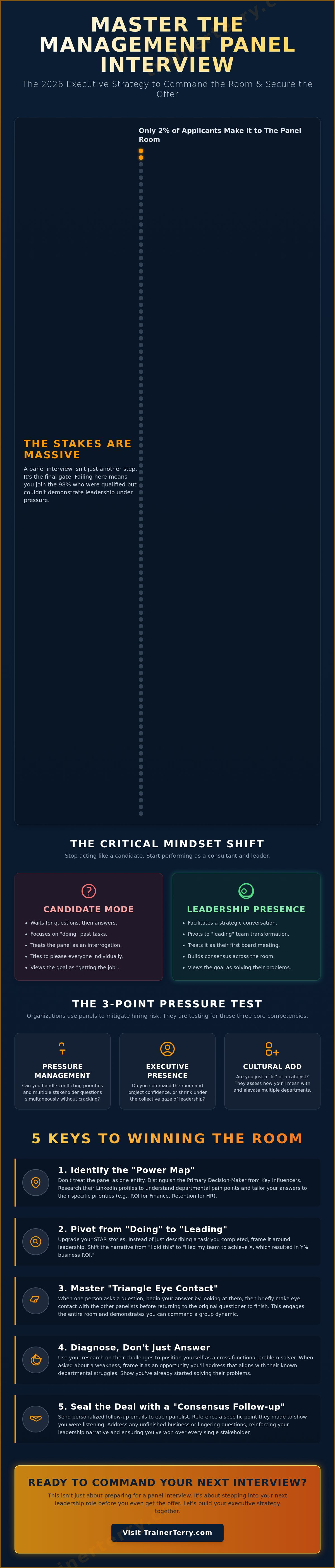
I've seen even the best leaders stumble here because they stay in candidate mode. It's time to flip the script. You're about to master the high-stakes dynamics of the modern interview by shifting your mindset into pure leadership presence. This guide reveals the 2026 executive strategy to command the room and win over cross-functional directors. You'll learn exactly how to align the panel's priorities, handle the 25% candidate drop-off risk, and secure the management offer you've earned.
Key Takeaways
- Identify the "Power Map" of your panel to distinguish between the primary decision-maker and the key influencers who drive the final consensus.
- Stop focusing on "doing" and start focusing on "leading" by pivoting your STAR stories toward team transformation and business ROI.
- Master the "Triangle Eye Contact" method while preparing for a panel interview for a management position to command the room and engage every stakeholder.
- Uncover deep-seated departmental pain points through strategic LinkedIn research to present yourself as a cross-functional problem solver.
- Seal the deal with a "Consensus Follow-up" that addresses unfinished business and reinforces your leadership narrative with every panelist.
What is a Management Panel Interview in 2026?
Forget the old one-on-one coffee chat. In 2026, a management panel is a high-stakes evaluation of your leadership viability. It's a cross-functional gauntlet designed to see if you can handle the weight of the role. While standard interview practices often focus on your past resume, a management panel looks at your future impact. It's no longer just about the hiring manager liking you. It's about a consensus-based decision where every stakeholder has veto power. If you don't win over the whole room, you don't get the offer.
Preparing for a panel interview for a management position requires a total mental shift. You have to stop thinking like a job seeker. Think of this as your first board meeting. You aren't there to beg for a job; you're there to solve their collective problems. Companies use these panels because modern corporate culture demands cross-functional alignment. If the Head of Product and the VP of Sales don't both believe in your vision, the organization won't move forward. You need to prove you can navigate these diverse interests without losing your footing.
The Shift from Candidate to Consultant
Answering questions is for entry-level roles. At the management level, you must facilitate a strategic conversation. When a panelist asks about a challenge, don't just say, "I did this." Instead, pivot the narrative to, "Here is how I'll lead your team to overcome that specific hurdle." You're diagnosing their pain points in real-time and offering a roadmap. The Consultative Candidate is a top-tier management profile who diagnoses organizational pain points and proposes leadership solutions in real-time. If you want to refine this approach, our High-level Interview Strategy coaching is built exactly for this transition. Don't just show up. Lead.
Why Organizations Use Panels for Leadership
Why put you through this pressure cooker? It's about risk mitigation. High-stakes management hires are expensive, and panels help reduce individual bias. They're testing three specific things to see if you have what it takes to thrive in their ecosystem:
- Pressure Management: They want to see if you can handle multiple perspectives and conflicting priorities simultaneously without cracking.
- Executive Presence: Do you command the room when the heat is on, or do you shrink under the collective gaze of leadership?
- Cultural Add: They're evaluating how you mesh with different departments in one sitting to ensure you aren't just a "fit," but a catalyst for growth.
They want to see if you're the missing piece of their leadership puzzle. This isn't just about your skills. It's about your ability to unify a room full of leaders who all have different agendas. Master this, and the offer is yours.
Stakeholder Mapping: Researching Your Panel Members
Most candidates treat a panel like a monolithic wall of faces. They're wrong. When you're preparing for a panel interview for a management position, you're looking at a complex web of competing interests. You need a "Power Map." This means identifying who the ultimate decision-maker is versus who holds the most social influence in the room. Usually, the hiring manager has the final say, but a dissenting voice from a key cross-functional peer can kill your chances. You've got to win them all, but you've got to speak their specific languages to do it.
Start by scrubbing their digital footprint. Use a high-impact LinkedIn makeover strategy to ensure your own profile is ready for the scrutiny you're about to receive, then dive into theirs. Look for more than just their titles. What are they posting about? If the Finance Director is sharing articles on lean operations, your stories better include ROI and cost-savings. If the Head of HR is focused on retention, highlight your mentorship wins. You're looking for departmental pain points that haven't been solved yet.
Decoding the Panel Personas
Every person in that room views you through a different lens. You need to anticipate these perspectives to stay ahead of the curve:
- The Peer: They're asking, "Will this person make my life harder or easier?" Focus on collaboration and cross-departmental support.
- The Direct Superior: They're looking for reliability. They want to know if they can delegate high-stakes projects to you without losing sleep.
- The HR/Culture Gatekeeper: They're scanning for EQ and organizational alignment. They care about how you represent the brand and manage conflict.
Preparing Your 'Stakeholder-Specific' Value Props
You can't give the same pitch to everyone. Tailor your leadership narrative so it resonates across the board. If you see a panelist recently transitioned from a different industry, mention how your own diverse background helps you adapt. This builds instant rapport. You're showing them that you've done the work before you even sat down. Prepare one specific question for each person that touches their "lens." Ask the Finance Lead about their 2026 growth targets, or ask the Peer about their biggest friction point in current workflows.
If this feels like a lot to juggle, you don't have to do it alone. You can schedule a free strategy call to map out your specific panel and identify exactly which value props will stick. Preparing for a panel interview for a management position is a game of precision. Don't leave your narrative to chance. Control the room by showing you understand their world as well as they do.
Mastering the Group Dynamic and Executive Presence
Mapping your stakeholders is only half the battle. Now, you have to lead them. Preparing for a panel interview for a management position is as much about your physical presence as it is about your answers. If you look like a candidate waiting for permission, you've already lost. You need to command the room from the moment you sit down. This starts with how you take up space. Keep your posture open and your hands visible. Avoid fidgeting or shrinking into your chair. Leaders don't hide; they project confidence through every movement.
One of the most effective tools in your arsenal is the strategic pause. When a panelist throws a complex question your way, don't rush to fill the silence. Take two seconds. Breathe. This shows you aren't reactive. It signals that you're a deliberate thinker who processes information before making a move. Controlling the pace of the room is a power move that forces the panel to sync with your rhythm, rather than the other way around.
The Art of the 'Global' Answer
Generic advice tells you to "make eye contact." That isn't enough for an executive role. You need the Triangle Eye Contact Method. When you start an answer, give the person who asked the question about 20% of your attention. For the remaining 80%, sweep the rest of the room. This engages the silent observers and makes them feel included in your vision. Use inclusive language like "As we align these departmental goals" to unify the group. If you notice a panelist has been quiet, direct a portion of your explanation toward them. It pulls them back into the conversation and shows you're aware of everyone in your "boardroom."
Handling High-Pressure Interrogations
The real test happens when you're caught in the "Contradictory Question" trap. Imagine the Finance Director asks how you'll cut costs, while the Ops Manager asks how you'll increase output. Don't pick a side. That's a trap. Instead, bridge the two opposing views. Acknowledge the validity of both priorities and explain how your leadership creates a synergy between them. This demonstrates high-level negotiation skills that most candidates lack.
Maintaining composure when faced with "The Skeptic" is equally vital. There's often one panelist designed to test your limits. Don't get defensive. Use active listening to validate their concern, then pivot back to your ROI-focused narrative. If you find your presence wavering under this heat, our Executive Presence Coaching can help you build that unshakeable leadership core. Preparing for a panel interview for a management position requires you to be the calmest person in the room. When you master the dynamic, you aren't just an interviewee. You're the clear choice for the job.
The Advanced STAR Method for Management Roles
Standard interview advice often suggests the STAR method as a simple way to structure answers. For a management role, that's not enough. When you're preparing for a panel interview for a management position, a basic STAR response feels small. It focuses too much on individual doing and not enough on strategic leading. The panel isn't hiring a worker bee. They're hiring a force multiplier. You need to pivot your stories to focus on team transformation and business ROI.
Your stories must demonstrate that you can manage complex stakeholder interests and drive results through others. If your Action steps only involve you sitting at a desk, you've failed the management test. You need to show how you diagnosed a problem, aligned your team, and navigated the organizational politics to reach a solution. This is the difference between being a manager on paper and being a leader in practice. You're proving that you can take the heat and still deliver for the company.
Crafting High-Impact Management Stories
The Situation in your story shouldn't be a simple task. It should be an organizational challenge that threatened the bottom line or team morale. When describing your Action, emphasize your delegation and strategic pivots. Did you reallocate resources? Did you mentor a struggling employee to improve their output? While you should follow the STAR method pillar for foundational structure, your management narrative must always point toward scalability. Show the panel that your success wasn't a fluke, but the result of a repeatable leadership process.
Quantifying Your Leadership Legacy
Move beyond vague claims like "I finished the project on time." In 2026, the C-suite demands hard data. Did you increase departmental efficiency by 22%? Did you reduce churn by 10 points? The Result is the high-stakes hook that captures a leader's attention and proves your long-term worth. Every story you tell should end with a metric that matters to the people sitting across from you. If you don't have a number, you don't have a result. It's that simple.
This includes how you handle failure. When a panelist asks about a mistake, don't hide. Own it. Describe the strategic pivot you made to mitigate the damage and what you implemented to ensure it never happens again. This shows the panel you have the EQ to handle high-pressure setbacks without losing your cool. If you're ready to stop guessing and start winning, our Career Advancement Blueprint will give you the exact framework to build these high-impact narratives. Stop telling stories. Start proving your impact.
Closing the Deal: Post-Panel Strategy and Action
The interview doesn't end when the Zoom call drops or the boardroom door closes. The real decision happens in the "Consensus Huddle" five minutes after you leave. Preparing for a panel interview for a management position requires a post-game strategy that is just as aggressive as your preparation. You've planted the seeds of your leadership; now you need to ensure they take root in the minds of every stakeholder. Stop waiting for the phone to ring. Take control of the narrative while the panel is still debating your viability.
Success at this level is about influencing the group's collective memory. You want them to remember you as the consultant who already understands their friction points. This is your chance to address "Unfinished Business." If a specific question felt like it needed more depth, or if you realized a key ROI metric was missing during the heat of the moment, use your follow-up to provide that clarity. It shows you're reflective and committed to accuracy. These are traits every high-level executive needs to survive in 2026. Review the panel's reactions. Did they lean in? Did they stop taking notes? Use those data points to refine your final pitch.
Strategic Thank-You Notes for Multiple Stakeholders
Never send a generic group email. It's lazy and signals that you don't value individual stakeholders. Instead, send tailored notes to each panelist within 24 hours. Reference a specific pain point they mentioned during the session. If the Finance Director was worried about budget leaks, remind them of your 22% efficiency win. If the HR lead focused on culture, reiterate your EQ-driven approach to conflict. You're reminding them that you didn't just listen; you processed their unique needs. Timing is everything. Speed signals energy and decisiveness.
Next Steps: Partnering for Performance
High-stakes panels are won in the weeks before the meeting, not just the hour of. If you're serious about securing the offer, you can't rely on luck. You need to pressure-test your presence before you step into the room. We've seen that 25% of candidates drop out at the interview stage because they weren't ready for the cross-functional heat. Don't be a statistic. Partnering with an expert for 1:1 Job Interview Prep ensures your stories are sharp and your presence is unshakeable.
You've done the work. You've mapped the stakeholders. Now, finish the job. If you want to ensure your strategy is airtight, schedule a free strategy call today. We'll review your upcoming panel and identify the exact levers you need to pull to become the obvious choice. Preparing for a panel interview for a management position is a marathon. Let's make sure you cross the finish line with the offer in hand.
Command Your Future Leadership Role
You have the roadmap. Now it's time to execute. Successfully preparing for a panel interview for a management position means moving beyond the basics. You aren't just answering questions; you're facilitating a strategic dialogue that proves your worth to every stakeholder in the room. By mastering the group dynamic and pivoting your STAR stories toward team transformation, you position yourself as the only viable choice. Don't let the pressure of the panel dictate your performance. Take charge.
This transition is too high-stakes to leave to chance. Trainer Terry, a former Corporate VP with 20+ years of experience, specializes in the executive STAR method and has a proven track record in high-stakes career transitions. Secure your next leadership role with Trainer Terry's Executive Interview Prep.
Your next level is waiting. Step into that room with the presence of the leader you've already become. You've earned this opportunity. Now go out there and claim it.
Frequently Asked Questions
How do I manage eye contact when there are 4 or 5 people on the panel?
Start your response by looking directly at the person who asked the question for the first few seconds. Then, sweep the room and give the other panel members about 80% of your attention as you finish your answer. This ensures everyone feels included in your strategic vision. Ending your answer by looking back at the original asker closes the loop and confirms you've addressed their specific concern.
What should I do if one panelist seems completely uninterested?
Don't let a distracted panelist derail your focus or lower your energy. Direct a portion of your next answer specifically toward them, perhaps by referencing a goal relevant to their department. This subtle "call-in" usually re-engages their attention without being confrontational. Your goal is to make your narrative so compelling and ROI-focused that they can't help but tune back into the conversation.
How do I handle conflicting questions from two different managers?
Bridge the two perspectives by acknowledging the validity of both managers' priorities. Explain how your leadership strategy creates synergy between these seemingly opposing goals rather than choosing one side. This demonstrates high-level negotiation skills and the ability to find common ground in a complex corporate environment. It shows you can lead through friction and align multiple stakeholders toward a single organizational objective.
Is it okay to bring notes or a portfolio to a management panel interview?
Bringing a professional portfolio is highly encouraged when preparing for a panel interview for a management position. Use it to showcase data-heavy results, team structures, or a 90-day roadmap for the department. However, don't use it as a crutch or a script. It should be a strategic visual aid that reinforces your authority, not a distraction that breaks eye contact or slows the conversation's pace.
How long should my answers be in a panel setting compared to a 1-on-1?
Keep your answers about 10% to 15% shorter than you would in a one-on-one setting. With multiple stakeholders in the room, the risk of losing someone's attention is much higher. Focus on punchy STAR stories that lead directly to a high-impact result. Concise answers leave more room for a back-and-forth dialogue, which is essential for building the consensus you need to secure the offer.
Should I send a separate thank-you email to every person on the panel?
Send a personalized, individual email to every person on the panel within 24 hours of the interview. A group email is a missed opportunity to reinforce your specific value to each leader. Mention a unique point or pain point each person raised during the session. This shows you were actively listening and that you're already thinking about how to solve their specific departmental challenges as a partner.
What is the best way to prepare if I don't know who is on the panel?
Assume you'll face a mix of Finance, Operations, and HR leaders if names haven't been provided. Preparing for a panel interview for a management position without a list means building versatile STAR stories that can pivot toward ROI, efficiency, or culture. Once you enter the room, quickly identify their roles and adjust your "lenses" to match their priorities in real-time. Flexibility is a core management trait.
How do I show leadership presence without appearing arrogant to peers?
Focus on "we" when discussing execution and "I" when discussing accountability and strategy. True leadership presence comes from owning the decision-making process while giving credit to the team for the final output. This balance shows you're confident enough to lead but humble enough to collaborate. Peers want to know you'll be a supportive partner who empowers them, not a dictator who ignores their expertise.
Article by
Terry Jones
Terry Jones is the Founder and Chief Career Strategist of the Career Advancement Blueprint and Executive Coach and Lead Consultant at FireBridge Consulting.
As an ICF Certified Accredited Career Coach and Certified Master Career Services professional, he partners with professionals at all levels, including senior leaders and executives, to navigate career transitions, secure new opportunities, and position themselves for advancement. His approach goes beyond surface level coaching, focusing on how individuals think, communicate, and lead so they can operate with clarity, authority, and strategic intent in high stakes environments.
In his work as an executive coach, Terry engages in high impact advisory conversations that help leaders strengthen decision making, elevate their presence, and align their leadership style with organizational expectations. He is known for helping clients translate their experience into influence, ensuring they are not only seen for what they have done, but trusted for what they are capable of leading next.
With over 20 years of corporate experience, including serving as a Vice President and leading Learning and Development functions for three New York City organizations, Terry brings a deep understanding of how companies evaluate talent, develop leaders, and make promotion decisions. This allows him to bridge the gap between individual ambition and organizational reality.
His insights have reached over 630,000 followers and generated more than 70 million video views, where he shares direct, experience driven guidance that helps professionals think differently and take action.