Signs of a Toxic Executive Team: How to Identify Systemic C-Suite Failure in 2026

Did you know that 57% of employees have walked away from their jobs specifically because of their leader? It's not just a bad boss; it's a systemic failure at the top. If you're feeling gaslit or dreading Monday mornings, you aren't imagining things. You're likely seeing the signs of a toxic executive team that is trading your mental health for their own internal infighting.
You've spent years building your career. It's frustrating to watch your progress stagnate because the C-suite can't get its act together. I've seen high-performers lose their professional edge simply because they were swimming in a poisoned well. This isn't just a personality clash. It's a structural breakdown of accountability that 71.9% of workers in toxic environments say defines their workplace today.
We're going to stop the bleeding right now. I'll help you identify the hidden patterns of collective leadership dysfunction and give you a tactical plan to either fix your situation or execute a clean exit. We'll look at the specific criteria to judge your leadership and how to protect your personal integrity before the culture breaks you.
Key Takeaways
- Identify the difference between a high-pressure environment and a systemic board-level failure that stalls your professional growth.
- Recognize the 7 unmistakable signs of a toxic executive team, from gaslighting tactics to public humiliation disguised as "radical candor."
- Protect your professional brand from the "guilt by association" trap that happens when you stay too long in a poisoned leadership culture.
- Use a 5-point audit to measure your mental runway and decide exactly when it's time to execute a strategic exit.
- Reclaim your leadership narrative by learning how to master the "cleanse" and position your resilience for your next career level.
Defining Collective Dysfunction: When the Whole Executive Team is Toxic
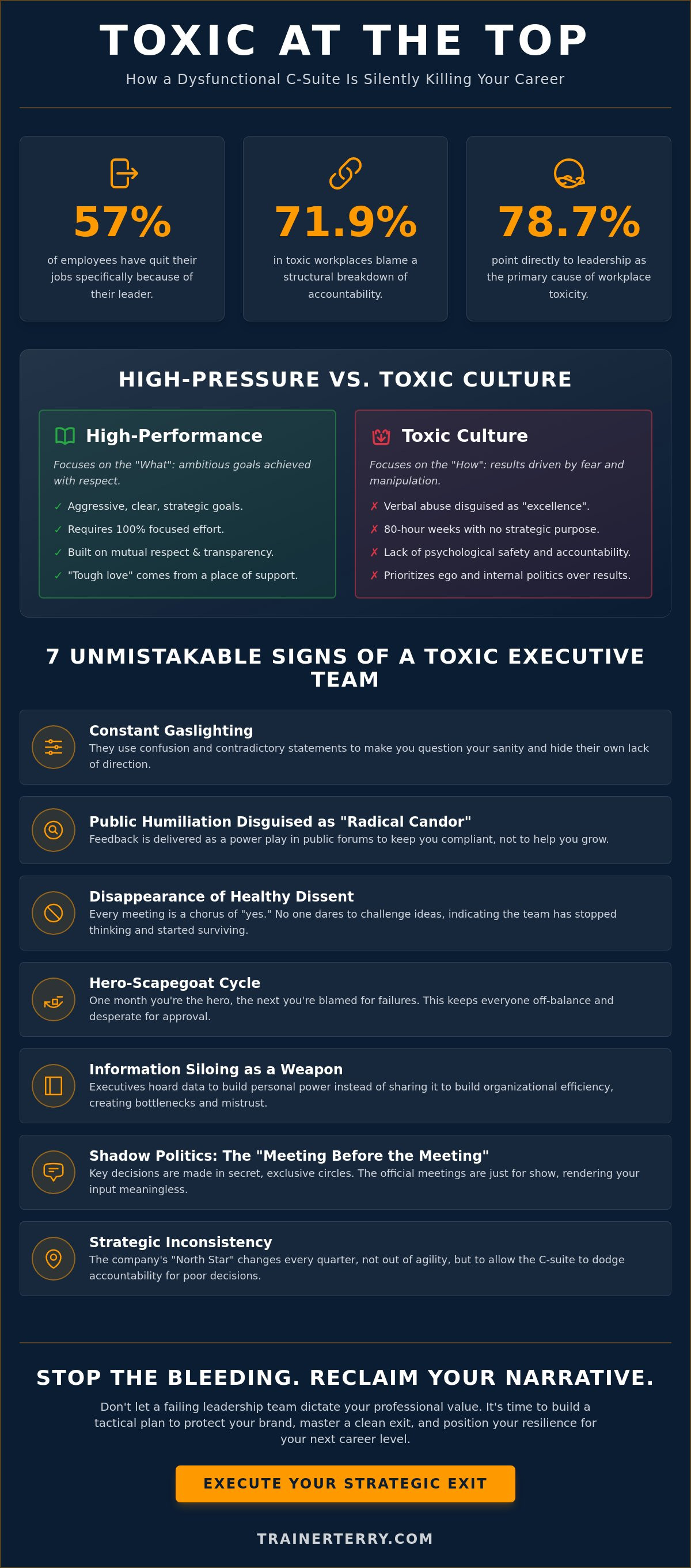
A single bad manager is a localized infection. You can isolate it, treat it, or cut it out. But when the rot spreads to the entire C-suite, you're looking at a systemic failure that threatens your entire professional future. Recognizing the signs of a toxic executive team is the only way to protect your career from a structure that's already collapsing. If a board of directors allows a leadership group to prioritize ego over results, they aren't just failing the shareholders; they're failing every high-performer in the building. According to 2026 data, 78.7% of employees in toxic environments point directly to leadership as the primary cause. When the people at the top stop holding each other accountable, the board has officially lost control.
Collective Executive Toxicity is a systemic lack of psychological safety and accountability where the group's survival is prioritized over the organization's health. Understanding what is a toxic leader helps you spot individual red flags, but a toxic team is different. It's a self-reinforcing loop of bad behavior. In this environment, the "Silent Enabler" is just as dangerous as the bully. This is the executive who stays quiet during a public shaming or ignores unethical "shortcuts" to keep their own seat at the table. Their silence isn't neutral; it's the fuel that keeps the toxicity burning.
High Pressure vs. Toxic Culture: Know the Difference
Don't confuse a high-performance environment with a toxic one. High pressure is about the "What", specifically the aggressive goals and the 100% effort required to hit them. Toxicity is about the "How", meaning the behaviors used to drive those results. Real "tough love" in leadership only works when there's a foundation of radical transparency and mutual respect. If "excellence" is being used as a mask to justify verbal abuse or 80-hour weeks without a strategic purpose, it's not a high-performance culture. It's a sweatshop with better furniture. If you're ready to find a culture that actually values your output, you need a Career Advancement Blueprint to help you transition safely.
The Anatomy of a Failed C-Suite
A failing executive team operates like a fortress, not a leadership body. You'll see "inner circles" where favoritism completely bypasses merit, leaving talented leaders on the outside looking in. Information siloing becomes a weapon. Executives hold onto data like it's currency, using it to build personal power rather than organizational efficiency. The most telling sign? The total disappearance of healthy dissent. If every executive meeting is a chorus of "yes" or a series of silent nods, the team has stopped thinking and started surviving. This isn't leadership; it's a defensive perimeter that will eventually crush your career growth if you don't have a plan to move up or move out.
7 Unmistakable Signs of a Toxic Executive Team
Stop questioning your sanity. If you're constantly told that you're just not seeing the big picture while the company's performance is crashing, you're being gaslit. This is one of the clearest signs of a toxic executive team. They use confusion as a shield to hide their own lack of direction. When feedback turns into public humiliation during a board meeting or QBR, they'll often call it "Radical Candor." It isn't. It's a power play designed to keep you small and compliant. Real leaders don't need to break you down to build the company up.
Watch the favor in the room. One month you're the hero; the next you're the scapegoat. This hero-scapegoat cycle keeps everyone off-balance and desperate for approval. It’s often paired with strategic inconsistency. If the "North Star" changes every three months, it's not agility. It's a way for the C-suite to dodge the consequences of their poor decisions. They can't be held accountable if the goalpost is always on wheels. Research into the classifications of toxic leadership shows that these behaviors aren't random; they're often a mix of narcissistic and authoritarian traits that create a "toxic triangle" between leaders, followers, and the environment.
Interpersonal Red Flags at the Top
Politics shouldn't be your full-time job. If you see the "meeting before the meeting" happening regularly, the actual decision-making has already moved into the shadows. That's political rot. You'll also see weaponized vulnerability. An executive might share a personal detail to build "trust," only to use it against you later to ensure compliance. If you're being blocked by a "gatekeeper" who controls all access to other C-suite members, they aren't protecting the team's time. They're protecting their own narrative and preventing any real accountability from taking hold.
Operational Symptoms of Toxicity
Look at the data. High turnover at the VP and Director levels is a massive red flag. If 57% of employees are leaving specifically because of leadership, the system is broken at the root. You'll also see budgeting used as a weapon. Resources go to the "loyalists" rather than the projects with the highest ROI. Finally, the "Always On" expectation is the ultimate sign of a failed strategy. When presence matters more than results, the leadership has no idea how to actually measure value. If this sounds like your Monday morning, it might be time to audit your career trajectory before the burnout sets in. A leadership team that refuses to invest in a Talent Development Strategy is a team that has already given up on the future.
The Invisible Cost: How Executive Toxicity Destroys Your Market Value
Think your reputation is safe just because you're doing your job? Think again. In the high-stakes executive world, you're judged by the company you keep. When you ignore the signs of a toxic executive team, you're essentially letting their collective failure stain your personal brand. This is the "Guilt by Association" trap. Recruiters and headhunters in 2026 aren't just looking at your individual KPIs; they're evaluating the health of the organizations you've led. If your C-suite is famous for internal wars or ethical lapses, the market assumes you're either part of the problem or too weak to change it. You're losing your "Career Catalyst" years, those prime windows where you should be stacking massive wins, not just dodging political bullets.
Staying in a poisoned environment makes you a smaller leader. It erodes your executive presence until you're playing defense 24/7. You stop taking the bold, strategic risks that get you noticed at the next level. Instead, you become an expert in "firefighting" and "surviving." But survival isn't a leadership skill that scales; it's a weight that drags down your market value every single day you stay. If you're seeing the signs of a toxic executive team, you're already paying a price that won't show up on a balance sheet but will definitely show up in your next salary negotiation.
The Health and Psychological Toll
Burnout isn't just about being overworked; it's the slow death of your professional identity. With 77% of leaders reporting burnout in 2025, the crisis is real. Chronic stress ruins your ability to make high-stakes decisions with precision. From an Executive Career Coach perspective, maintaining mental clarity is your most important asset. Different dysfunctional leadership team styles, like "Shark Tanks" where everyone is an enemy, drain your cognitive reserves. You can't lead a team if you're too busy watching your own back.
Damaging Your Professional Narrative
If you stay in a toxic environment for too long, the market stops seeing you as a victim and starts seeing you as a participant. It's a red flag on your LinkedIn profile that screams stagnation. Executing a Career Transition is incredibly difficult when your self-belief has been systematically dismantled by a failing C-suite. To win your next role, you must pivot your narrative. Don't be the "bitter" candidate. Frame the exit as a strategic choice to find a culture that aligns with your high-performance standards. You aren't running away. You're moving toward a higher level of accountability.
The Executive Exit Strategy: A 5-Point Audit
Stop waiting for a miracle. A toxic C-suite doesn't wake up one day and decide to lead with integrity. You need a cold, hard audit of your current position to decide if you're a builder or just a sacrificial lamb. Start with an Integrity Audit. If you're lying to your direct reports to cover for a leadership team that can't hit a target, your professional brand is already bleeding. Next, calculate your runways. Most professionals only look at their bank account, but your mental runway is far more critical. With 77% of leaders reporting burnout in 2025, you need to know your "freedom date" before your health forces the decision for you.
Look at the ceiling. Is it made of glass or lead? If the signs of a toxic executive team include a total lack of internal promotion for anyone outside the "inner circle," you're in a dead-end seat. Finally, check the Board of Directors. If they're ignoring the 57% turnover rate among VPs, they aren't just unaware; they're complicit. You can't win a game where the refs are in on the fix. It's time to stop making excuses for a system that is designed to exploit your high performance without ever rewarding your loyalty.
Step 1: Documenting the Dysfunction
Stop focusing on how the toxicity makes you feel and start documenting how it kills the business. Track the lost ROI, the stalled projects, and the talent drain. This data isn't just for your exit; it's the raw material for your future interviews. Keep a "Success Journal" to remind yourself that you're the one driving results despite the chaos. This habit protects you from gaslighting and ensures you have concrete data for the STAR Method stories you'll need to ace your next high-stakes interview.
Step 2: The 'Stay and Fight' vs. 'Pivot' Decision
Can you actually influence the culture? If the rot is isolated to one person, maybe. But if the whole team is poisoned, you're fighting a losing battle. Don't fall for the sunk cost fallacy just because you've put in five years of sweat equity. Staying in a failing system doesn't make you loyal; it makes you a participant in your own career stagnation. You need an objective perspective to see the path forward clearly. If you're ready to stop guessing and start executing a real move, a Free Strategy Call is the fastest way to gain the clarity you need to level up.
Reclaiming Your Narrative: From Toxic C-Suite to High-Performance Leadership
You’ve identified the signs of a toxic executive team. Now what? You don’t let it define you. High-performers are often the primary targets of toxic teams because your competence highlights their failure. They’ll try to gaslight you into thinking you’re the problem to keep you from questioning their lack of direction. Don't buy it. You’ve survived the fire; now it’s time to use that heat to forge a better career. Reclaiming your narrative is about shifting the focus from the chaos you left to the results you delivered in spite of it. This is how you turn a toxic stint into a story of resilience and strategic execution.
This process requires a professional cleanse. It isn't just about taking a vacation; it's about rebuilding your executive presence from the ground up. You need to move from a defensive mindset to an offensive strategy. If you've been fighting fires for years, your leadership muscles might be tired, but they aren't broken. The Career Advancement Blueprint is designed for this exact moment. It helps you secure a "clean" leadership role where accountability isn't just a buzzword and your results actually lead to rewards.
Rebuilding Your Executive Brand
Your LinkedIn positioning must change immediately. Stop looking like a survivor and start looking like a strategist who thrives on results. Your "hidden" network is your strongest asset right now. These are the peers and partners who saw you perform when the C-suite was falling apart. When you craft your "Why I'm Leaving" story, maintain 100% professional integrity. Focus on the lack of strategic alignment or the need for a culture that prioritizes ROI over ego. Never vent; just state the facts and move to the value you bring. This keeps your brand clean while signaling that you have high standards for leadership.
Next Steps for the High-Performance Leader
Set your non-negotiable cultural boundaries before you sign the next offer. You are vetting them just as much as they are vetting you. During the interview, ask how the executive team handles failure. Ask about the specific metrics they use for leadership accountability. If the answers are vague, walk away. You've already seen what happens when 78.7% of employees blame leadership for a toxic environment. Don't become part of that statistic again. You have the talent and the experience to lead at the highest level. Don't let a toxic team kill your career. Schedule your strategy call today and let’s build your exit map.
Take Command of Your Career Future
You’ve identified the signs of a toxic executive team and now you have the tools to protect your professional brand. Don't let a failing C-suite drain your potential or stall your market value. You now have the audit framework to measure your mental runway and the strategic insight to reclaim your leadership narrative. Your career is a high-performance asset. It deserves a culture that prioritizes accountability over ego.
I’ve spent 20 years as a Corporate VP, so I understand these power dynamics from the inside. My proven framework for navigating C-suite politics and promotion strategy is designed to get you out of the line of fire and into a role where you can actually lead. If you're ready to stop surviving and start executing a real move, let's get to work. Ready to build your executive exit strategy? Schedule a free call with Trainer Terry. You’ve done the hard work of spotting the rot. Now, take the next step toward the level you truly deserve. You’ve got this.
Common Questions About Executive Dysfunction
Can a toxic executive team ever be fixed from within?
Systemic change almost always requires the Board of Directors to step in and replace the core leadership. If the signs of a toxic executive team include a total lack of accountability at the top, you won't fix it from the middle. You're better off focusing on your own Career Positioning Strategy. Don't try to be the hero in a story that's already reached its final chapter.
How do I tell the difference between a 'toxic' team and a 'demanding' one?
Look at the "How" versus the "What." A demanding team wants high ROI and 100% effort to reach aggressive goals. A toxic team wants compliance and uses public humiliation or gaslighting to get it. If you're hitting your KPIs but still getting crushed in meetings, that's not high performance. It's a behavioral failure. Don't confuse "tough love" with a toxic power play.
Should I talk to HR about a toxic executive team?
HR is there to protect the organization from liability, not to act as your personal advocate. In many cases, reporting the executive team to HR can put a target on your back. Unless you have documented evidence of illegal activity, focus on building your exit strategy first. Your mental health is your own responsibility. HR isn't your therapist; they're the company's defense.
What is the #1 sign that my CEO is toxic?
The #1 sign of a toxic CEO is the total absence of self-accountability. If they constantly blame market conditions or specific scapegoats for every failure, you're in trouble. A leader who can't own a mistake can't lead a turnaround. This behavior creates the foundational signs of a toxic executive team that eventually drive away 57% of top talent according to 2026 turnover data.
How long should I stay in a toxic leadership role before it hurts my resume?
You should aim to execute your pivot within 12 to 18 months of identifying the dysfunction. Staying longer than two years in a poisoned environment suggests you've become a participant in the culture. Recruiters in 2026 are highly sensitive to "guilt by association." Don't let their failed leadership narrative become the headline of your professional brand. Move before the rot sets in.
How do I explain leaving a toxic company in a job interview without sounding negative?
Shift the focus to strategic alignment and cultural fit. Instead of saying the leadership was toxic, say you are seeking an environment that prioritizes radical transparency and data-driven accountability. You aren't running away from a bad boss; you're moving toward a higher standard of excellence. This shows executive presence and keeps the conversation focused on your future results and professional value.
Can one toxic executive ruin an otherwise healthy team?
Yes, a single toxic executive can destabilize an entire group if they aren't held accountable by the CEO. Toxicity is contagious. It forces healthy leaders into defensive positions, which kills innovation and trust. If the CEO won't cut out the rot, the whole team will eventually succumb to the same patterns of siloing and infighting. One rotten apple always spoils the barrel.
What are the legal protections for executives in toxic workplaces?
Legal protections usually focus on harassment, discrimination, or whistleblower activities. While being a "jerk" isn't illegal, a hostile work environment can lead to constructive discharge claims in certain jurisdictions. Review your executive contract for "Good Reason" termination clauses that might allow you to exit with your severance intact. Always consult a legal professional before you make a move. Know your rights before you act.

Article by
Terry Jones
Terry Jones is the Founder and Chief Career Strategist of the Career Advancement Blueprint and Executive Coach and Lead Consultant at FireBridge Consulting.
As an ICF Certified Accredited Career Coach and Certified Master Career Services professional, he partners with professionals at all levels, including senior leaders and executives, to navigate career transitions, secure new opportunities, and position themselves for advancement. His approach goes beyond surface level coaching, focusing on how individuals think, communicate, and lead so they can operate with clarity, authority, and strategic intent in high stakes environments.
In his work as an executive coach, Terry engages in high impact advisory conversations that help leaders strengthen decision making, elevate their presence, and align their leadership style with organizational expectations. He is known for helping clients translate their experience into influence, ensuring they are not only seen for what they have done, but trusted for what they are capable of leading next.
With over 20 years of corporate experience, including serving as a Vice President and leading Learning and Development functions for three New York City organizations, Terry brings a deep understanding of how companies evaluate talent, develop leaders, and make promotion decisions. This allows him to bridge the gap between individual ambition and organizational reality.
His insights have reached over 630,000 followers and generated more than 70 million video views, where he shares direct, experience driven guidance that helps professionals think differently and take action.