Career Ceiling: What to Do When You Can't Get Promoted in 2026

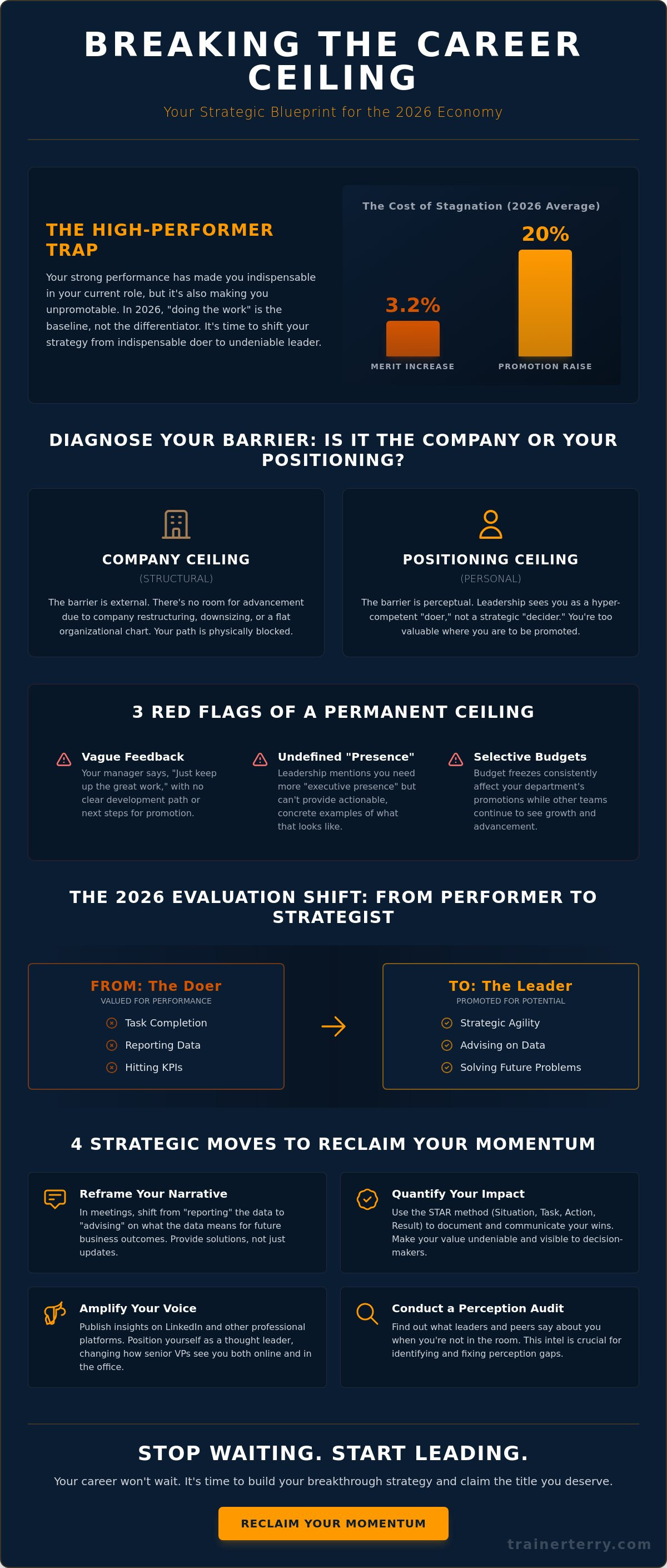
Stop hitting your head against the glass. Your career ceiling isn't a dead end; it's a diagnostic signal that your current "High-Performer" narrative has reached its expiration date. You're likely feeling invisible despite your results, watching less-qualified peers move up while you're stuck with a 3.2% merit increase in a high-inflation 2026 economy. If you're hitting a career ceiling what to do when you can't get promoted, the problem isn't your work ethic. It's your strategy.
I get it. It's exhausting to be the most reliable person in the room while being the least recognized. I'm going to show you exactly how to stop being "the doer" and start being the leader that companies cannot afford to lose. You will learn how to build undeniable executive presence, how to navigate the June 2026 EU Pay Transparency Directive to your advantage, and how to map out a strategic exit plan if your current ceiling is permanent. No more excuses. It's time to level up.
Key Takeaways
- Stop guessing why you're stuck and learn to identify if the barrier is structural or a flaw in your own professional positioning.
- Navigate a career ceiling what to do when you can't get promoted by shifting your narrative from "high-performer" to "executive leader" that commands the room.
- Apply the "Stay vs. Go" framework to calculate the real cost of waiting for a promotion that might never come.
- Deploy the STAR method to quantify your internal wins and ensure your impact is visible to those who make the decisions.
- Get a preview of a structured advancement strategy designed for the 2026 economy to help you reclaim your professional momentum.
Identifying the Career Ceiling: Why Your Hard Work Isn't Enough in 2026
You’ve been grinding for months. You hit every KPI. You stay late. Yet, the promotion list comes out and your name is missing. That’s the career ceiling. It’s that invisible barrier where your performance no longer fuels your advancement. In 2026, the corporate game has shifted. Companies don't reward tenure or task completion like they used to. They reward strategic agility. If you are hitting a career ceiling what to do when you can't get promoted depends entirely on whether the barrier is structural or personal.
You must diagnose the "why" immediately. A Company Ceiling is structural; there is literally no room above you or the business is shrinking. A Positioning Ceiling is personal. It means the leadership sees you as a "doer" rather than a "decider." This is a classic manifestation of The Peter Principle. You have become so efficient at your current level that moving you would actually hurt the department’s immediate output. It’s the ultimate high-performer trap. They don't want to promote you because you're too valuable exactly where you are.
The 3 Warning Signs of a Permanent Ceiling
First, feedback becomes vague. If your manager says, "You're doing great, just keep it up," without giving you a roadmap, you're stuck. Second, your executive presence is questioned without actionable steps. If they can't define what "presence" looks like for you, they're stalling. Third, watch the money. If budget freezes only seem to apply to your department while the "People" function sees a 4.5% promotion rate, you’re being pigeonholed while others move up.
Performance vs. Potential: The 2026 Evaluation Shift
By May 2026, AI has automated the majority of routine task management. Doing the work is now the baseline, not a differentiator. Your KPIs are just your entry ticket to stay employed. Promotions are now reserved for those showing "Strategic Potential." Strategic Potential is the ability to solve problems the CEO hasn't even seen yet. To move up, you need a Career Advancement Blueprint that shifts the narrative from your past tasks to your future leadership. Stop being the most reliable worker and start being the most strategic asset. The 3.2% average merit increase for 2026 isn't enough to keep up with your value. It's time to demand the 20% raise that comes with a real title change.
The High-Performer Trap: Decoding the 'Invisible' Barriers to Promotion
You’re the first one in and the last one out. You’ve hit every goal. Yet, you’re still in the same seat. This is the High-Performer Trap. In the 2026 corporate landscape, being "good at your job" is a baseline requirement, not a promotion strategy. Promotion rates have stabilized at a selective 4.0 percent as of late 2025. If you’re hitting a career ceiling what to do when you can't get promoted is simple: stop being a tool and start being a partner. No one is coming to save your career. You have to take it.
Your greatest enemy isn't your colleague; it’s your own utility. If you are too efficient at task execution, you become indispensable in your current role. This is one of the classic Signs your career has hit a ceiling. You have to break the perception that you are just a "doer." If you don’t control the narrative of your value, the company will write a narrative of your utility. They’ll keep you exactly where you are because it’s convenient for them. It’s tough love, but it’s the truth: your hard work is currently making you unpromotable.
Waiting for your turn is a dead-end strategy. In a world where merit increases are hovering around 3.2 percent, "patience" is just another word for stagnant wages. You need to pivot now before your brand depreciates. You aren't just competing against people; you're competing against the "Ghost Competitors" of outdated perceptions and internal biases.
Mastering Executive Presence and Communication
Room control is everything. Stop asking for permission to lead and start providing solutions. In your next stakeholder meeting, shift from "reporting" to "advising." Don't just show the data; tell them what the data means for the Q3 bottom line. This is where you build internal authority. Use your LinkedIn profile to publish insights on industry trends that matter to your senior leaders. When your VP sees your thought leadership online, it changes how they view you in the office. If you're struggling to find your voice, consider joining our office hours to sharpen your communication strategy and start speaking like a leader.
The Perception Audit: What Do They Say When You're Not in the Room?
You need to know what the "Ghost Competitors" are saying. These are the biases and perceptions that block your path. Conduct a perception audit by asking mentors for brutally honest feedback. Ask them what the perception of your leadership is among the executive team. Executive Presence is the gap between what you do and who you are perceived to be. If your skills don't align with the company's 2026 shift toward strategic agility, you're invisible. Identify these Narrative Gaps and close them before the next review cycle. Don't let a lack of clarity kill your momentum.
Assessing Your Options: Should You Pivot Internally or Plan a Strategic Exit?
You're at a crossroads. Decisions made in May 2026 carry weight because the market is selective and merit budgets are tight. If you're staring at a career ceiling what to do when you can't get promoted requires a cold, hard look at the "Stay vs. Go" framework. You need to ask yourself five critical questions: Is the barrier my immediate boss or the board? Is the company actually growing? Do I have a champion in a different department? Is my current role being automated? Does the organization truly value strategic agility? If the answer to three or more of these is "no," your brand is depreciating every day you stay.
Staying too long in a stagnant role makes you look like a "safe" utility player rather than a high-potential leader. In 2026, the average total increase budget is only 3.5 percent. If you're waiting for a promotion to fix your salary, you're losing the inflation battle. You need a 90-day internal rebrand sprint to change how you're perceived, or you need to start planning a strategic exit. Stop waiting for the company to recognize you. You have to force the issue or find a new room.
The Internal Pivot: Fighting for the Breakthrough
Don't just talk to your manager. Identify the "Power Centers" in your company. These are the executives who control the budget and the promotion lists. Build a "Business Case for Promotion" that focuses on ROI rather than your years of service. Show them how your leadership will drive a specific outcome, like a 10 percent increase in operational efficiency. If you need to pressure-test your negotiation strategy, leveraging Office Hours is the fastest way to get direct feedback before you step into the room. You have to show them that promoting you is a smart business investment, not a favor.
The Strategic Exit: Pivoting to a Higher Ceiling
Sometimes the ceiling is made of concrete. If your audit shows the path is blocked, don't settle for a lateral move at a new company. Use the "Leapfrog Method" to interview for the senior title you've already earned. Position your time at your current firm as a period of "operational mastery" rather than stagnation. When you realize the current company's ceiling is permanent, it's time to trigger the Career Change Blueprint for a strategic move. This isn't just about finding a job; it's about finding a career catalyst that respects your leadership potential. When facing a career ceiling what to do when you can't get promoted often means finding a new room where the ceiling is much higher.
How to Break Through: 4 Strategic Moves to Reclaim Your Momentum
Stop collecting certifications that no one cares about. In 2026, companies don't reward the person with the most skills; they reward the person with the most visible impact. If you are staring at a career ceiling what to do when you can't get promoted involves four tactical shifts. You have to move from being a "reliable asset" to a "strategic necessity." This isn't about working harder. It's about working louder and more intentionally.
- Step 1: Audit your narrative. Rewrite your internal reputation. If leadership sees you as a tactical executor, you'll stay stuck. You must rewrite your story to highlight decision-making and risk management.
- Step 2: Deploy the STAR Method. Stop listing your responsibilities. Start quantifying your wins. Every weekly update should show how you moved the needle on a core business goal.
- Step 3: Strategic Networking. You need a sponsor, not just a mentor. Mentors give you advice; sponsors give you opportunities. Find the person who has the power to say your name in the rooms where decisions are made.
- Step 4: The 'Mini-Promotion'. Volunteer for a high-visibility project that sits outside your job description. This proves you can already do the next job before they even give you the title.
Using the STAR Method for Internal Advancement
Results are the only currency that matters in a high-speed corporate environment. You must frame every achievement using The STAR Method. This turns your daily tasks into a high-performance narrative. Don't tell your boss you managed a team; tell them how you optimized the workflow to increase output by 15 percent while reducing costs. Shift your weekly updates into "Executive Briefs." Train yourself to think in results rather than tasks. When you speak the language of ROI, you become the obvious choice for the next opening.
Internal Rebranding and LinkedIn Positioning
Your internal reputation is often mirrored by your external presence. Update your LinkedIn Positioning to reflect your leadership level, not your current title. This attracts internal eyes and reminds stakeholders that you have a market value outside the company. Use the "Social Proof" strategy by securing public shout-outs from cross-departmental leaders. When other departments want to work with you, your own boss will realize your value is increasing. If you're ready to stop hitting the glass, it's time to build a Career Advancement Blueprint that secures your next level.
Designing Your Breakthrough with the Career Advancement Blueprint
Generic career advice is a waste of your time. In 2026, you don't need a "mentor" to tell you to keep working hard. You need a specific, aggressive strategy that treats your career like the multi-million dollar asset it is. If you're hitting a career ceiling what to do when you can't get promoted is simple: stop using a tactical map for a strategic war. You need a custom blueprint. Most professionals get stuck because they're using entry-level habits to try and reach executive rooms. It doesn't work. You have to change the game or you'll keep losing it.
I built the Career Advancement Blueprint because I've seen both sides of the table. As a former VP, I know exactly what the board says when the door is closed. I know why they pass over the "hard worker" and choose the "strategic leader." My 1:1 strategy sessions aren't about holding your hand; they're about identifying the specific cracks in your professional positioning that are holding you back. We identify your ceiling and we break it. No more excuses. It's time to take ownership of your trajectory.
The Blueprint for Promotion and Growth
This isn't a long-term academic study. It's a 6-week sprint designed to move you from being a "passed over" employee to an indispensable leader. We focus on an internal rebrand that forces the company to see your value in a new light. We also dive deep into salary and offer negotiation. With the 2026 average merit increase sitting at just 3.2 percent, you can't afford to wait for a standard raise. You need the 20 percent jump that comes with a real title change. Our Executive Presence workshop refines your communication so you start controlling the room before you even speak.
Take Action: Your Next Level is Waiting
Calculate the cost of your inaction. If you stay in your current role for another year without a promotion, you're losing tens of thousands of dollars in salary and equity. Your brand is depreciating while you wait for permission to lead. 2026 is the year of the Strategic Individual. The companies that are surviving the AI shift are the ones that value leaders who can solve complex problems. Be that leader. Stop letting your potential rot in a role that has no room for you. It's time to stop hitting your head against the glass. Schedule a free strategy call today and let's diagnose exactly what's standing between you and your next level. Your breakthrough starts with a single decision. Make it now.
Reclaim Your Professional Momentum Today
You've seen the data. The selective 2026 market means waiting for a 3.2% merit increase isn't a growth plan. If you're tired of hitting a career ceiling what to do when you can't get promoted is clear: stop acting like a worker and start leading like an executive. We've covered how to audit your narrative and why the STAR Method is your secret weapon for securing high-stakes internal wins. Hard work is just the baseline; strategic visibility is the breakthrough.
I've spent 20+ years as a Corporate VP. I've been in the rooms where these promotion decisions happen. My coaching is built on pure strategy, not fluff. We use high-stakes interview techniques to ensure you aren't just an option; you're the only choice. Stop making excuses for a company that doesn't see your value. If the path is blocked, we build a new one together.
Break through your career ceiling with the Career Advancement Blueprint.
Don't let another year of stagnation drain your potential. Your next level is waiting for you to claim it. Let's get to work.
Frequently Asked Questions
Is it possible to be too good at my job to be promoted?
Yes, being indispensable in a tactical role often makes you unpromotable because your manager fears losing your current output. This is a primary driver of a career ceiling what to do when you can't get promoted is to train your successor immediately. If you don't have a replacement ready, you're stuck as the "doer" while the "leaders" move up. You have to prove the department can survive without you in the trenches.
How do I ask why I wasn't promoted without sounding bitter?
Ask for a "gap analysis" instead of a simple explanation. Frame the conversation around the specific business goals for the next level and ask which leadership competencies you missed. This shows strategic maturity rather than emotional frustration. It forces your manager to provide a concrete roadmap instead of giving you vague feedback like "just keep it up." Focus on the ROI you need to deliver for that next title.
Should I stay at a company for 5 years if I haven't been promoted?
Staying five years without a promotion in a high-inflation 2026 economy is likely costing you 20 percent in potential market value. If the promotion rate in your department is below the 4.0 percent national average, you're stagnating. Evaluate if you're building new skills or just repeating the same year five times. If you aren't growing, your brand is depreciating every single day you stay in that seat.
What is the difference between a mentor and a sponsor for promotions?
A mentor gives you advice on how to improve; a sponsor uses their political capital to advocate for you behind closed doors. You need a sponsor to break a career ceiling what to do when you can't get promoted often involves finding an executive who will put their reputation on the line for your advancement. Advice is helpful for growth, but high-level advocacy is what actually secures the title and the raise.
How much does a career coach help with internal promotions?
A coach provides the objective strategy your manager won't give you. They help you rewrite your internal narrative and prepare for high-stakes salary negotiations that go beyond the standard 3.5 percent total increase budget. It's about shifting your positioning from a "high-performer" to an "executive asset" that the company cannot afford to lose. A coach identifies the blind spots that are currently killing your momentum.
Can I use the STAR method for an internal performance review?
Absolutely, the STAR method is the most effective way to turn vague tasks into quantifiable business results. Instead of saying you managed projects, state how your specific actions led to a 12 percent reduction in operational overhead. This speaks the language of the board and proves your ROI. It makes your promotion a logical business decision rather than a favor, which is essential in a tight 2026 economy.
What should I do if my boss is the reason I can't get promoted?
You must build "skip-level" relationships and cross-departmental visibility to bypass the bottleneck. Start solving problems for your boss's peers or the executive team directly. This creates internal demand for your leadership that a single manager can't block. If your boss is actively sabotaging your growth, use that visibility to secure a strategic exit to a company that actually values your potential and leadership.
How do I update my LinkedIn if I'm looking for an internal promotion?
Shift your LinkedIn headline from your current tactical title to the leadership value you provide. Share insights on industry trends that align with your company's 2026 goals to build authority. This creates "social proof" that senior stakeholders and internal recruiters will notice. It signals that you are a thought leader in your space, making your internal advancement feel like a natural and necessary progression for the firm.

Article by
Terry Jones
Terry Jones is the Founder and Chief Career Strategist of the Career Advancement Blueprint and Executive Coach and Lead Consultant at FireBridge Consulting.
As an ICF Certified Accredited Career Coach and Certified Master Career Services professional, he partners with professionals at all levels, including senior leaders and executives, to navigate career transitions, secure new opportunities, and position themselves for advancement. His approach goes beyond surface level coaching, focusing on how individuals think, communicate, and lead so they can operate with clarity, authority, and strategic intent in high stakes environments.
In his work as an executive coach, Terry engages in high impact advisory conversations that help leaders strengthen decision making, elevate their presence, and align their leadership style with organizational expectations. He is known for helping clients translate their experience into influence, ensuring they are not only seen for what they have done, but trusted for what they are capable of leading next.
With over 20 years of corporate experience, including serving as a Vice President and leading Learning and Development functions for three New York City organizations, Terry brings a deep understanding of how companies evaluate talent, develop leaders, and make promotion decisions. This allows him to bridge the gap between individual ambition and organizational reality.
His insights have reached over 630,000 followers and generated more than 70 million video views, where he shares direct, experience driven guidance that helps professionals think differently and take action.