How to Prepare for an Interview in 2026: The No-Excuses Guide to Landing the Offer

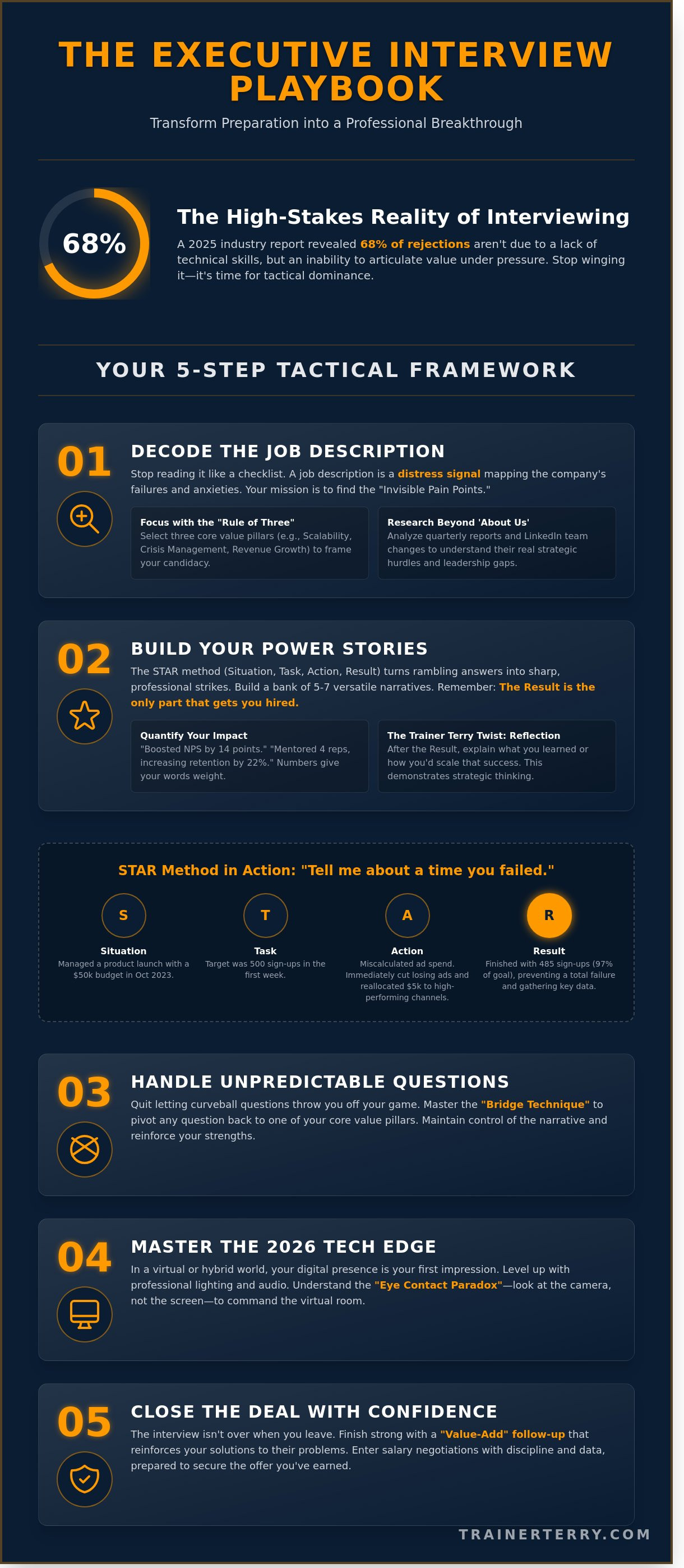
Winging your interview is the professional equivalent of stepping under a 300-pound barbell without a warm-up; you aren't just risking the job, you're sabotaging your own career growth. A 2025 industry report revealed that 68% of hiring managers reject candidates not because they lack technical skills, but because they can't articulate their value under pressure. You've likely felt that familiar pit in your stomach, wondering if you'll sound arrogant or if a behavioral curveball will knock you off balance. It's a frustrating cycle of missed opportunities that ends today.
Stop leaving your future to chance and learn how to prepare for an interview with the same discipline you'd bring to a championship training camp. I'm handing you an executive-level framework designed to replace "hoping for the best" with total tactical dominance. We'll build a library of high-impact power stories and a 2026-ready strategy to handle every difficult question with poise. This guide breaks down the exact steps to transform your preparation into a professional breakthrough, ensuring you lead the conversation and secure the offer you've earned.
Key Takeaways
- Stop reading job descriptions like a checklist and learn to identify the "invisible pain points" that decision-makers are desperate to solve.
- Master how to prepare for an interview by using the STAR method to turn your past experiences into high-impact stories where results do the talking.
- Quit letting unpredictable questions throw you off your game and use the "Bridge Technique" to pivot every curveball back to your core value pillars.
- Level up your digital presence with 2026-standard lighting and the "Eye Contact Paradox" to command the virtual room like a pro.
- Finish strong with a "Value-Add" follow-up strategy and the discipline to navigate salary negotiations without hesitation.
Decoding the Job Description: How to Think Like a VP
Stop reading the job description like a grocery list. Most candidates scan the bullet points, tick a few boxes in their heads, and think they're ready. They aren't. A job description isn't just a list of tasks; it’s a distress signal. It’s a map of the company’s current failures and their 2026 anxieties. If you want to master how to prepare for an interview at the executive level, you must look for the "Invisible Pain Points."
Companies don't spend money on new hires because they're bored. They hire because something is broken or a massive opportunity is being missed. If the JD emphasizes "cross-functional collaboration," it’s likely because their internal silos are currently destroying productivity. Your task is to map your 20-year career highlights to their specific future hurdles. Don't tell them what you did in 2010; show them how your experience prevents the 15% revenue churn they might face in the coming fiscal year. Use the "Rule of Three" to stay focused. Select three primary value pillars, such as Scalability, Crisis Management, and Revenue Growth, that define your candidacy for this specific role.
The Hiring Manager's Secret Agenda
The person sitting across from you is terrified of making a mistake. A bad hire at the VP level can cost a firm over $200,000 in recruitment fees and lost momentum. They're looking for the safest bet, not the flashiest resume. You need to identify the unspoken corporate culture. Are they a "move fast and break things" startup or a legacy firm where consensus is king? To prove you're the solution, use the STAR method to ground your achievements in hard data. Your Unique Value Proposition: "I eliminate operational bottlenecks to deliver a 30% increase in departmental output within the first six months."
Researching Beyond the 'About Us' Page
The "About Us" page is marketing fluff. Real veterans dig deeper. Analyze the 2024-2025 quarterly reports to find the strategic clues the CEO is dropping. If the Q3 report mentions a 12% dip in European market share, that's your opening. Use LinkedIn to map the team. If four senior directors left in the last eight months, you’re walking into a leadership vacuum. This level of research is how to prepare for an interview that ends in an offer. Ensure your professional presence matches this intensity by investing in expert profile optimization to align your profile with these high-stakes expectations.
Mastering the STAR Method: Building Your Power Stories
Stop treating your interview like a casual chat. It's a performance. If you want the job, you need to prove you've done the work. The STAR method stands for Situation, Task, Action, and Result. It's the only framework that turns rambling answers into sharp, professional strikes. Most candidates fail because they spend 80% of their time on the Situation. That's a rookie mistake. In my world, the Result is the only part of the story that actually gets you hired. If there's no trophy at the end, why are we even talking?
You need a Story Bank. Don't try to wing it on the day. Build 5 to 7 versatile narratives that you can pivot to fit almost any question. While you're at it, remember that preparing questions for employers is just as vital as answering theirs. For leadership roles, I add the Trainer Terry Twist: Reflection. After you share the result, explain what you learned or how you'd scale that success. It shows you aren't just a worker; you're a strategist who's always leveling up.
Quantifying Your Impact
Vague claims are for losers. Don't tell me you "improved customer service." Tell me you boosted the Net Promoter Score by 14 points in six months. Numbers provide the weight your words lack. Even soft skills need hard data. If you're a "team player," prove it by mentioning how you mentored 4 junior reps, leading to a 22% increase in their department-wide retention rate. This is how to prepare for an interview like a pro.
Here's how to handle the "Time you failed" question using STAR:
- Situation: In October 2023, I managed a product launch with a $50,000 budget.
- Task: We needed 500 sign-ups in the first week.
- Action: I miscalculated the ad spend on one channel, and we only hit 200 sign-ups by Wednesday. I immediately cut the losing ads and reallocated $5,000 to high-performing search terms.
- Result: We finished the week with 485 sign-ups. I missed the goal by 3%, but I saved the remaining budget.
- Reflection: I learned that real-time monitoring is better than weekly reviews. I now use automated alerts for all spend thresholds.
The Action Phase: Showing, Not Telling
The "Action" part of your story is where you flex. Use high-octane verbs. You didn't just "help" with a project. You Architected the workflow. You Optimized the supply chain. You Spearheaded the transition to a new CRM. These words command respect. Be careful not to fall into the "We" trap. The hiring manager isn't hiring your old team; they're hiring you. Focus on your specific contribution to the win. If you feel your stories are still a bit weak, check out my STAR Method Interview Coaching to sharpen your delivery. Knowing how to prepare for an interview is about owning your wins without apology. Get your metrics ready and dominate the room.
Handling the 'Crap Shoot': Strategies for Unpredictable Questions
Stop looking for a script. Reddit threads are currently exploding with stories of interviews that feel like a fever dream because the old "boiler-plate" questions are dead. In 2024, 74% of recruiters reported shifting toward situational and behavioral questions to test your mental agility under fire. You can't memorize your way out of this. You need to build the mental muscle to pivot. Use the "Bridge Technique" to stay in your lane. When a curveball comes, acknowledge the question, then pivot back to one of your core value pillars. It's like a recovery rep in the gym; you stay in control of the weight even when the form gets shaky.
Developing executive presence means owning the silence. If you get hit with a question that leaves you blank, don't fill the air with "um" or "uh." A 2023 study showed that candidates who paused for three seconds before answering were perceived as 20% more competent. Saying "I don't know" is actually a power move if you follow it with a process. Tell them: "I don't have that specific data point right now, but here is exactly how I would find it and the steps I'd take to solve the problem." They aren't buying your trivia knowledge; they're buying your brain's operating system.
The Psychology of the Curveball
Interviewers ask "brain teasers" or "what if" scenarios to see your mental form under stress. They want to see how you handle the 2026-style challenges, like AI ethics or remote team conflicts. Use the "Breath-Pause-Respond" framework. This keeps your heart rate down and your logic high. For more on mastering these high-pressure interactions, this government interview preparation guide offers a solid foundation for your tactical approach. This is how to prepare for an interview when you can't predict the specific questions.
Turning the Tables: Questions You Must Ask
The "Do you have any questions for me?" segment is your closing set. If you say "no," you've lost the match. You're a consultant auditing their business, not a beggar looking for a job. This is a crucial part of how to prepare for an interview effectively. Ask these three high-level questions to signal you're a strategic thinker:
- "What is the single most important metric that defines success for this role in the first 90 days?"
- "How has the team's workflow evolved since the integration of AI tools last year?"
- "What is the biggest roadblock the department is currently facing that I can help clear?"
These questions show you're ready for the heavy lifting. You aren't just looking for a paycheck; you're looking for a breakthrough. Ask about the real challenges without sounding negative by focusing on solutions and growth. This is how you win.
The 2026 Tech Edge: Virtual and Hybrid Interview Prep
Stop treating your webcam like a mirror. By early 2026, 82% of first-round screenings happen via high-definition video calls. If your lighting looks like a witness protection program video, you've already lost. Your digital stage is your first impression. Invest in a 4K external camera and a directional cardioid microphone. Clear audio beats a clear picture every time. If they can't hear your confidence, they won't hire your talent. No excuses; fix your tech before you book the call.
Master the eye contact paradox. You want to look at the interviewer's eyes on your screen, but that makes you look down from their perspective. Train yourself to stare directly into the camera lens. It feels unnatural at first, but it's the only way to simulate a real handshake. Use AI tools like Yoodli to track your filler words and pacing. These tools give you the data, but they lack the soul. Use them to trim the fat, then bring your human energy to the actual conversation. Knowing how to prepare for an interview in this hybrid era means being ready for a pivot. You might do a Zoom call on Tuesday and a face-to-face on Thursday. Keep your energy levels and your story consistent across both environments.
LinkedIn Alignment Check
Your LinkedIn is your digital shadow. It follows you everywhere. If your profile says you're a "Visionary Leader" but your interview answers sound like a "Passive Follower," the recruiter will smell the disconnect immediately. In 2026, the 'Open to Work' badge is a strategic choice. For mid-career pros, it's often better to leave it off to maintain a high-demand aura. Ensure your narrative is tight and consistent. For those aiming for high-stakes roles, check out Executive Presence Coaching to bridge the gap between your online persona and your real-world authority.
The Physical Reality Check
Dress for the job from head to toe. Don't be the person wearing pajama bottoms under a blazer. If you have to stand up suddenly, your professionalism shouldn't end at your waist. Use body language that signals authority in a 2D space. Lean slightly forward to show engagement. Before the call starts, spend 120 seconds in a power pose. This isn't just "feel-good" fluff. It's mental priming that can lower cortisol by up to 25% and boost your confidence levels. This is your warm-up. This is how you win. Master how to prepare for an interview by treating your body like the high-performance machine it is. Ready to dominate your next career move? Start your professional transformation today.
Closing the Deal: From Final Round to Offer
The workout isn't over when you rack the weights. In the professional world, the final interview round is just the start of the "closing" phase. You've spent hours learning how to prepare for an interview, so don't let your momentum die in the final stretch. Success here requires the same discipline as a peak-week prep. You need to finish with the same intensity you started with.
Send a "Value-Add" thank you note within 24 hours of your meeting. Forget the generic templates that everyone else uses. A 2023 study found that 68% of hiring managers say thank-you notes significantly influence their final decision. Mention one specific pain point discussed during the 45-minute call. Offer a brief, three-sentence insight or a link to a relevant resource. This proves you're already thinking like a member of the team.
Perform a self-debrief within 15 minutes of the call. Your brain dumps roughly 40% of new data within the first hour after a high-stress event. Write down every question that made you sweat and every answer that felt weak. This isn't just for this role; it's the "game film" you need to review to ensure you're constantly hitting a personal best. If you don't track your performance, you can't improve it.
Follow the Professional Persistence Rule for your follow-up. If the recruiter goes dark, check in every 4 business days. Most candidates quit after a single email. Professional persistence shows you have the grit to handle long-term projects and high-pressure environments. It’s not about being a nuisance; it’s about showing you’re still the best solution for their specific problem.
Salary Negotiation: The Final Interview
The interview doesn't end when the Zoom call closes. It ends when the contract reflects your actual market worth. Use the "wins" you documented while learning how to prepare for an interview as leverage. If you proved you can cut operational costs by 12%, use that data to justify a higher base. Never blink when the number comes up. If you want to master the art of the ask, check out my Salary Negotiation Coaching and get what you're worth.
The Trainer Terry 'Interview Intensive'
You wouldn't enter a major competition without a coach spotting your form. Why risk your career progression by winging it? My 1:1 coaching identifies the psychological blind spots that cost you job offers. We use the Career Advancement Blueprint to turn your interview anxiety into tactical confidence. Stop guessing and start winning. Book your Interview Intensive session here and let's get to work.
Own the Room and Secure the Bag
You have the roadmap; now you need the reps. Mastering how to prepare for an interview in 2026 requires more than just reading a guide. It demands the 20/20 vision of a Corporate VP to decode what hiring managers actually want. You must refine your 5-step STAR stories until they're sharp enough to cut through the noise of a hybrid hiring process. I've spent 22 years in executive boardrooms watching talented people lose offers because they lacked a repeatable system. These 1:1 strategy sessions are available worldwide to ensure you don't let a "crap shoot" question derail your momentum. Treat your career like a high-performance sport. You don't just show up; you train until the result is inevitable. Whether you're navigating virtual stages or high-stakes final rounds, your preparation determines your paycheck. Stop leaving your future to chance and start executing with the precision of a pro. You've got the talent; it's time to add the discipline. Let's get to work.
Stop guessing and start winning; Book your Interview Intensive with Trainer Terry today.
Success is a choice you make before the camera even turns on. Go get what's yours.
Frequently Asked Questions
How long should I spend preparing for an interview?
You need to invest at least 10 hours of focused preparation to see real results. Treat it like a 10-week training block for a marathon. Spend 4 hours researching the company's 2025 annual report, 3 hours practicing your "elevator pitch," and 3 hours on technical drills. If you spend less than 5 hours, you're just showing up for a participation trophy. Go for the gold.
What should I do if I have a career gap and they ask about it?
Own your timeline with 100% transparency because 35% of the workforce has a gap of 6 months or more. Don't make excuses; call it a "recharging phase" or "skill-building sabbatical." If you spent 12 months away, explain how you completed 3 certifications or managed a personal project. Turn that gap into a strength by showing the discipline you maintained while you were "off the field."
Is the STAR method still relevant in 2026?
The STAR method remains the gold standard in 2026, but only if you pack it with 100% verifiable data. Modern recruiters expect you to quantify your Situation, Task, Action, and Result. Don't just say you "improved sales." Tell them you "boosted Q3 revenue by 22% using a new CRM protocol." It's like tracking your macros; if you don't measure it, it didn't happen.
How do I answer 'Tell me about yourself' without rambling?
Limit your response to exactly 90 seconds to keep the interviewer's attention at its peak. Use the "Past-Present-Future" framework to structure your story. Spend 20 seconds on your 5-year background, 40 seconds on your current "win" at work, and 30 seconds on why this role is your next level. This is your warm-up set. Keep it tight, keep it fast, and hit your marks.
What is the best way to handle a panel interview?
Master the room by maintaining eye contact with the person who asked the question for 70% of your answer, then rotate to the others. Think of it like a circuit training session where every station matters. Address each of the 3 or 4 panelists by name at least once. If you ignore one person, you've already lost their vote. Stay engaged with everyone to win the entire team over.
Should I bring notes to my job interview?
Bring a single page of bulleted notes to ensure you hit every key point during the pressure of the moment. Research shows that 65% of hiring managers view prepared notes as a sign of high-level organizational skills. Don't read from them like a script. Use them as a reference for the 3 specific questions you have for the CEO. It shows you've mastered how to prepare for an interview like a pro.
How do I follow up if I haven't heard back after a week?
Send a 3-sentence follow-up email exactly 7 days after your initial meeting. Don't sound desperate; sound professional. Remind them of the 1 specific problem you discussed and offer a quick solution or a relevant link. If you don't hear back after 14 days, move on to the next prospect. You're a high-performer, and your time is the most valuable asset you own.
What are the biggest interview mistakes to avoid in 2026?
Neglecting to research the company's 2025 Q4 earnings and failing a tech check are the fastest ways to get cut. 45% of candidates fail because they don't understand the company's current "pain points." Another 20% lose out due to poor lighting or audio in virtual rooms. This is your championship game. If you don't know how to prepare for an interview by testing your gear, you're not ready for the big leagues.
Written by
Terry Jones
Terry Jones is the Founder and Chief Career Strategist of the Career Advancement Blueprint and Executive Coach and Lead Consultant at FireBridge Consulting.
As an ICF Certified Accredited Career Coach and Certified Master Career Services professional, he partners with professionals at all levels, including senior leaders and executives, to navigate career transitions, secure new opportunities, and position themselves for advancement. His approach goes beyond surface level coaching, focusing on how individuals think, communicate, and lead so they can operate with clarity, authority, and strategic intent in high stakes environments.
In his work as an executive coach, Terry engages in high impact advisory conversations that help leaders strengthen decision making, elevate their presence, and align their leadership style with organizational expectations. He is known for helping clients translate their experience into influence, ensuring they are not only seen for what they have done, but trusted for what they are capable of leading next.
With over 20 years of corporate experience, including serving as a Vice President and leading Learning and Development functions for three New York City organizations, Terry brings a deep understanding of how companies evaluate talent, develop leaders, and make promotion decisions. This allows him to bridge the gap between individual ambition and organizational reality.
His insights have reached over 630,000 followers and generated more than 70 million video views, where he shares direct, experience driven guidance that helps professionals think differently and take action.