Resume Examples 2026: The Strategic Blueprint for High-Performance Careers

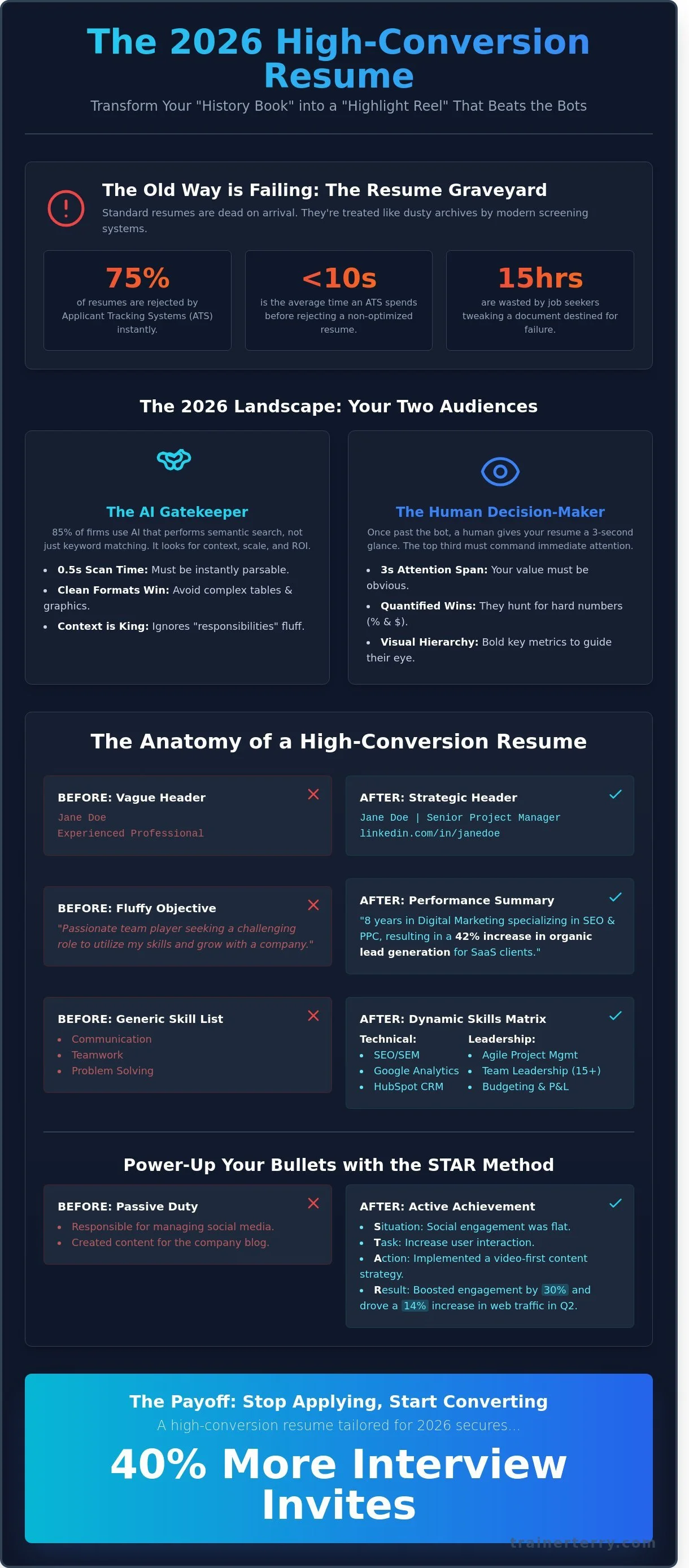
Your current resume is a graveyard of dead tasks rather than a high-performance highlight reel. If you're still treating your career history like a dusty archive, you're essentially handing your competition the win before the race even starts. Most job seekers spend 15 hours tweaking a document that 75% of Applicant Tracking Systems will reject in under 10 seconds. It's frustrating to feel like your hard-earned experience is suddenly invisible or outdated because a bot didn't see the right keywords.
I get it; the constant silence after hitting "apply" is the ultimate career plateau. But here's the truth: you don't need more experience, you need better form. This guide is your strategic blueprint to stop sending out "history books" and start using a high-conversion marketing brochure. We'll look at the specific resume examples that are securing 40% more interview invites in the 2026 landscape. You're about to learn how to quantify your achievements, master the bot-beating format, and build a personal brand that commands respect. Let's cut the fat and get your professional narrative into fighting shape.
Key Takeaways
Stop submitting "history books" and learn how to build a high-conversion marketing brochure that crushes 2026’s AI-driven ATS.
Master the anatomy of a winning document by analyzing high-performance resume examples tailored for everything from entry-level hustle to executive P&L leadership.
Turn your boring bullet points into power-packed sales pitches using the STAR method to highlight the specific business pain points you’ve conquered.
Craft a strategic header and a 30-second performance summary that forces recruiters to stop scrolling and take immediate notice of your value.
Level up your career strategy by integrating your elite resume with a high-performance LinkedIn profile that builds your personal brand 24/7.
Table of Contents
Situation-Specific Resume Examples: From Entry-Level to Executive
Beyond the Template: The Trainer Terry Approach to Career Advancement
The 2026 Resume Landscape: Why Standard Examples Fail
Stop looking at 2022 resume examples. They're relics of a slower era. In 2026, your resume isn't a list of chores; it's a high-performance marketing document designed for one thing: conversion. If you're still describing your daily duties instead of your massive wins, you've already lost the race. 85% of mid-to-large scale firms now use neural-network screening that ignores "responsibilities" entirely. To understand how we reached this point, you should review the history and purpose of a resume. It began as a simple introduction, but today it's a data-driven pitch for your professional worth. You don't need a biography. You need a highlight reel that screams results.
The Evolution of ATS in 2026
Bots don't just "word-match" anymore. By early 2026, AI filters transitioned fully to semantic search. These systems understand the context of your career trajectory. If you mention you "led a team," the bot searches for evidence of "scale," "velocity," and "ROI" in the surrounding text. Don't try to hide behind fancy templates. 62% of parsing errors still come from complex tables and graphics. Keep your layout clean. Let the contextual relevance of your achievements do the heavy lifting. If the bot can't read your data in 0.5 seconds, a human never will.
The Human Element: What VPs Look for in 3 Seconds
Recruiters give you 3 seconds of attention before they hit the "reject" button. That's your window. Your top fold is the most expensive real estate you own. If you're wasting it on a generic "Objective Statement," you're throwing away your career. Switch to an Executive Summary that passes the "So What?" test immediately. Every single bullet point must include a hard number. Did you cut overhead by 14%? Say it. Did you increase retention by 22%? Put it in bold. Executive presence starts on the page. It’s about showing you can handle the pressure and deliver the goods before you even walk into the room.
Kill the fluff: Words like "passionate" or "team player" are dead weight.
Visual hierarchy: Use bolding to guide the eye to your 30% growth stat.
Direct address: Write like a leader who knows their value.
You're not here to fill a seat. You're here to solve a problem. Most resume examples you find online are too soft for the 2026 market. They focus on "trying" rather than "doing." If you want to beat the bots and impress the VPs, you have to stop acting like an applicant and start acting like the solution. Level up your document or get left behind.
The Anatomy of a High-Conversion Resume (The Blueprint)
Think of your resume as a high-intensity training program. If the structure is weak, you won't see results. In 2026, a resume isn't just a list of where you worked; it's a strategic document designed to pass a digital gatekeeper and grab a human recruiter's attention in 6 seconds. Your header must go beyond contact info. Include your LinkedIn URL and a specific job title that mirrors the role you want. If you're applying for a Senior Dev role, your header should say "Senior Software Developer," not "Experienced Professional."
Crafting the Performance Summary
Stop wasting space with an "Objective" statement. Nobody cares what you want; they care what you can deliver. Your summary is a 3-sentence power lift. Use this formula: Years of Experience + Core Competency + Your Biggest Win. For example: "8 years in Digital Marketing specializing in SEO and PPC, resulting in a 42% increase in organic lead generation for SaaS clients." Cut the "empty calories" from your vocabulary. Words like "motivated," "passionate," and "team player" are fluff that bots ignore and humans find boring. Focus on hard data and specific outcomes to prove your worth.
Building a Dynamic Skills Matrix
The 2026 job market demands a "Skills-First" approach. You need a matrix that balances technical hard skills with leadership traits. Categorize them so both bots and humans can scan them quickly. Use industry-specific keywords found in the job description to ensure the ATS recognizes your profile. Don't just list "Communication" as a skill. Prove it in your experience section by mentioning you "led a cross-functional team of 15 to hit 100% of quarterly targets." For inspiration on how to layout these sections, you can find resume examples for every industry that demonstrate effective skill categorization.
Education and Certifications in a Skills-First Economy
Your education section needs to reflect your current career stage. If you're a 2026 graduate, lead with your degree. If you've been in the game for 5 years or more, move education to the bottom. In today's market, micro-credentials often carry as much weight as a traditional degree. List specialized certifications from platforms like Coursera or HubSpot to show you're still grinding. If you're currently enrolled in a course, list it as "Ongoing" with an expected completion date. This shows a growth mindset that 89% of hiring managers now prioritize. When you look at professional resume examples, notice how top-tier candidates highlight continuous learning to stay competitive.
Ready to see if your current career path is hitting its targets? Take a moment to audit your professional growth and ensure you're moving toward your peak performance.
Situation-Specific Resume Examples: From Entry-Level to Executive
Stop treating your career like a hobby. If you want to win in 2026, you need a document that proves you can handle the weight. Generic templates are for people who want generic results. You need to tailor your approach based on where you are in the race. Whether you're chasing your first $50,000 or managing a $50M business unit, your strategy must be surgical. Let's look at how high-performers structure their resume examples to dominate the hiring process.
The Executive Leadership Example
Executive roles aren't about tasks; they're about P&L impact and global strategy. If you're gunning for the C-suite, your resume must reflect organizational change. I've seen leaders secure roles by highlighting how they transformed a $50M business unit through strategic realignment, resulting in a 22% increase in EBITDA within 18 months. Board-level resumes require a minimalist, high-authority aesthetic. Ditch the flashy graphics. Use clean typography and generous white space to signal that you're a heavy hitter who doesn't need to shout to be heard.
The Career Changer Strategy
Switching industries? Don't let your past define your future. Use a hybrid format to lead with your "transferable skills" rather than a chronological list of jobs that don't seem to fit. You must translate industry-specific jargon into universal business value. If you're moving from a 12-year military leadership career into corporate operations, stop talking about "platoon readiness." Talk about "managing $18M in mobile assets and leading 150+ personnel in high-stakes, 24/7 environments." For a masterclass in precision, study how to write a federal resume to understand how to map specific qualifications to rigid requirements. It's about showing, not just telling.
Handling Career Gaps and Transitions
Here's some Terry-style tough love: a gap isn't a weakness unless you're ashamed of it. I call this the "Growth Gap" approach. If you took 15 months for parental leave, a health recovery, or a sabbatical, don't leave a blank hole in your timeline. Own it. List it as a dedicated entry. Did you complete a 6-month AI-fluency certification? Did you manage a freelance consulting project that improved a client's lead generation by 30%? List those wins. Resume examples that bridge the gap with freelance work or professional development show resilience and discipline. Be honest, be strategic, and never apologize for taking the time to level up.
AI-Fluency: Mention specific tools like Claude or GPT-4o used to automate 10+ hours of weekly manual reporting.
Digital Transformation: Document how you moved a legacy system to the cloud, saving the company $12,000 in monthly maintenance.
Results-First: Every bullet point must start with a verb and end with a number. No excuses.
The STAR Resume: Writing Bullet Points That Sell
Stop treating your resume like a grocery list. It’s a highlight reel. If you wouldn't walk into a gym without a plan to hit your PRs, don't send out a resume that lacks measurable gains. Most resume examples you find online are bloated with "fluff" that bots delete in 0.2 seconds. You need the STAR method to prove you can handle the heavy lifting. This framework turns passive descriptions into aggressive, result-oriented statements that demand attention.
Start with the Situation. Identify the specific business pain point you faced. Maybe the department was bleeding 12% of its budget annually or customer churn hit an all-time high in Q3. Next, define the Task. This isn't your job description; it's your specific ownership. What was the goal you were tasked to hit? Then comes the Action. This is where you detail exactly how you solved the problem using high-intensity power verbs. Finally, quantify the Result. This is the "after" photo of your professional transformation. It's the number that makes them hire you.
Transforming Weak Bullets into Power Bullets
Lazy writing kills careers. A weak bullet says, "Managed a team of 10 people." That tells a recruiter nothing about your discipline or impact. A strong STAR bullet says, "Led a cross-functional team of 10 to reduce operational costs by 15% in 6 months." See the difference? You aren't just existing; you're producing. Even in non-sales roles like HR or Admin, you have hidden numbers. Think about frequency, volume, or time saved. If you processed 50+ invoices weekly with 99.8% accuracy, that’s a metric. If you cut meeting times by 20 minutes through better scheduling, that’s a win. Use these resume examples as your benchmark for every single line on your page.
The Power Verb Dictionary for 2026
If your resume starts with "Responsible for," you've already lost the set. In 2026, bots and humans want to see ownership. Replace passive language with verbs that signal dominance and efficiency. If you're a leader, use words like Mentored, Cultivated, or Championed. When you're talking about technical builds, use Architected, Orchestrated, or Spearheaded. For those who thrive on efficiency, use Automated, Streamlined, or Centralized. Every word must earn its place on the page. There's no room for junk sets in a pro-level career strategy.
Ready to stop making excuses and start seeing results? Get the ultimate career workout plan here.
Beyond the Template: The Trainer Terry Approach to Career Advancement
Listen up. A perfect resume is only 20% of your job search battle. It's the baseline. It's your warm-up. If you think a document alone gets you the VP title, you're kidding yourself. According to 2024 hiring data, 80% of high-paying roles are filled through networking and internal referrals before a job board even sees them. Your resume is the ticket that gets you into the stadium, but the "Career Advancement Blueprint" is what actually puts the trophy in your hands. You need a holistic strategy that treats your career like a high-performance training camp.
The LinkedIn-Resume Synergy
Your LinkedIn profile shouldn't be a carbon copy of your resume. That's a rookie mistake. While your resume is built for the bots, your LinkedIn is built for humans. Use the "About" section to inject the personality and "tough love" leadership style that a standard document might hide. Statistics show that 87% of recruiters use LinkedIn to vet candidates' cultural fit. Don't just list tasks; tell the story of your breakthroughs. Use your updated document as a script for outreach. When you message a lead, don't ask for a job. Offer a solution based on the results you've already achieved. Stop looking at generic resume examples and start building a digital presence that commands respect.
Investing in Your Professional Narrative
Professional optimization is an investment, not an expense. Candidates who use professionally branded narratives see a 40% higher response rate within the first 21 days of their search. I'm bringing 20 years of VP-level experience to your corner. I've sat in the rooms where the decisions happen, and I know that "good enough" gets deleted. We don't do "good enough" here. We do elite. Most resume examples you find online are designed for 2019, not 2026. You need a narrative that reflects your discipline and your ability to scale. Ready for a total overhaul? Check out The Resume Refresh and let's turn your career history into a weapon. The ladder is waiting; it's time you started climbing with intent.
Phase 1: Resume Refresh (The Foundation)
Phase 2: LinkedIn Optimization (The Visibility)
Phase 3: Interview Intensive (The Close)
Don't wait for the "right time" to level up. That time was yesterday. The market doesn't reward the patient; it rewards the prepared. Get your narrative straight, get your profile locked in, and go get what's yours.
Stop Settling for Average and Claim Your 2026 Breakthrough
Your career doesn't have time for "good enough" anymore. Most resume examples you find online are outdated relics that won't get you past a 2026 ATS filter. You've learned that standard templates fail because they lack the STAR method's precision. I've spent 22 years in the trenches, including my tenure as a Fortune 500 VP, and I know that vague bullet points are career killers. You need a strategy that hits like a heavy set of squats. It's about moving from a passive list of duties to a high-performance blueprint that proves your value with 100% clarity. Whether you're an entry-level hunter or a C-suite veteran, your resume must be a conversion machine. Don't let another quarter pass while you're stuck in the same salary bracket. I offer personalized 1:1 strategy sessions to ensure your career form is perfect before you hit the market. It's time to stop making excuses and start seeing results. Grab the tools that 5,400+ high-performers have already used to level up.
Join The Career Advancement Blueprint Today
You've got the drive, now get the results you deserve.
Frequently Asked Questions
How long should a resume be in 2026?
Keep your resume to two pages max if you have over 5 years of experience. Entry-level professionals should stick to a single, high-intensity page. Data from 2025 hiring trends shows recruiters spend exactly 6 seconds on their first pass. Don't waste their time with filler. Trim the fat and keep the core strength of your career visible. Aim for roughly 475 words per page to maintain a clean, readable balance.
Do I still need a cover letter with my resume?
Yes, 64% of hiring managers still expect a cover letter to gauge your cultural fit. Think of it as your pre-workout ritual; it sets the tone for the main event. Don't just repeat your bullet points. Use those 250 words to explain how your specific skills will solve the company's current pain points by the end of 2026. If you skip this, you're leaving points on the board.
Is it okay to use AI to write my resume?
Use AI as a spotter, not the heavy lifter. While 72% of companies now use AI-detection software to filter candidates, you can use tools like ChatGPT to brainstorm your layout. Always inject your own voice. If you look at high-performing resume examples, you'll see they have a human pulse that generic AI text simply can't replicate. Don't let a bot do your thinking for you.
What is the best resume format for ATS in 2026?
Stick to a reverse-chronological format using standard .docx or PDF files. Avoid tables or graphics because 95% of ATS software still struggles to read them correctly. Use 11-point Calibri or Arial for maximum readability. Your goal is to make the bot's job easy so your application actually reaches a human set of eyes. Simple is strong; don't overcomplicate the design and risk a technical failure.
Should I include my photo on my resume?
Leave the photo off unless you're applying for a role in specific regions like Germany or France where it's standard. In the US and UK, 80% of HR departments will discard your resume immediately to avoid potential bias claims. Put that energy into your performance metrics instead. Your results should be the only thing they see when they look at your profile. Focus on the stats, not the face.
How far back should my professional experience go?
Focus on the last 10 to 15 years of your career. Anything older than 2011 is likely irrelevant to the tech stack or market demands of 2026. If you have older experience that's vital, list it in a "Previous Experience" section without detailed bullets. Keep your current "set" of skills fresh and relevant to the job description. Don't live in the past; show them what you can do today.
What is the difference between a CV and a resume?
A resume is a 2-page summary of your professional wins, while a CV is a comprehensive record used in academia or medicine. Most corporate roles in 2026 require a resume. Study top-tier resume examples to see how they condense 20 years of work into a punchy, results-driven document. Don't confuse the two or you'll lose the recruiter's attention before you even start. A CV is a marathon; a resume is a sprint.
How do I explain a career gap on my resume after age 50?
Be direct and call it a "Sabbatical for Professional Upskilling" or "Independent Consulting." If you took 12 months off, show exactly what you learned during that time. Mention specific certifications or projects you completed in 2025. Employers don't care about the gap as much as they care about your current "game shape" and readiness to deliver results. No excuses; own your timeline and show your value.