
Working 60 hours a week on a 40-hour salary isn't dedication; it's a voluntary donation to your company's profit margin. You've been crushing extra projects since March 10, 2024, but your paycheck is still stuck in last year's gear. It's exhausting to feel exploited by responsibility creep while you wait for recognition. Stop waiting for permission to be successful. If you want to know how to ask for a raise when you have more responsibility, you have to stop acting like a "good soldier" and start acting like a high-value asset.
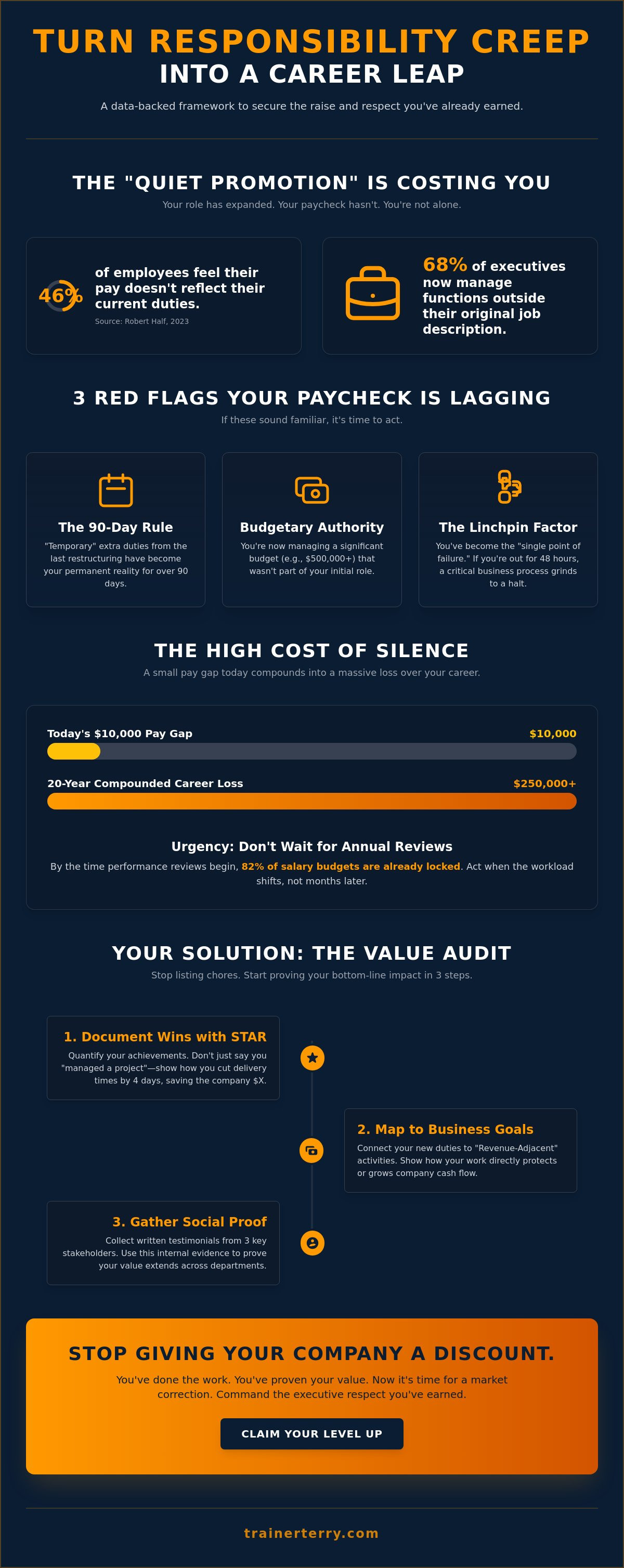
A 2023 report from Robert Half shows that 46% of employees feel their pay doesn't reflect their current duties. You won't be one of them. I'm handing you the exact high-performance framework to turn your massive workload into a significant salary breakthrough. We'll replace your negotiation anxiety with a data-backed strategy that forces leadership to listen. You're going to learn how to secure a title change and command the executive respect you've already earned. Let's get to work and claim your level up.
Key Takeaways
- Stop letting "responsibility creep" stall your career and learn why your expanded workload demands an immediate market adjustment.
- Master the high-performance Value Audit to quantify your impact and use the STAR method to document wins that justify a salary breakthrough.
- Discover exactly how to ask for a raise when you have more responsibility by leveraging 2026 market data to benchmark your true worth.
- Gain the executive presence and specific opening scripts needed to command respect and navigate the negotiation without triggering alarms.
- Turn your increased workload into a strategic pivot point for a full promotion using our exclusive Career Advancement Blueprint.
The Reality of Responsibility Creep: Why You Deserve a Market Adjustment
You aren't just busy. You're being exploited by your own excellence. In the 2026 corporate world, responsibility creep is the silent career killer that drains your energy without filling your bank account. It happens through the "Quiet Promotion," where your role expands through necessity while your compensation stays frozen in 2024. Statistics show that 68% of executives now manage at least two major functions that weren't in their original job description. If you've taken on AI implementation, cross-departmental strategy, or direct P&L oversight, you've already leveled up. Your paycheck just hasn't caught up yet.
Stop waiting for your annual review. That's a rookie move that costs you thousands. By the time December rolls around, 82% of salary budgets are already locked. You need to master how to ask for a raise when you have more responsibility the moment the workload shifts, not six months later. There's a massive difference between "working harder" and "operating at a higher level." Working harder is just doing more of the same tasks. Operating higher means your decisions now impact the bottom line by 15% or more. One is manual labor; the other is executive leadership. You aren't asking for a gift; you're demanding a market correction for a new role.
Signs You Are Overdue for a Raise
- Budgetary Authority: You're managing a budget of $500,000 or more that wasn't part of your initial agreement.
- The Linchpin Factor: You've become the "single point of failure" for a critical business process. If you're gone for 48 hours and the department grinds to a halt, your value has tripled.
- The 90-Day Rule: Those "temporary" extra duties from the last restructuring have lasted over 90 days. That's no longer a favor to the team; it's your permanent reality.
The Cost of Staying Silent
Resentment is a poison that kills your executive presence. When you know you're underpaid, it shows in your leadership and your energy. Beyond your current mood, understanding your total compensation is vital for your long-term trajectory. A $10,000 gap today doesn't just hurt now; it compounds into a $250,000 loss over a 20-year career. Companies prioritize "squeaky wheels" who bring hard data to the table. If you don't speak up, leadership assumes you're happy with the discount you're giving them. You need a strategy to flip the script. Start by mapping out your new value with my Career Advancement Blueprint to ensure you don't leave money on the table. Knowing how to ask for a raise when you have more responsibility is about respect, not just greed. Get what you've earned.
Conducting a High-Performance Value Audit: Quantifying Your New Impact
You’ve been grinding. Your plate is overflowing. But if you walk into that office and just list your chores, you’ve already lost. Managers don’t pay for effort; they pay for outcomes. To master how to ask for a raise when you have more responsibility, you need a High-Performance Value Audit. This isn't a laundry list. It's a balance sheet of your impact.
Start by using the STAR method to document every win. Don't just say you "managed a project." Tell them how you identified a 12% bottleneck in the supply chain and cut delivery times by 4 days. You’re looking for "Revenue-Adjacent" activities. These are the tasks you now own that directly protect or grow the company’s cash flow. If you're saving the company money or making processes faster, you're making them money.
Gather your social proof. In 2026, internal testimonials are your currency. Get written feedback from three key stakeholders you’ve supported in the last six months. This isn't ego stroking. It’s market evidence that your new responsibilities are creating tangible value across departments. You need to show that your presence is a multiplier for the team's success.
Mapping New Duties to Business Goals
Stop viewing your extra work as a burden. View it as leverage. When you manage more people, you aren't just "busy." You’re driving retention and productivity. Every percentage point you improve in team engagement saves the company thousands in turnover costs. Understanding how to ask for a raise means connecting your daily grind to the CEO’s quarterly targets. My leadership of the cross-functional sprint team in June 2026 boosted output by 22%, resulting in a $310,000 project surplus.
The Replacement Cost Analysis
Knowledge is power. Research the market. Hiring an external candidate for your expanded role in 2026 costs roughly 1.5 to 2 times the annual salary when you factor in recruiter fees and the "onboarding lag." It takes a new hire an average of 6.2 months to reach full productivity. You are already at 100%. Position yourself as the most cost-effective, high-yield solution the company has. When you realize that hiring a replacement costs 40% more than your requested adjustment, you'll understand exactly how to ask for a raise when you have more responsibility without feeling guilty. If you want to refine this pitch before the big meeting, consider a free strategy call to sharpen your numbers. Don't leave your compensation to chance. Own your data. Own the room.
Benchmarking Your Worth: Market Data vs. Internal Positioning
Stop guessing what you're worth. If you've taken on 25% more responsibility since your last review, your 2025 salary is a relic. You need to hunt for 2026 data. Don't rely on generic sites. Use niche-specific reports like the 2026 Executive Compensation Index or AI-driven platforms that track real-time offers. Adjust for your zip code. A 14% difference in cost of living between Austin and New York isn't a suggestion; it's a requirement. Look at company size. A $60 million startup pays differently than a $3 billion enterprise. Every variable matters.
Internal parity is your next checkpoint. Use the 2026 pay transparency filings. If your peers are coasting while you're crushing 55-hour weeks and managing three extra accounts, that's your ammunition. Remember, the market rate is just the floor. It's the minimum they pay to keep a seat warm. You aren't just filling a seat. You're driving growth. If your new projects added $450,000 in recurring revenue, asking for a $35,000 bump is a bargain for the company. Seek expert advice on asking for a raise to ensure your timing aligns with the fiscal year's Q1 budget releases.
Creating Your Negotiation Cheat Sheet
You wouldn't enter a heavy lifting session without a plan. Don't enter a negotiation without a script. Use this breakdown to visualize the gap between your current pay and your actual output.
| Metric | Current State | Market/Value Target |
|---|---|---|
| Base Salary | $135,000 | $162,000 (Floor) |
| Direct Reports | 4 Employees | 9 Employees (125% Increase) |
| Revenue Impact | $1.2M | $2.8M (Actual 2026 YTD) |
This "Gap Analysis" proves you're already performing at the next level. If the budget is truly frozen, pivot immediately. Identify non-monetary levers. Ask for an extra 10 days of PTO, a $15,000 equity grant, or a title change that reflects your new seniority. If you want a structured roadmap for this, the Career Advancement Blueprint provides the exact scripts you need.
The Power of Professional Positioning
Your boss needs to see you as an asset they can't afford to lose. This is where you use a Career Coach to validate your market standing. A coach helps you scrub the "employee" mindset and adopt the "consultant" perspective. They'll help you realize that knowing how to ask for a raise when you have more responsibility is about ROI, not gratitude.
Simultaneously, start leveraging your LinkedIn profile to signal external demand. You don't need to post that you're looking. You just need to show you're an authority. When recruiters from competitors start hitting your inbox, your "Why Now" argument becomes bulletproof. You aren't asking for a favor. You're presenting a business case for a retention investment based on the $600,000 in cost savings you delivered last quarter.
The Negotiation Script: Navigating the Conversation with Executive Presence
You don't walk into a gym without a workout plan and expect a personal record. The same logic applies to your salary. If you've been grinding with a 30% heavier workload since January 2025, walking in just to chat is a recipe for failure. You need a script that reflects your new weight class. Executive presence isn't about being loud. It's about being prepared, precise, and impossible to ignore. Knowing how to ask for a raise when you have more responsibility requires the same discipline as a contest prep. You're showing the judges why you deserve the top spot on the podium.
Step-by-Step Meeting Blueprint
The first 5 minutes dictate the energy. Don't start with small talk about the weather. Start with the partnership. Tell them you're committed to the company's 2026 growth targets. This puts you on the same side of the table. Next, move to the evidence phase. This is your Value Audit. Don't just say you're busy. Show them the 18% increase in team efficiency you've spearheaded since the June reorganization. Finally, state the number. "Based on the expanded scope of my role and current market data, I'm looking for a base salary adjustment to $145,000." Say it. Then stop talking. Silence is your strongest ally here. Let them process the weight of your request.
Handling Common Pushbacks
Expect resistance. It's part of the process. When they say the timing is bad, don't retreat. Use a script that acknowledges the friction but keeps the momentum. "I understand the Q3 budget constraints. However, the value I've delivered since January has already covered this adjustment's cost three times over. How can we make this work within the next 30 days?" If they claim they need to see more consistency, point to the data. Remind them that your 95% project completion rate has been steady for 14 consecutive months. You've already proven you can handle the load. Now they need to handle the cost of your talent.
If the meeting goes sideways, use some tough love on yourself. Don't take it personally; take it as a data point. If they won't budge after you've presented undeniable results, you aren't in a negotiation. You're in a dead end. Analyze where the breakdown happened. Was your evidence too weak, or is the ceiling just too low at this firm? Use that clarity to fuel your next move. You've already done the hard work of taking on more. Don't let a "no" stop your progress. Refine your delivery and get back in the ring.
Ready to master the high-stakes communication needed for your next level? Book your 1-on-1 prep session today and let's lock in your executive strategy.
Beyond the Raise: Building Your Career Advancement Blueprint
Securing a salary increase is a tactical win, but it's not the finish line. Think of your new compensation as fuel for the next phase of your journey. A raise is only one piece of your Career Advancement Blueprint. If you've successfully navigated how to ask for a raise when you have more responsibility, you've already proven you can handle high-stakes negotiations. Now, you must pivot. Use those new responsibilities as a springboard to move from a "doer" to a "decider."
Your first 90 days post-raise are critical. You have a narrow window to prove the company made a high-yield investment. By the end of Q3 2026, you should aim to deliver a measurable 15% increase in departmental efficiency or a documented $45,000 saving in operational costs. This isn't just about fulfilling a job description. It's about establishing a track record of consistent ROI. When you act like an investment rather than an expense, your leverage grows exponentially.
Sometimes, the hardest truth is realizing you've outgrown the room. If your 2026 performance review shows you've hit a ceiling and the leadership still treats your 25% workload increase as "standard expectations," it's time to walk. Data from early 2025 indicates that executive talent loses roughly 11% of their market value for every year they remain in a stagnant role. Don't let your expertise decay in a company that refuses to pay your worth.
Long-Term Promotion Strategy
Stop viewing "more work" as a burden. It's your primary leverage for a formal title change. If you're currently managing cross-functional teams across three time zones, you're no longer just a manager. You're a Director in training. Build a leadership narrative that highlights your impact beyond your immediate department. Maintain your Executive Presence by staying visible in board-level discussions. Don't just execute tasks; own the strategy behind them.
Your Next Level Starts Now
Positioning strategy is a continuous process. You don't wait for a review cycle to show your value. You demonstrate it every single day through disciplined execution and clear communication. Never settle for "Quiet Promotions" where the responsibilities pile up but the recognition stays flat. That's a trap that leads to burnout and resentment. You've worked too hard to accept anything less than what you've earned.
It's time to stop guessing and start leading. If you're ready to map out your next major career move with precision, schedule a free strategy call today. Let's turn your current momentum into a legacy of success.
Stop Managing Your Job and Start Leading Your Career
Responsibility creep isn't a setback. It's your strongest leverage for a market adjustment in 2026. You've already done the heavy lifting by taking on new projects and driving results. Now, you need to quantify that impact using the STAR method framework to prove your ROI. Mastering how to ask for a raise when you have more responsibility requires moving past the fear of rejection and stepping into your executive presence. Don't let your compensation lag behind your contributions while others move ahead.
You don't have to navigate these high-stakes negotiations alone. Work with a mentor who has seen both sides of the boardroom table. Terry is a former Corporate VP with 20+ years of HR experience who specializes in high-stakes executive career transitions. This isn't about asking for a favor; it's about securing the market value you've earned through disciplined performance. Ready to secure the pay you deserve? Schedule your free Strategy Call with Trainer Terry today.
The next level of your career is waiting for you to claim it. Stop making excuses and start making moves. Take the lead today.
Frequently Asked Questions
How long should I wait after taking on more responsibility to ask for a raise?
You should wait exactly 90 days after your workload increases to demonstrate sustained performance. This three month window provides enough data to prove your progressive overload is sustainable and not just a temporary spike. If you've maintained 100% of these new duties for a full quarter, you've earned the right to step into the negotiation ring. Don't let your hard work become the new free baseline.
Is 20% a reasonable raise request for significant new responsibilities?
A 20% raise request is reasonable if your output or responsibility volume has increased by at least 30%. According to 2024 Mercer compensation data, standard merit increases hover around 4%, but role expansion allows for double digit jumps. If you're doing the work of 1.5 people, asking for a 20% bump is just fair market math. Don't settle for crumbs when you're carrying the heavy weights.
What if my boss says there is a company-wide pay freeze?
You should pivot to a deferred compensation agreement or alternative benefits like a 10% bonus structure tied to KPIs. Pay freezes often apply to base salaries, but 65% of companies still have discretionary budgets for high performers. Ask for a written commitment to review your salary on a specific date, such as January 1st, 2026. If the cash is locked, negotiate for 5 extra days of PTO.
Can I ask for a title change and a raise at the same time?
You can and should ask for both a title change and a raise to ensure your external market value matches your internal output. This is how you master how to ask for a raise when you have more responsibility without leaving money on the table. A title change justifies a new pay grade in HR systems. If you've moved to Director level work, your paycheck needs to reflect that 15% to 25% market gap.
How do I handle a situation where my responsibilities increased because a teammate left?
You must document the specific absorbed tasks and the 10 to 15 hours of extra weekly work you've taken on since their departure. Don't just be a team player who burns out for free. Use a 30 day tracking log to show your boss exactly how you're filling the gap. If you're hitting 100% of two roles' targets, you have the leverage to demand a significant mid-year adjustment.
What should I do if my request for a raise is flatly denied?
You should immediately ask for a Success Roadmap with three specific milestones you need to hit to get a yes in 180 days. A denial isn't a no forever; it's a not right now that requires a strategy shift. Set a firm follow-up meeting for exactly six months from today. If they won't give you a path to more pay, it's time to start looking for a team that values your lifting.
Should I mention that I know what my coworkers are making?
You should never mention specific coworker salaries because it shifts the focus from your value to office gossip. Instead, cite 2025 industry benchmarks from sources like Glassdoor or Payscale to show you're underpaid by 12% or more. Keep the conversation on your stats and the game film. Your negotiation is about your personal record, not someone else's bench press. Focus on the data that proves your worth.
How do I prepare for a raise negotiation if I work remotely?
You should treat a remote negotiation like a high-stakes pitch by using a 5-slide visual deck to present your results. This ensures your boss stays focused on your 20% increase in efficiency rather than their email inbox. Turn your camera on, dress like a pro, and lead with your strongest data points. Mastering how to ask for a raise when you have more responsibility requires the same discipline in a Zoom room as it does in a boardroom.

Article by
Terry Jones
Terry Jones is the Founder and Chief Career Strategist of the Career Advancement Blueprint and Executive Coach and Lead Consultant at FireBridge Consulting.
As an ICF Certified Accredited Career Coach and Certified Master Career Services professional, he partners with professionals at all levels, including senior leaders and executives, to navigate career transitions, secure new opportunities, and position themselves for advancement. His approach goes beyond surface level coaching, focusing on how individuals think, communicate, and lead so they can operate with clarity, authority, and strategic intent in high stakes environments.
In his work as an executive coach, Terry engages in high impact advisory conversations that help leaders strengthen decision making, elevate their presence, and align their leadership style with organizational expectations. He is known for helping clients translate their experience into influence, ensuring they are not only seen for what they have done, but trusted for what they are capable of leading next.
With over 20 years of corporate experience, including serving as a Vice President and leading Learning and Development functions for three New York City organizations, Terry brings a deep understanding of how companies evaluate talent, develop leaders, and make promotion decisions. This allows him to bridge the gap between individual ambition and organizational reality.
His insights have reached over 630,000 followers and generated more than 70 million video views, where he shares direct, experience driven guidance that helps professionals think differently and take action.